
Beyond Simple Ratings: Assessing Trust through Link Strength in Complex Social Networks
A trust evaluation scheme for complex links in a social network: a link strength perspective
The paper proposes a dual-dimensional trust evaluation scheme for social networks, integrating "Link Reliability" (past interaction history) and "Link Strength" (relationship closeness). It introduces specialized algorithms for serial, parallel, and hybrid link topologies, achieving state-of-the-art accuracy in malicious user detection and information propagation prediction.
TL;DR
Trust in social networks is often treated as a simple "score," but this ignores the underlying structure of human relationships. This paper introduces a comprehensive evaluation scheme that combines Link Reliability (honesty in past interactions) with Link Strength (the intimacy and stability of the tie). By modeling social links as matrices and accounting for complex topologies (serial, parallel, and hybrid), the authors achieve significantly higher accuracy in identifying malicious actors and predicting how information spreads.
The Missing Dimension: Why "Reliability" Isn't Enough
Most trust models are reactive—they look at what happened (comments, ratings) to predict what will happen next. However, the authors argue that a single positive interaction between strangers doesn't constitute a "trustworthy link" in a functional sense.
The Motivation: A high rating from a one-time interaction might suggest reliability, but without "Strength"—derived from interaction frequency, mutual friends, and shared communities—the relationship remains fragile. The authors' insight is to fuse these two dimensions to create a more robust "Link Trust" metric.
Methodology: Deconstructing the Link Trust Matrix
The core of the paper lies in the formalization of the Social Network Graph Model and the Link Trust Matrix.
1. Link Reliability
Reliability is calculated using three primary behavioral factors:
- Comment Factor: Uses sentiment analysis to score interactions, with a heavy penalty for negative feedback.
- Forwarding Factor: Measures implicit trust through the ratio of content shared.
- Approving Factor: Quantifies direct support via "likes" or "approvals."
2. Link Strength
Strength captures the "closeness" of the tie through four sophisticated indicators:
- Comment Stability: The variance of past ratings (consistent ratings indicate a stable tie).
- Mutual Reliability: The degree to which trust is reciprocal.
- Interaction Frequency: Contact intensity over time.
- Community Similarity: Leveraging shared group memberships, where smaller common communities carry higher weight.
 Figure 1: Illustration of serial, parallel, and hybrid link structures used in the trust propagation model.
3. Handling Complex Topologies
The paper excels in its treatment of Indirect Links. For a source user to trust a distant target user, trust must propagate. The authors provide specific recursive formulas for:
- Serial Links: Applying a decay factor based on path distance.
- Parallel Links: Using weighted averages of multiple paths.
- Hybrid Links: Recursively simplifying complex graphs into equivalent serial/parallel components.
Experimental Results: Precision in Action
Using a dataset from Sina Weibo (1,251 IDs, 170k+ records), the researchers compared their "Reliability + Strength" (BRS) approach against traditional baselines like EigenTrust.
Key Findings:
- Malicious Detection: The BRS method achieved 95.7% accuracy in detecting untrustworthy links. Many malicious users trick "Reliability-only" models by having a few positive interactions, but they fail the "Strength" test because they lack consistent, deep engagement with honest users.
- Information Propagation: Links classified as "Strong" showed significantly higher "Forwarding Rates" and "Propagation Depths" compared to "Weak" links.
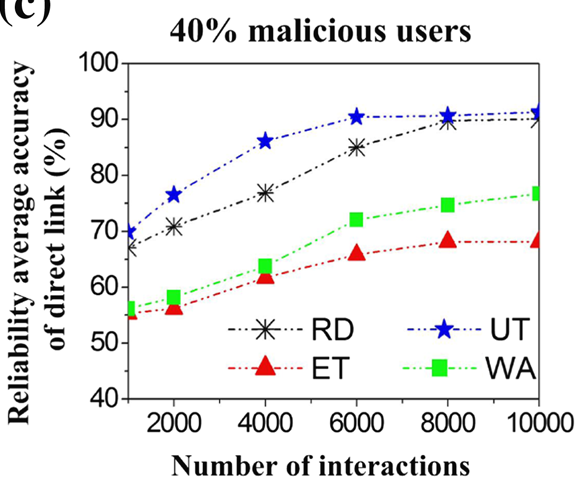 Figure 2: Performance comparison showing our reliability degree calculation (RD) approaching the efficiency of compute-heavy ultimate trust ratings while maintaining lower overhead.
Critical Insight: The "Active User" Rule
One of the most valuable aspects of this research is Rule 3 (Active User Rule), which posits that a link is only trustworthy if every intermediate user in the path meets a minimum threshold for both reliability and strength. This prevents "trust leakage" through weak or compromised nodes in a chain, a common flaw in simpler transitive trust models.
Conclusion & Future Outlook
This work demonstrates that "Link Strength" is not just a sociological concept but a critical computational metric for network security. By quantifying the stability of ties, we can better defend against reputation inflation and improve the quality of recommendations in social systems.
Future Work: The authors suggest moving toward localized trust evaluation that doesn't require global network knowledge—a crucial step for scaling to the massive, decentralized social networks of tomorrow.