
SRMTE: Strengthening Mobile Social Networks through D-S Evidence Theory-based Service Recovery
A service recovery method based on trust evaluation in mobile social network
This paper proposes SRMTE, a novel service recovery method for mobile social networks (MSNs) that utilizes Dempster-Shafer (D-S) evidence theory to select optimal backup devices. By integrating direct trust (QoS and interaction history) with recommended trust from cluster heads, it ensures continuous multimedia content delivery despite node mobility or malicious behavior.
TL;DR
In the volatile environment of Mobile Social Networks (MSNs), service interruptions are a frequent nuisance. This paper introduces SRMTE (Service Recovery Method based on Trust Evaluation), a framework that uses the mathematical power of D-S Evidence Theory to pick the most reliable "backup" device when a service fails. By considering both direct experience and community recommendations, it significantly boosts packet delivery rates and slashes recovery time.
Problem & Motivation: The Fragility of Mobile Sharing
Mobile Social Networks (the self-organizing type, similar to MANETs) allow users to share videos and data without traditional infrastructure. However, they face a "triple threat":
- Mobility: Nodes move out of range, breaking links.
- Resources: Battery death or hardware failure causes silent drops.
- Malice: Internal nodes might selfishly drop packets or maliciously tamper with data.
Existing recovery methods like Resend Request Strategy (RRS) are "trust-blind"—they might replace a failing node with a malicious one, leading to a cycle of failures. The authors recognized that Trust is the missing component for robust service restoration.
Methodology: The Core of Trust Fusion
The brilliance of the SRMTE approach lies in how it quantifies "trust" using D-S Evidence Theory—a framework that excels at handling uncertainty and conflicting information.
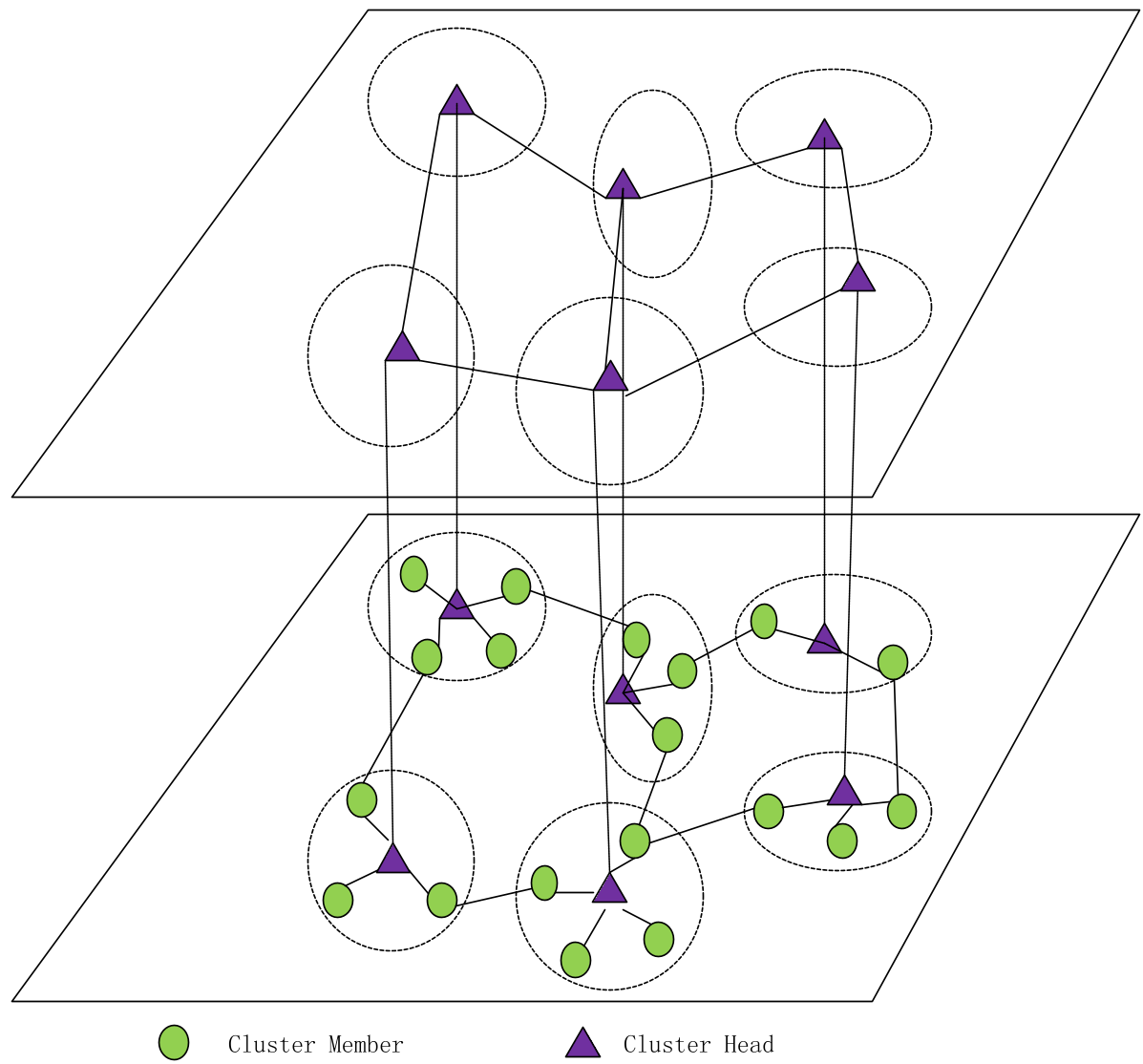
1. The Clustered Architecture
The network is organized into clusters. Each cluster has a Cluster Head (CH) that acts as a local manager, tracking which members are providing which services and monitoring their behavior.
2. Multi-Source Evidence Fusion
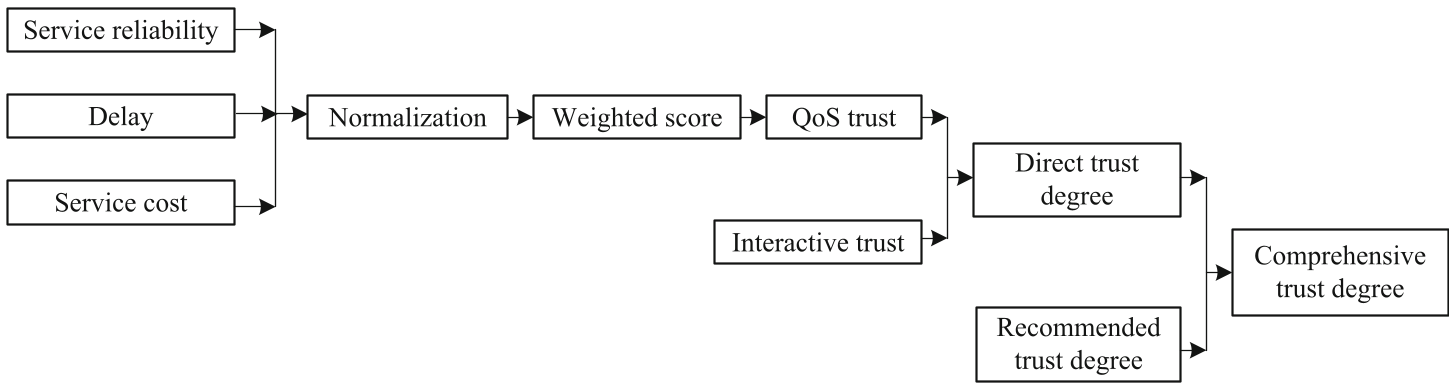
To evaluate a backup node , the requester looks at:
- Direct Trust (): A combination of QoS Trust (reliability, delay, and cost) and Interactive Trust (historical success rates of direct peer-to-peer interactions).
- Recommended Trust (): The collective opinion of a node's one-hop neighbors, aggregated by the Cluster Head.
These are expressed as Basic Probability Assignments (BPA) for three states: {Trust, Distrust, Uncertainty}. Using the D-S combination rule, these vectors are fused into a single Belief function (Bel). The node with the highest Bel value is chosen as the replacement.
Experiments: Proving the Resilience
The authors compared SRMTE against four baselines, including trust-less strategies (BSRS, RRS) and older trust models (HTMM, GTMS).
Key Finding 1: Packet Delivery in Hostile Environments
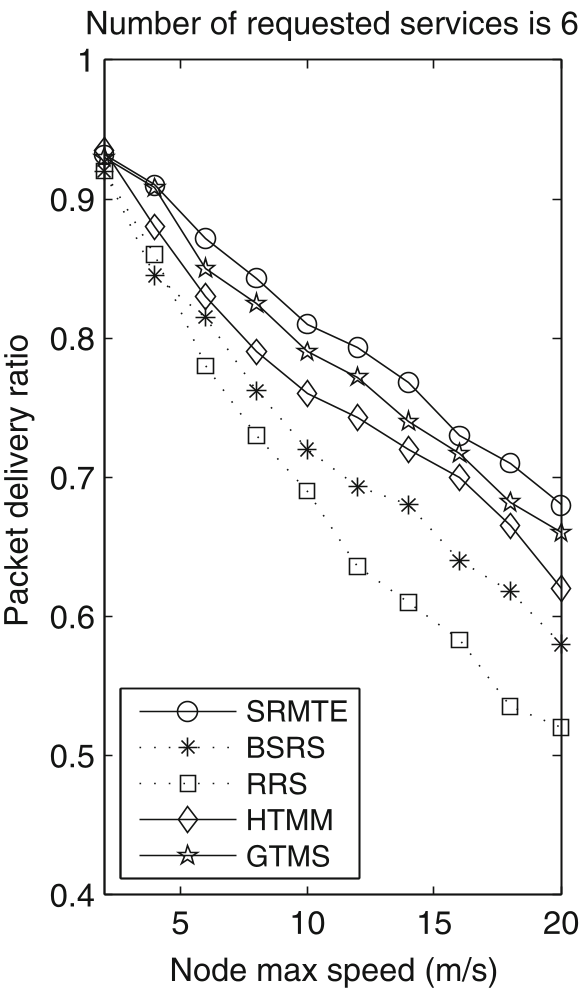
As the number of malicious nodes increases, trust-less methods (BSRS/RRS) see their packet delivery ratios collapse below 50%. SRMTE maintains significantly higher performance because its D-S fusion effectively filters out untrustworthy neighbors.
Key Finding 2: Speed of Execution
Speed is critical for multimedia. Even with high node mobility (up to 20 m/s), SRMTE recovers services faster than HTMM or GTMS. This is because SRMTE's evidence collection is more streamlined, avoiding the heavy overhead of collecting "valid certificates" or "local storage info" required by older hybrid models.
Critical Analysis & Conclusion
Takeaway
SRMTE proves that a hierarchical (clustered) trust model is highly efficient for mobile networks. By using D-S evidence theory, the system doesn't just look at "if" a node works, but "how reliably" it works, creating a Self-Healing network layer.
Limitations & Future Work
While robust, the model assumes Cluster Heads are always trustworthy. In a truly hostile environment, a compromised CH could subvert the entire trust chain. The authors suggest that future work will focus on proactive detection—filtering malicious nodes before they are even considered for a service path, particularly for time-sensitive applications like video conferencing.
Final Verdict: A solid application of evidence theory to a practical networking problem, moving MSNs closer to the reliability levels of structured infrastructure.