
Beyond Metadata: Why Social Context is the Key to Reliable Crowdsourced Data
A Trust Framework for Social Participatory Sensing Systems
This paper introduces an application-agnostic trust framework for social participatory sensing systems, combining data quality assessments with social network trust metrics. Using a fuzzy logic-based approach, it calculates a comprehensive "Trust of Contribution" (ToC) score to filter out unreliable data in crowdsourcing tasks.
TL;DR
In the world of participatory sensing (think Waze or noise-mapping apps), how do we know if a user's update is real or fake? This paper argues that looking at the data isn't enough—you have to look at the friendship. By combining data quality with social network metrics through Fuzzy Logic, the authors created a framework that mirrors human intuition, identifying bad actors 15% more effectively than traditional methods.
Background: The Trust Gap in Social Sensing
Participatory sensing empowers ordinary citizens to act as mobile sensors. However, this openness is a double-edged sword. Malicious users can upload "trash data," and even well-meaning users might provide low-quality input due to poor calibration or lack of expertise.
Current SOTA solutions often rely on hardware (TPM) or purely statistical reputation models (like Beta reputation). The missing link? Social Context. As humans, we naturally trust a price tip from a close friend more than a casual acquaintance. This paper codifies that intuition into a scalable algorithm.
Methodology: The Fuzzy Logic Bridge
The genius of this framework lies in its two-pronged evaluation system, processed through a Fuzzy Inference System (FIS).
1. Quality of Contribution (QoC)
This is the objective side: Is the image blurry? Is the GPS coordinate relevant to the task? Is the reading an outlier?
2. Trust of Participant (ToP)
This is where the paper shines, blending personal and social dimensions:
- Personal: Expertise (extracted via NLP from social profiles), Timeliness, and Locality (how familiar is the user with the region they are reporting on?).
- Social: Friendship Duration and Interaction Frequency (measured using the Gompertz function to model relationship growth).
The "Human" Engine
Instead of a rigid mathematical formula that might fail with noisy data, the authors use Fuzzy Logic.
- Fuzzification: Converts raw scores (e.g., 85% data quality) into linguistic terms like "High" or "Medium."
- Rule Base: A set of 16 "If-Then" rules (e.g., If ToP is Med2 and QoC is Low, then Trust is Medium).
- Defuzzification: Converts these linguistic terms back into a crisp trust score (0 to 1).
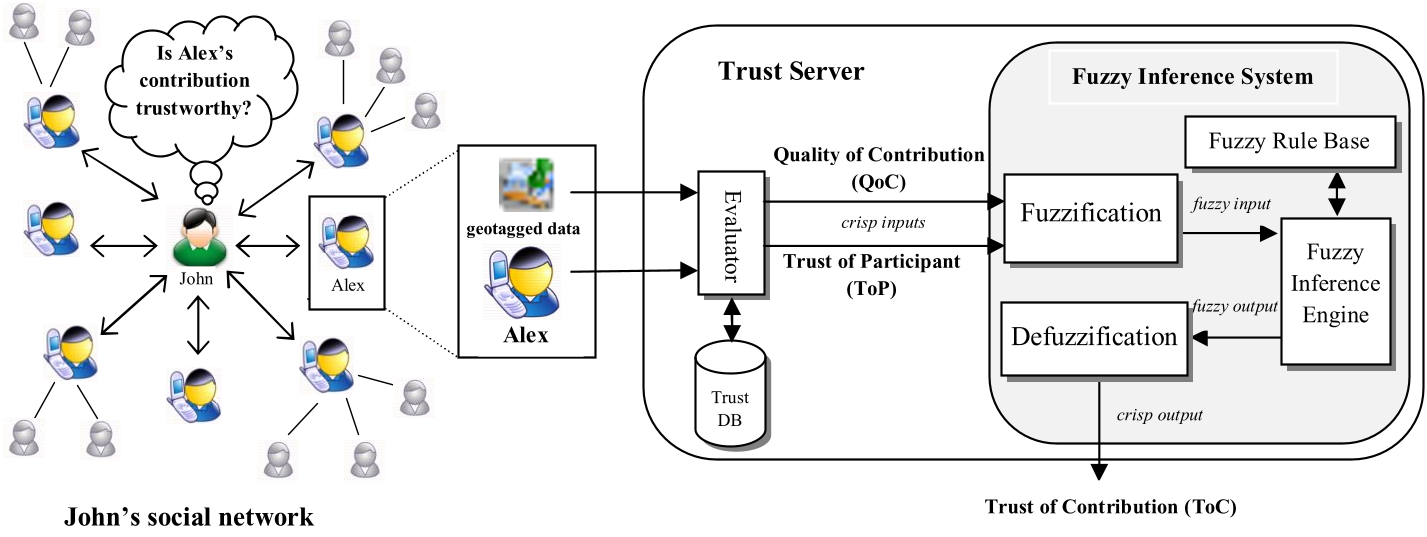 Fig 1: The Trust Framework Architecture - Integrating Social Networks with a Third-Party Trust Server.
Experiments: How it Handles "Betrayal"
The researchers tested the system against a "Baseline" (data quality only) and "Baseline-Rep" (standard reputation).
The most compelling test was Scenario 2, where a previously "Good" user suddenly starts providing "Bad" data (simulating sensor failure or loss of interest).
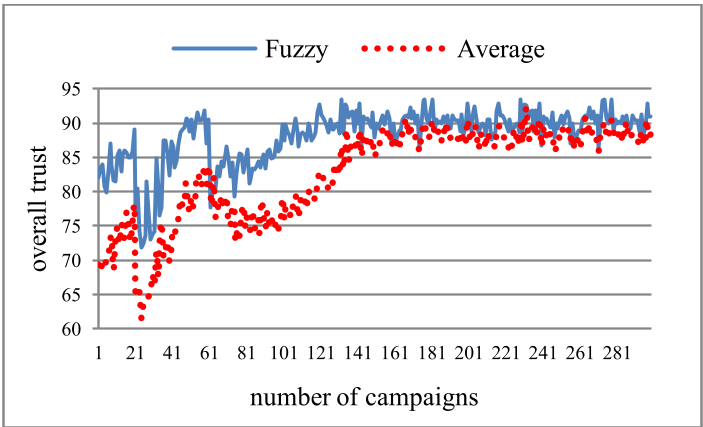 Fig 2: Evolution of Overall Trust in Scenario 2. The Fuzzy method (top line) recovers and maintains higher trust levels even when user behavior fluctuates.
Key Findings:
- Higher Accuracy: The system outperformed the baseline by 15% in overall trust.
- Rapid Adaptation: Because the system uses an asymmetrical update rule (), trust is "built slowly but destroyed quickly," allowing for the rapid revocation of untrusted data.
Critical Insight: Why Fuzzy Logic?
Most engineers lean toward binary logic or linear regression. However, trust is inherently non-linear and subjective. Using trapezoidal membership functions (see below) allows the system to handle the "gray areas" of human behavior that traditional algorithms often ignore.
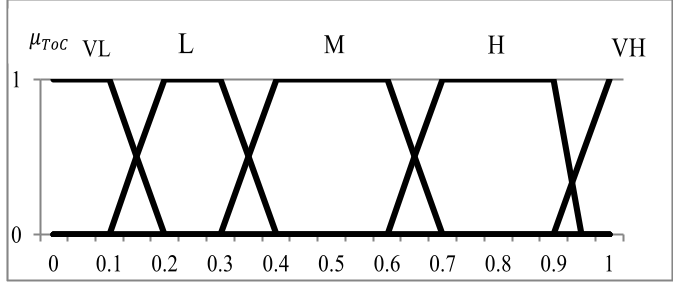 Fig 3: Membership functions for QoC and ToP, translating numerical data into linguistic logic.
Future Outlook
While the framework is a massive step forward for social crowdsourcing, its reliance on a "Third Party Trust Server" poses potential privacy concerns. Future iterations might look at decentralizing this logic—perhaps using Edge Computing or Privacy-Preserving computation—to ensure that while we trust the data, we don't have to sacrifice the participant's anonymity.
Final Takeaway
Trust isn't just a number; it's a relationship. By mapping the "warmth" of social ties to the "cold" metrics of data quality, this framework makes participatory sensing ready for the real, messy world of social networks.