
TGDP: Revolutionizing Social Privacy via Trust-Grained Differential Privacy
A Trust-Grained Personalized Privacy-Preserving Scheme for Big Social Data
This paper introduces TGDP, a trust-grained personalized differential privacy mechanism for online social networks (OSNs). By quantifying interpersonal trust through a combination of interaction frequency and network topology, the method dynamically adjusts the privacy parameter ε for each data inquiry, ensuring fine-grained protection.
TL;DR
Researchers have developed TGDP, a personalized privacy-preserving scheme that adjusts the noise added to social data based on how much the data owner trusts the person asking. By moving away from "one-size-fits-all" differential privacy, this method ensures that your close friends see more accurate data while strangers are kept at a distance with stronger privacy safeguards.
The Problem: The Inflexibility of "One-Size-Fits-All" Privacy
In the era of big social data, Differential Privacy (DP) has become the gold standard for sharing information while protecting individual identities. However, traditional DP assumes every user in a network requires the exact same level of protection.
In reality, privacy is contextual and personal. You are likely willing to share precise location or contact details with a family member but would require extreme anonymity when a third-party Advertiser or a stranger inquires. Prior works on Distance-based privacy tried to solve this, but they were too coarse—everyone at a distance of "2 steps" received the same privacy, regardless of whether they were a close classmate or a distant acquaintance.
Methodology: Quantifying Trust into Privacy
The authors argue that Trust is the root of Privacy. They propose a dual-layer approach to transform social interactions into a mathematical privacy budget.
1. The Trust Model
TGDP evaluates trust through two lens:
- Implicit Interaction: Tracks how often () and how long () two users interact. Frequent interaction usually indicates higher trust.
- Topological Relation: Considers the structural distance (shortest path) and the "prestige" (Degree Centrality) of the user.
2. Personalized Mapping
Once a trust value is established, it is mapped to the DP parameter . The formula ensures that:
- High Trust Large : Less noise is added, maximizing the utility of the shared data.
- Low Trust Small : More Laplacian noise is injected, providing a "privacy shield."
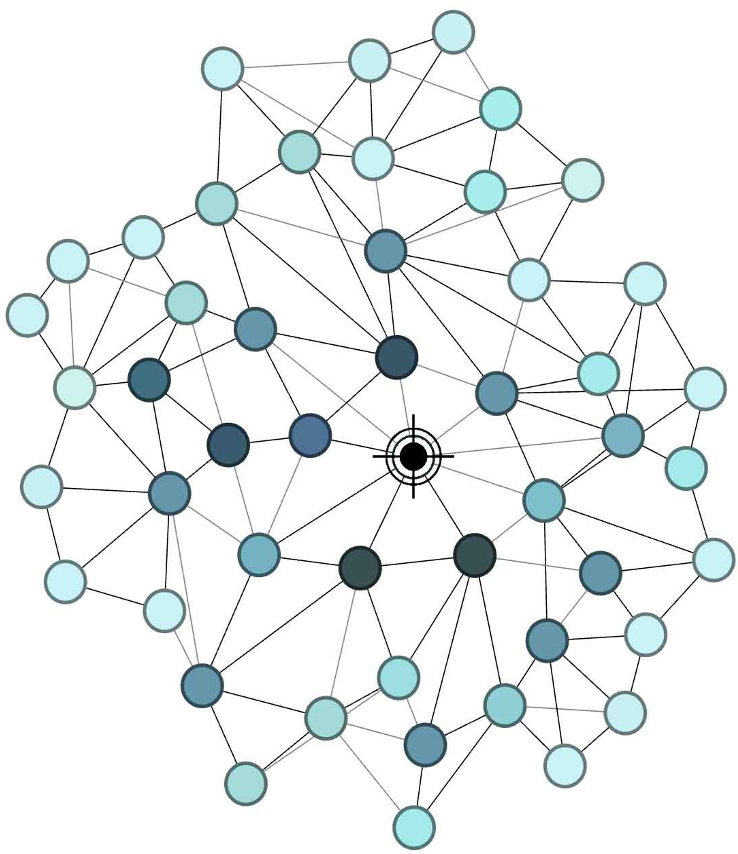 Figure 1: The Trust-based scheme where noise levels fluctuate based on the interpersonal trust relationship.
Experiments and Performance
Testing the algorithm on a YouTube social dataset (1,400 nodes, 24,000 edges), the researchers evaluated the RMSE (Root Mean Square Error) to measure data utility.
Key Insights:
- Personalization Works: As shown in the experimental graphs, the privacy level () successfully fluctuates with interaction frequency, proving the system is fine-grained.
- Superior Utility: In scenarios with high trust (0.8 - 1.0), TGDP significantly outperformed traditional DP by providing much more accurate data (lower RMSE).
- Beyond Distance: Unlike distance-based schemes (which show flat performance for all users at the same hop-count), TGDP reveals that users at the same distance should often have different privacy levels based on their actual interactions.
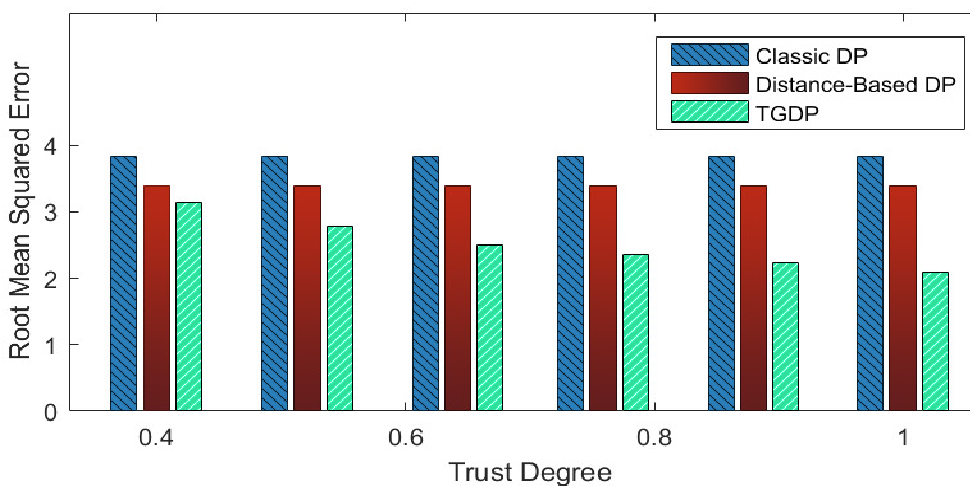 Figure 2: Performance comparison at Distance=1. TGDP maintains lower error as trust increases.
Critical Analysis & Conclusion
Takeaway
The TGDP framework successfully bridges the gap between social science concepts (Trust) and hard data science (Differential Privacy). It treats privacy as a dynamic asset rather than a static constraint.
Limitations & Future Work
- Cold Start Problem: For new users with zero interactions, the system defaults to topological distance, which may be less accurate.
- Compute Overhead: Calculating trust values for every node-pair in massive social graphs (billions of edges) could be computationally expensive.
- Dynamic Trust: Social trust changes over time (friends become strangers). Future iterations should include a "time decay" factor for trust values.
Overall, this work is a major step toward Empathetic AI and Data Systems—systems that understand the social nuances of the users they protect.