
Trust me, I’m an Expert: Decoding the Social DNA of MMO Trust Networks
Trust Me, I'm an Expert: Trust, Homophily and Expertise in MMOs
This paper explores trust dynamics in Massively Multiplayer Online Games (MMOs) through the lens of homophily and expertise, using data from EverQuest II. It categorizes player attributes (ascribed vs. acquired) and introduces a modified preferential attachment generative model that accounts for node lifetime and social components specific to virtual worlds.
TL;DR
Does the "birds of a feather flock together" rule apply when you're slaying dragons? This research dives into EverQuest II to analyze how trust forms in virtual worlds. While players still trust people of their own age and gender (Ascribed Homophily), they actively seek out different character classes and races to succeed in the game (Functional Heterophily). The study culminates in a new mathematical model for network generation that accounts for the unique "dying" and "gelling" patterns of online communities.
Background: Living in a Virtual Society
Massively Multiplayer Online Games (MMOs) are not just games; they are complex socio-technical systems. In EverQuest II (EQ2), trust is a tangible commodity—you literally grant other players access to your virtual home. The authors utilize this "Trust Access" data to map out a social graph of 15,237 players to see if online trust mirrors the real world.
The Problem: The Conflict of Similarity vs. Utility
In the offline world, homophily (similarity) is the primary driver of connection. However, MMOs are "instrumental" environments. If a group only consists of "Healers," they will fail. Therefore, the game’s design creates a tension:
- The Social Instinct: I want to be around people like me.
- The Rational Need: I need individuals with skills I don't have.
The paper argues that existing network models (like Simple Preferential Attachment) fail to capture this tension or the fact that online players eventually "quit" the game, changing the network's diameter over time.
Methodology: A New Topology of Digital Trust
The authors categorized player attributes into a structured topology to test multiple hypotheses:
| Category | Attributes | Observation in EQ2 |
|---|---|---|
| Ascribed Status | Gender, Age | Homophily (Players stick to their own kind) |
| Acquired Status | Class, Race, Guild | Heterophily (Players branch out for utility) |
| Value | Challenge/Leveling Speed | No clear pattern |
The Generative Model
To replicate these findings, the authors modified the classic Barabási-Albert model. Instead of just "the rich get richer," they added:
- Lifetime Decay: A node's ability to form edges decreases as its "tenure" in the game increases.
- Bounded Probability: A function that increases connectivity probability for similar ascribed traits but decreases it for similar functional traits (like character class).
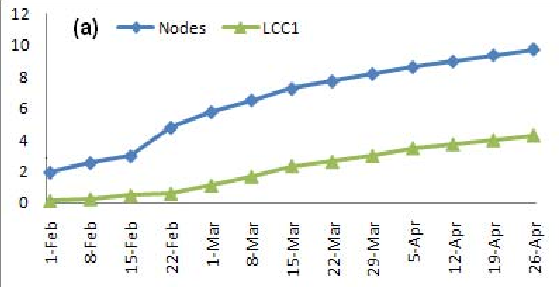 Figure 1: Temporal properties showing the "gelling point" and the fluctuating diameter of the LCC (Largest Connected Component).
Experiments & Results: Where Offline Rules Break
The study’s most striking find is the reversal of homophily in functional categories.
- Class Heterophily: Only 1.74% of trust relationships were between players of the same class (Table IV). In EQ2, a diverse "party" is essential for survival.
- The "Age" Factor: Younger and older players rarely trust each other with house access. The age difference in "Trustee" relationships was significantly lower than in casual "Visitor" relationships, suggesting that deep trust is still age-dependent.
- Network Structure: Unlike the Internet or citation networks, the MMO trust network is highly fragmented. Over 1,400 components exist, many representing small "cliques" of players who only trust each other and remain isolated from the global "Largest Connected Component" (LCC).
 Figure 2: Relative levels at trust formation, showing that "Trustee" access is often granted from lower-level players to higher-level "Experts."
Deep Insight: "Trusting the Expert"
The paper reveals a "Mentor-Apprentice" dynamic in trust. Lower-level players are more likely to grant "Trustee" access to higher-level players (58.03%) than vice versa. This suggests that in virtual worlds, Expertise overrides Similarity. We don't just trust people who look like us; we trust people who can protect us or provide resources.
Critical Analysis & Conclusion
Takeaway
The mapping between the offline and online world is "incomplete." We carry our biological biases (gender/age) into the digital realm, but we successfully shed our status biases (class/race) in favor of meritocracy and functional necessity.
Limitations
- Data Age: The study uses 2006 data. Modern "matchmaking" algorithms in current games might further erode natural trust formation.
- Proxy Values: "Leveling speed" is a weak proxy for "Value Homophily" (personal beliefs).
Future Outlook
This work paves the way for better recommendation engines in collaborative environments. By understanding that "functional heterophily" drives success, developers can build systems that suggest teammates who are socially compatible (age/gender homophily) but technically diverse (skill heterophily).