
The Robot Will See You Now: Is Robot-Patient Trust Comparable to Human Therapy?
With the recent advances in computing, artificial intelligence (AI) is quickly becoming a key component in the future of advanced applications. In one application in particular, AI has played a major role -that of revolutionizing traditional healthcare assistance. Using embodied interactive agents, or interactive robots, in healthcare scenarios has emerged as an innovative way to interact with patients. As an essential factor for interpersonal interaction, trust plays a crucial role in establishing and maintaining a patient-agent relationship. In this paper, we discuss a study related to healthcare in which we examine aspects of trust between humans and interactive robots during a therapy intervention in which the agent provides corrective feedback. A total of twenty participants were randomly assigned to receive corrective feedback from either a robotic agent or a human agent. Survey results indicate trust in a therapy intervention coupled with a robotic agent is comparable to that of trust in an intervention coupled with a human agent. Results also show a trend that the agent condition has a medium-sized effect on trust. In addition, we found that participants in the robot therapist condition are 3.5 times likely to have trust involved in their decision than the participants in the human therapist condition. These results indicate that the deployment of interactive robot agents in healthcare scenarios has the potential to maintain quality of health for future generations
This study investigates human-robot trust in healthcare by comparing a humanoid robot (NAO) with a human therapist in a rehabilitation task. Using the SuperPop VR system, the researchers validated that trust in robotic agents is equivalent to—and in some behavioral aspects, higher than—trust in human therapists.
TL;DR
With a looming shortage of healthcare professionals and an aging population, robots are moving from the factory floor to the clinic. This study by Xu et al. proves that patients don't just "accept" robot therapists—they trust them at levels equivalent to, or even exceeding, human counterparts. However, this raises a new ethical dilemma: the phenomenon of 3.5x higher trust involvement, suggesting we might be prone to "overtrusting" our silicon caregivers.
Problem & Motivation: The Looming Care Gap
In the United States alone, nearly 42 million people suffer from motor function disorders. By 2050, this number is expected to skyrocket. Traditional physical therapy is labor-intensive and often suffers from a lack of patient engagement. While robots like the NAO humanoid have been used as "exercise partners," a fundamental question remained: Can a machine replace the sacred trust between a doctor and a patient?
Prior research suggested people overtrust robots in emergencies (like following a robot into a smoky building). The authors of this study wanted to see if this "overtrust" or "equivalent trust" exists in the nuanced world of corrective medical feedback.
Methodology: The SuperPop VR Experiment
To test this, the researchers used SuperPop VR, a game where participants "pop" virtual bubbles to improve upper-body motor functions.
The Two-Condition Setup
The experiment divided 20 participants into two groups:
- The Robot Condition: The NAO robot (58cm tall, humanoid) provided verbal instructions and corrective feedback ("Move a little faster").
- The Human Condition: A human physical therapist provided the exact same scripted feedback and gestures.
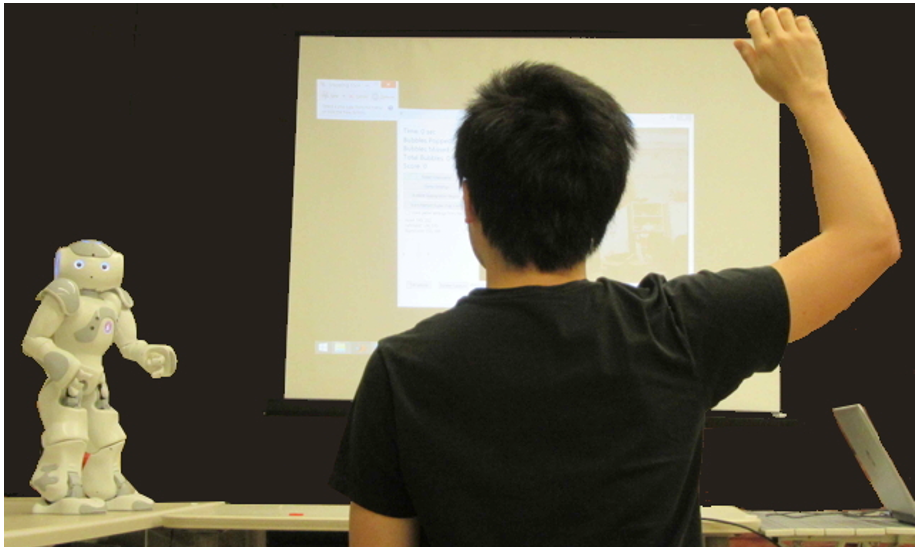
The system used a Microsoft Kinect to measure Movement Time (MT) and calculate performance based on Fitt's Law, ensuring the feedback given by both the human and the robot was objectively identical.
Results: Breaking the Trust Ceiling
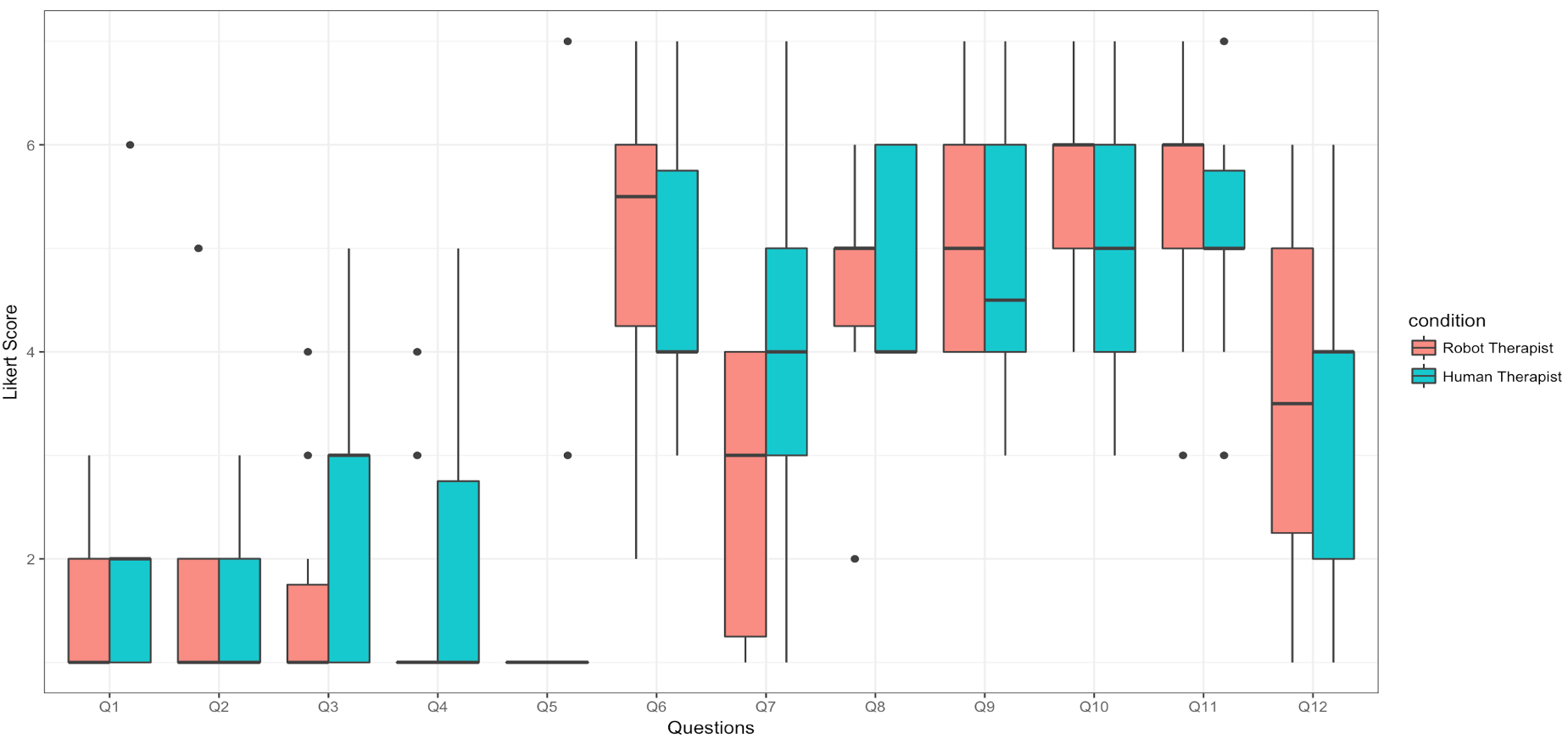
The findings were striking. Not only was the robot's trust rating equal to the humans, but it outperformed the human therapist in several perceived metrics:
- Deception: The robot was viewed as less deceptive than the human.
- Reliability: Participants rated the robot higher on the reliability and dependability scale.
- Trust Odds: The most significant finding was the Odds Ratio of 3.5. Participants in the robot condition were 3.5 times more likely to explicitly state that their decision to follow guidance was based on trust, whereas human-group participants often viewed the interaction as more perfunctory.
Deep Insight: The Risk of Overtrust
While high trust is good for "compliance" (getting patients to do their exercises), it introduces a massive ethical risk: Overtrust. The study found that only 10% of participants internally questioned the robot’s guidance. In a real-world scenario, if a robot makes a technical error or provides harmful corrective feedback, a patient who "blindly trusts" the system could end up with an injury.
Conversely, the paper notes Undertrust as a hurdle—if a patient views the robot as "just a machine," they may ignore its corrective feedback, leading to poor recovery outcomes.
Conclusion & Future Outlook
Xu and her team have demonstrated that there is no "trust barrier" preventing robots from entering the healthcare workforce. The robot therapist is not perceived as a cold machine, but as a reliable, non-deceptive partner.
The Takeaway? The challenge for the next generation of AI developers isn't just making robots smarter; it's developing trust calibration—the ability for a robot to sense if a patient is trusting it too much or too little and adjusting its social behavior to ensure safety and maximum therapeutic benefit.
Reference: Xu, J., Bryant, D. G., & Howard, A. (2018). Validating the Equivalency of Trust in Human-Robot Healthcare Scenarios.