
Towards Trust Inference: Leveraging the Power of Niche Interests in Bipartite Networks
Towards trust inference from bipartite social networks
This paper introduces a structural approach for inferring trust relations between users in bipartite social networks (e.g., users and items). By leveraging the topological information of the bipartite graph, the authors propose a weighted trust inference formula that maps actor-item interactions into a social trust graph without requiring explicit trust feedback.
TL;DR
In the world of social recommendation, trust is the "Holy Grail" for personalization. But what if a platform doesn't have a "Follow" or "Trust" button? This paper proves that we can accurately infer trust by looking at what users interact with. The core insight: sharing a love for an obscure indie movie is a much stronger signal of trust/similarity than both liking a blockbuster like Harry Potter.
Background: The Ghost in the Machine
Social networks are essentially bipartite graphs: on one side are Actors (users), on the other are Items (books, videos, reviews). While trust has been proven to enhance recommendation accuracy and robustness against malicious users, it is rarely explicitly stated. Most users are "passive," consuming content without labeling their peers.
The researchers posed a critical question: Can we reconstruct a social "Web of Trust" using nothing but the structure of these actor-item interactions?
The Intuition: The Popularity Penalty
The authors argue that traditional similarity metrics (like the Naive method of counting shared items) are flawed. If two people both follow a global celebrity or buy a top-selling product, it says very little about their personal connection.
The methodology rests on two pillars:
- Relative Diversity: Using a Jaccard Index on the "two-hop" neighborhood to see how similar the users' broader interaction circles are.
- Shared-Item Popularity: Giving higher "Trust Weight" to items with low in-degrees.
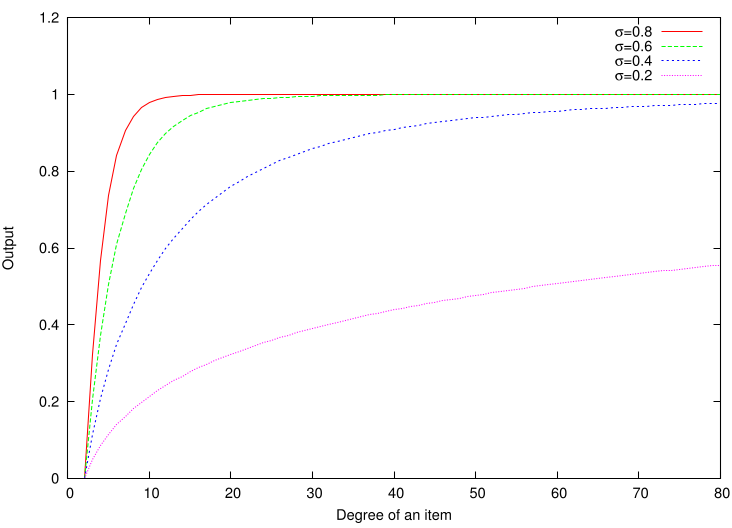 Figure 1: The formula penalizes items as their degree (popularity) grows, rewarding "niche" connections.
Methodology: The Trust Formula
The trust between user and is calculated as:
- : The "Teleportation" factor (base probability of trust).
- : Jaccard similarity of their two-hop neighbors.
- : The distance based on item popularity.
By adjusting , the model defines the threshold at which an item becomes "too popular" to be a useful indicator of trust.
Experimental Results: Proving the Connection
Testing on the Epinions dataset—a platform where users both rate items and explicitly list "trusted" peers—the authors found that their structural approach significantly outperformed naive link prediction.
 The proposed method achieved 61.75% accuracy in predicting real trust relations, compared to only 49.20% for the baseline.
Furthermore, the "social-ness" of the generated graph was verified. The clustering coefficients and degree distributions closely matched those of real human social networks, suggesting the inferred links were not just mathematical artifacts but representative of actual social structures.
Critical Insight & Future Outlook
This work highlights a fundamental truth in social data science: Structure is Signal. Even without a social layer, our consumption patterns reveal our social affiliations.
Limitations:
- The model is currently symmetric ( trusts as much as trusts ), whereas real trust is often directed.
- It relies on static snapshots; real-world trust evolves over time as "popular" items shift.
Future Work: Integration into large-scale engines like Apache Giraph and incorporating content-based features (e.g., text analysis of reviews) could further sharpen the inference. This provides a blueprint for any platform to transform a simple "rating system" into a vibrant, trust-aware social community.
Conclusion
By punishing the "Harry Potter" effect and rewarding niche intersections, we can find the hidden social threads in any bipartite network. This allows developers to build trust-aware recommendations from day one, even in the absence of explicit social features.