
TISoN: Solving the "Unique Path Problem" in Social Trust Networks
TISoN: Trust Inference in Trust-Oriented Social Networks
2016-04-26
Summary
Problem
Method
Results
Takeaways
This paper introduces TISoN (Trust Inference in trust-oriented Social Networks), a comprehensive framework for estimating indirect trust between non-adjacent users in Online Social Networks (OSNs). It combines a novel Trust Path Searching (TPS) algorithm with a Trust Inference Measure (TIM) that utilizes PathAverage, PathVariance, and PathWeight to outperform classical baselines like TIDALTRUST.
## TL;DR
In the vast expanse of Online Social Networks (OSNs), deciding whether to trust a stranger often depends on "who you know that knows them." **TISoN** (Trust Inference in Social Networks) introduces a refined mathematical framework to infer this indirect trust. By moving beyond simple shortest-path logic and incorporating path stability and user behavioral constraints, TISoN achieves higher accuracy and handles networks with over a million nodes with ease.
## The Problem: The Flaw in "Friend-of-a-Friend" Logic
Most existing trust algorithms, such as the pioneering **TIDALTRUST**, utilize a shortest-path approach. However, the authors identify a critical failure known as the **Unique Path Problem**.
Imagine Alice is connected to John only through a long chain of low-trust acquaintances, but the very last person in that chain happens to trust John fully. TIDALTRUST might assign John a "Full Trust" score (10/10) because it ignores the "weak links" earlier in the chain. This is physically counter-intuitive: a chain is only as strong as its weakest link.
## Methodology: Quality Over Proximity
TISoN redefines trust inference through two core components:
### 1. Trust Path Searching (TPS)
Instead of blindly searching the whole graph, TPS uses two behavioral levers:
* **MTT (Minimum Trust Threshold)**: "I only listen to people I trust at least $X$ amount."
* **TTL (Time To Live)**: "I don't trust rumors passed through more than $Y$ people."
### 2. Trust Inference Measure (TIM)
Once paths are found, TISoN calculates a **Path Strength ($s_p$)** using three key metrics:
* **PathAverage ($\bar{t}_p$)**: The mean trust along the chain.
* **PathVariance ($v_p$)**: Ensuring the trust levels are consistent. High variance suggests an unreliable chain.
* **PathWeight ($w_p$)**: Shorter paths are naturally weighted more heavily.

*Figure: A partially trusted OSN where TISoN evaluates multiple paths from a source to a target.*
## Experiments & SOTA Comparison
The authors tested TISoN against **TIDALTRUST**, **RN-TRUST**, and **SWTRUST** using the **Advogato** dataset—a real-world social network of developers.
### Key Findings:
* **Accuracy Peaks at "Medium Confidence"**: The highest Fscore was achieved when users were moderately cautious (e.g., TTL=5, MTT=0.5). Being too strict (high MTT) loses too much information, while being too lax (low MTT) invites noise from "untrustworthy" nodes.
* **Scalability**: While RN-TRUST struggles as the network grows, TISoN remains efficient. In a simulated environment of **1 million users**, TISoN’s runtime remained significantly lower than its competitors due to its targeted path searching.
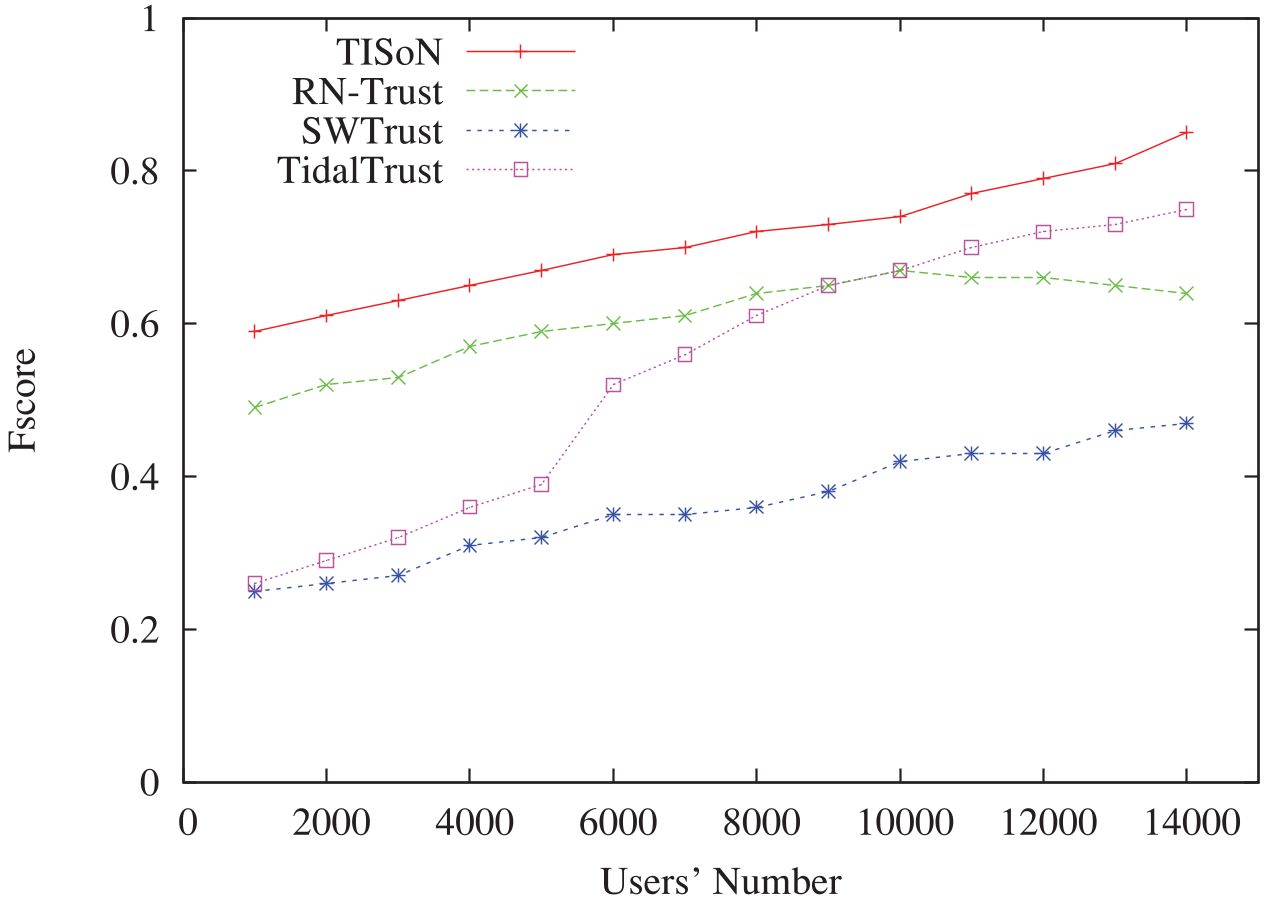
*Figure: TISoN consistently outperforms other methods in Fscore as the number of users increases.*
## Academic Insight: Why it Works
The brilliance of TISoN lies in the **Max-Aggregation** strategy. By calculating the strength of all valid paths and selecting the "Most Trustable Path" (MTP), the model mirrors human psychology: we tend to rely on our most reliable source of information rather than an average of everyone we barely know.
## Conclusion & Future Work
TISoN successfully addresses the qualitative aspects of trust that purely topological models miss. Its ability to filter "malicious" opinions through the MTT parameter makes it robust for real-world deployment. Moving forward, the authors suggest integrating **Fuzzy Logic** (e.g., using terms like "Very Trustworthy" instead of 0.82) to make the system more user-friendly.
**Takeaway for Researchers**: When designing trust metrics, the *stability* of the path (variance) is often as important as the *value* of the trust itself.