
Trusting the Numbers: A Measurement Theory Approach to Social Network Trust
Trust management framework for social networks
The paper proposes a novel trust management framework inspired by physical measurement theory, utilizing two key metrics: Impression and Confidence. By borrowing from Error Propagation Theory, it introduces a systematic methodology for computing transitive and aggregated trust in social networks, achieving a 2250x increase in "trust view" on real-world datasets.
Executive Summary
In the digital age, we frequently make "blind decisions"—purchasing from unknown vendors or following advice from strangers. This paper, "Trust Management Framework for Social Networks", attempts to ground these subjective human interactions in the objective reality of Physical Measurement Theory.
TL;DR: The authors treat human trust like a physical measurement. Your "Impression" of someone is the value, and your "Confidence" is the margin of error. By applying the laws of Error Propagation, the system can calculate how much you should trust a "friend of a friend" with massive scale and mathematical accuracy.
Problem & Motivation: The Sparsity of Trust
Social networks like Facebook or LinkedIn are vast, yet our direct "trust links" are incredibly sparse. In the Epinions dataset analyzed by the authors, only 0.02% of possible user pairs had direct trust relations.
Prior works in trust management (like Subjective Logic) tried to model the human brain, but modeling human psychology is notoriously difficult. The authors’ insight is profound: Why model the brain when we can model the observation? Just as a scientist accounts for error when combining measurements from different instruments, a social network should account for "confidence decay" when combining opinions across a chain of people.
Methodology: From Physics to Psychology
The core of the framework transitions trust from a vague feeling to a dual-metric system:
- Impression (): The quantitative score of trust (e.g., 0 to 1).
- Confidence (): How certain you are, mapped to a Radius () representing the potential error.
1. Trust Transitivity (The Chain)
When Alice trusts Bob, and Bob trusts Charlie, how much does Alice trust Charlie? The authors use a multiplication rule for the impression: . To handle the uncertainty, they apply the Relative Error Propagation formula:

This ensures that confidence never artificially increases across a chain; it only stays the same or decays, reflecting the real-world intuition that hearsay is less reliable than direct experience.
2. Trust Aggregation (The Consensus)
If five different people give you feedback on a single person, your confidence should increase. The authors adapt the Weighted Mean and Variance formulas from statistics to merge these parallel paths.
(Note: The framework acts as a bridge between individual subjective ratings and a global calculated trust graph.)
Experiments & Results: Expanding the "Trust View"
The authors validated their math using the Epinions dataset (over 400k users). They synthesized confidence based on the number of reviews a user rated.
Key Findings:
- Accuracy: The calculated indirect trust (2-hop) was a "good approximation" of actual direct ratings left by users, proving the math reflects reality.
- Coverage: This is the "killer app" of the paper. By calculating 3-hop trust paths, they increased the "Trust View" from 0.02% to 46.8%.
- The 2250x Jump: The system effectively allows a user to "know" who to trust among thousands of other users they have never met, without losing the mathematical rigor of the confidence level.
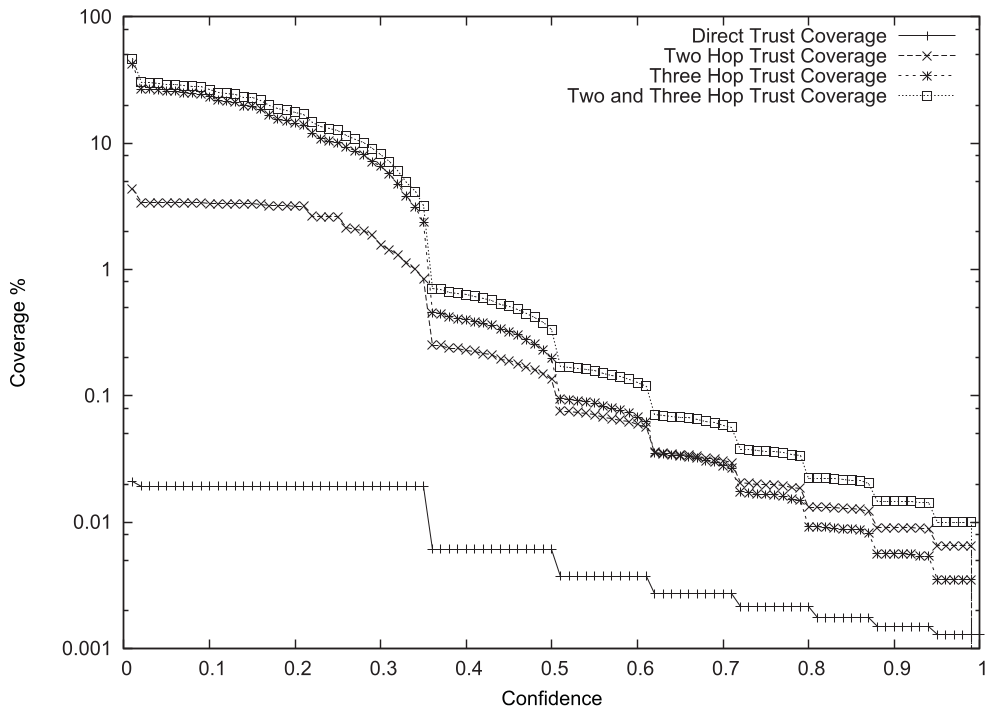 Fig: The tradeoff between desired confidence levels and the percentage of the network you can effectively "see" and trust.
Critical Analysis & Conclusion
Takeaway
The genius of this paper lies in its Inductive Bias. Instead of trying to reinvent how trust works, it borrows 200 years of Physical Measurement Theory. It proves that trust isn't just a social construct; it's data that follows the laws of error and variance.
Limitations
- Independence Assumption: The error propagation formula assumes trust paths are independent. In a real social network, "echo chambers" or collusion among malicious nodes (Sybil attacks) could violate this, leading to over-confidence.
- Dynamic Trust: Trust changes over time (people change), but this framework treats it as a static measurement.
Future Outlook
This framework provides a scaffold for Trustworthy AI. As we move toward decentralized autonomous organizations (DAOs) and P2P networks, having a "Control Theory" for trust—where we can mathematically bound our uncertainty—will be critical for security and adoption.