
Measuring the Intangible: A Robust Trust Framework for Health Social Networks
Trust Management of Health Care Information in Social Networks
This paper presents a trust management framework for Health Social Networks (HSNs) that utilizes a measurement-theory-based approach to quantify human trust using "Impression" and "Confidence" metrics. The framework is applied to secure health information via filtering and to optimize health-related advertisement tools by identifying Knowledge Opinion Leaders (KOLs).
TL;DR
In the high-stakes world of online health advice, "fake news" isn't just a nuisance—it's a clinical risk. This paper introduces a trust management framework that treats social trust like a physical measurement. By calculating both a Trust Impression (the score) and Confidence (the certainty), the authors demonstrate how to filter out malicious attackers and boost the effectiveness of health marketing by identifying true influencers.
Background: The Price of Misinformation
Health Social Networks (HSNs) have become go-to resources for patients. However, these platforms are vulnerable to:
- Disinformation Attacks: Malicious actors promoting dangerous treatments.
- Sybil Attacks: Using fake IDs to inflate the reputation of a product or user.
- Distorted Advertisements: Influencers who lack genuine expertise.
Standard reputation systems often fail because they ignore uncertainty. A user might have a 5-star rating, but if that rating is based on only one interaction, our confidence in that 5-star score should be low.
Methodology: Trust as Physics
The core innovation of this research is the analogy between Trust and Physical Measurement.
1. The Metrics: m and c
- Impression (m): The "measured" value of trust (e.g., how reliable is Bob?).
- Confidence (c): How certain we are about that measurement.
- Range (R) & Radius (r): These represent the "error bars." If confidence is low, the radius is high, indicating the trust score could vary significantly from the measured mean.
2. Transitive and Aggregate Trust
How do you trust someone you don't know?
- Transitive Trust: If Alice trusts Bob and Bob trusts Charlie, the framework uses Error Propagation Theory to calculate Alice's trust in Charlie. The uncertainty increases with every "hop" in the chain.
- Aggregation: When multiple friends give opinions on the same doctor, the system uses a weighted mean. If the opinions are similar, confidence increases. If they conflict, confidence drops—a sophisticated way to detect controversy or manipulation.
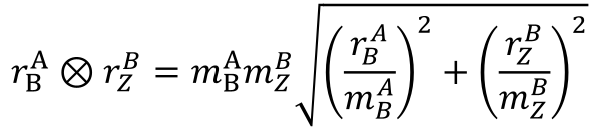 (Equation for Transitive Uncertainty based on Relative Error)
Experiments & Results
The authors tested their framework using data from Epinions.com, focusing on the health and wellness categories.
Defending Against Attacks (DoS)
The study simulated attacks where malicious users (attackers) tried to spread misleading information.
- The Threshold Effect: By setting a confidence threshold (e.g., ignoring any trust path with ), the impact of attackers was drastically reduced.
- Saturation: Interestingly, the "impact" of attackers saturates. In the framework, once a user has enough information from trusted sources, a few new malicious voices cannot easily sway the aggregate trust score.
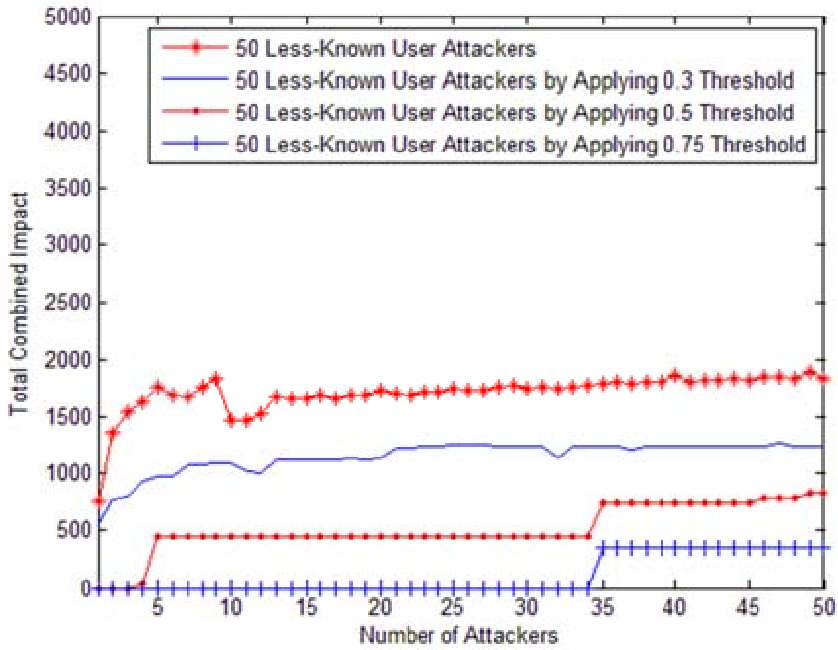 Fig: Shows how Less-known Users (potential attackers) lose their "Power" to influence the network once the Confidence threshold is applied.
Intelligent Advertising
The framework also identifies Knowledge Opinion Leaders (KOLs). Unlike traditional metrics that just count "likes" or "ratings," this framework identifies KOLs based on Trust Power—the reach of their influence weighted by the confidence others have in them. This leads to "Intelligent AD effects" where marketing is reinforced by consensus among highly trusted sources.
Critical Analysis & Conclusion
Takeaway
The "Impression-Confidence" model is a powerful tool for social network administrators. Its ability to quantify uncertainty makes it inherently more resilient to "noise" than simple average-rating systems.
Limitations
- Complexity: Implementing error propagation in a massive, real-time social graph (millions of nodes) requires significant computational optimization.
- Cold Start: New, legitimate users start with low , meaning their valid insights might be filtered out initially along with the attackers.
Future Work
The researchers aim to integrate this framework deeper into pervasive medical applications, potentially using it to verify data coming from wearable medical sensors where "measurement error" is both literal and metaphorical.
Academic Reference: Chomphoosang, P., et al. "Trust Management of Health Care Information in Social Networks." Proceedings of the IEEE Conference.