
Game Theory vs. Free-Riders: Architecting Trust in Social Networks
A Trust Measurement in Social Networks Based on Game Theory
The paper introduces a comprehensive trust measurement model for social networks, integrating service reliability, feedback effectiveness, and recommendation credibility. Evaluation is performed via a Game Theory framework to objectively calculate trust degrees and enforce decentralized discipline.
TL;DR
Trust is the "hidden currency" of social networks, yet it is easily exploited by malicious actors. This paper proposes a robust trust measurement model that decomposes trust into three distinct dimensions—Service, Feedback, and Recommendation—and utilizes Evolutionary Game Theory to punish selfish "free-riders," ensuring the long-term survival of cooperative nodes.
Problem & Motivation: The Free-Rider Crisis
In any decentralized network, the "Free-Riding" problem is a constant threat. Nodes attempt to benefit from the community (e.g., downloading files or receiving recommendations) without offering high-quality services or honest feedback in return. Prior works often treated trust as a monolithic probability, making them blind to sophisticated attacks like:
- Dishonest Recommendation: Promoting low-quality nodes to gain professional or strategic leverage.
- False Feedback: Boosting the reputation of malicious peers or slandering honest ones.
The authors' insight is that trust must be multi-dimensional. A node might be a great service provider but a terrible recommender.
Methodology: The Three Pillars of Trust
The proposed model evaluates entities based on four roles: Service, Feedback, Recommendation, and Managed nodes. The system calculates a global trust degree by weighting three specific factors:
- Service Reliability (): Calculated based on direct feedback values filtered by the recommender's effectiveness.
- Feedback Effectiveness (): Derived using a similarity formula to detect if a node's feedback aligns with the consensus or is anomalous.
- Recommendation Credibility (): Measured by the historical success of nodes previously suggested by that recommender.
The Punishment Mechanism
To enforce these metrics, the authors introduce Evolutionary Game Theory (EGT). Unlike static statistics, EGT treats strategy selection as an evolving process.
- Specific Cycles: If a node’s or drops below a threshold, it enters a specific punishment cycle (e.g., losing the right to request services).
- Multi-Strategy Game: The model uses a profit matrix for different trust levels. By adjusting the profit/penalty co-efficients (), they ensure that being "Completely Trustful" () is the Nash Equilibrium of the system.
(Note: This diagram illustrates the interaction between feedback nodes, service nodes, and the managed system layer.)
Experiments: Survival of the Honest
The researchers simulated a network of 1,000 nodes, including completely trustful, mixed-type, and various malicious categories (random, disguised, and completely malicious).
Key Findings:
- Without Punishment: Malicious nodes () and Random Malicious nodes () quickly dominate. Within 50 generations, the ecosystem effectively collapses into a low-trust state.
- With Punishment: The system shows a dramatic shift. Completely Trustful nodes () gain the majority of the population, and even "Disguised" malicious nodes are forced to provide trustful services to survive the game.
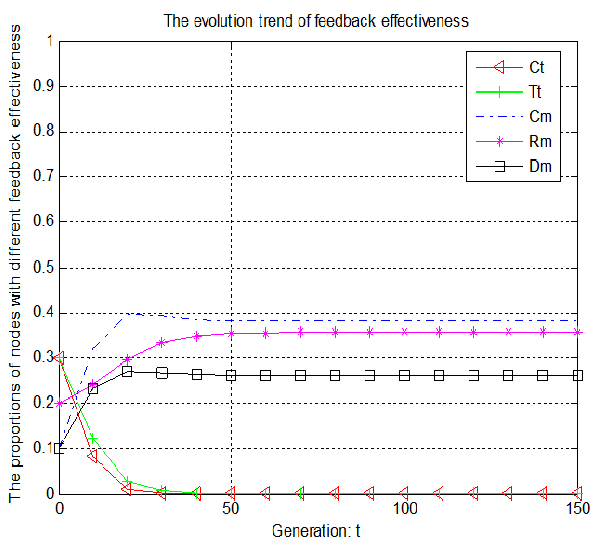 Fig 2: With the punishment mechanism, honest nodes (Ct) successfully reclaim the network dominance.
Critical Analysis & Conclusion
Takeaway
This work highlights that trust is not a static score but a dynamic strategy. By punishing specific behaviors (like bad feedback) while allowing other functions (like providing service), the model provides a nuanced way to rehabilitate nodes rather than just banishing them.
Limitations
- Weight Sensitivity: The global trust depends on weights (), which may vary drastically across different applications (e.g., a file-sharing network vs. a professional LinkedIn-style network).
- Computational Overhead: Implementing 5-strategy game matrices for every node pair in a massive social network could present scalability challenges.
Future Outlook
The authors suggest moving toward more localized trust contexts—considering relationships like "family" or "classmates." Integrating this game-theoretic approach with Zero-Knowledge Proofs or Blockchain could provide the decentralized infrastructure needed to implement these punishment cycles without a central authority.