
MarkovTrust: Decoding Social Influence Through User Interactions on Twitter
Applying Trust Metrics Based on User Interactions to Recommendation in Social Networks
The paper introduces MarkovTrust, a computationally efficient trust inference model tailored for Twitter that estimates trust via user interactions (retweets and mentions) using Markov chains. By integrating these trust metrics into a tweet recommender system, the authors demonstrate improved recommendation quality, particularly in terms of recall.
TL;DR
In the noisy ecosystem of Twitter, traditional content-based filtering often falls short. This paper presents MarkovTrust, a framework that transforms raw interactions—like retweets and mentions—into a quantifiable trust metric using Markov chains. By treating the social graph as a series of transition probabilities, the authors demonstrate that "social trust" can significantly boost the recall of tweet recommendations, even if the classical property of transitivity doesn't always hold.
Problem & Motivation: The "Silence" of Explicit Feedback
Recommender systems typically thrive on explicit signals (e.g., 5-star ratings). However, Twitter users rarely rate each other. This creates a "cold-start" and "sparsity" problem for traditional collaborative filtering.
The authors identify a critical gap: while models like EigenTrust exist for P2P networks, they don't account for the unique nuances of microblogging:
- Interaction Intensity: Not all interactions are equal; a retweet signifies a different endorsement level than a mention.
- Temporal Decay: Interests shift, and trust between users "ages."
- Transitivity Issues: If A trusts B and B trusts C, does A necessarily want to see C's content?
Methodology: Markov Models as Trust Proxies
The core innovation lies in the MarkovTrust formula. The authors define direct trust () as a weighted ratio of interactions:
Where acts as a tuner between mentions () and retweets (). To handle propagation—calculating trust between users who haven't directly interacted—they apply a -step random walk:
System Architecture
The proposed architecture is split into a Crawler (which uses trust to prioritize which nodes to scrape) and a Recommender (which uses trust as a feature for a classifier).
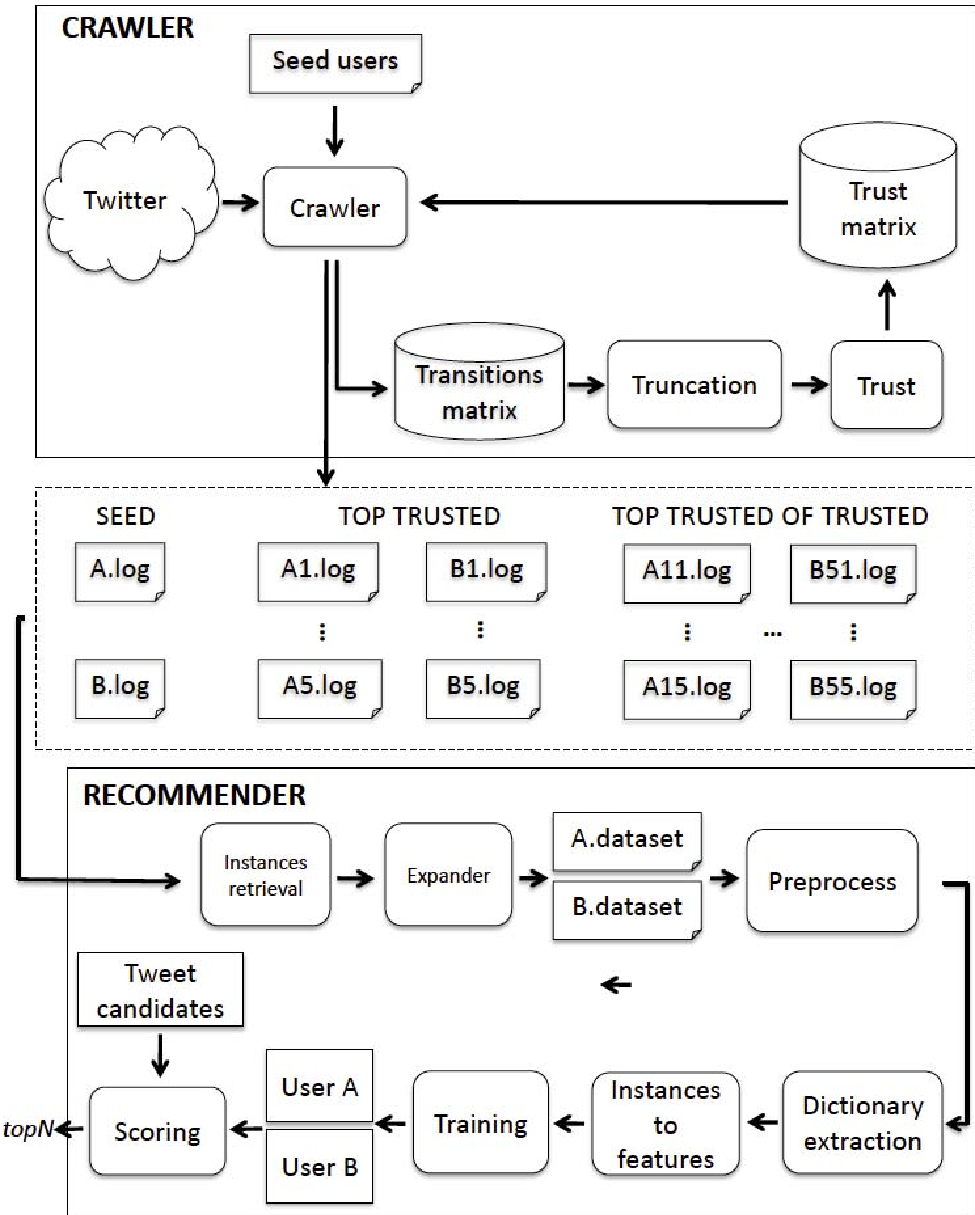 Fig 1: The dual-module architecture showing how seed users propagate trust to discover new content.
Experiments: Does Trust Actually Help?
The authors validated the model over six months of data. Two major findings emerged:
- The Transitivity Paradox: Contrary to expectations, the researchers found no strong correlation in trust rankings among common neighbors (the expected was not lower for top-ranked users). This suggests that on Twitter, trust might be purely "local" and highly interest-specific rather than a transitive social currency.
- Performance Boost: Despite the transitivity issues, adding the Trust feature to Naive Bayes (NB) and SVM classifiers provided a measurable uplift.
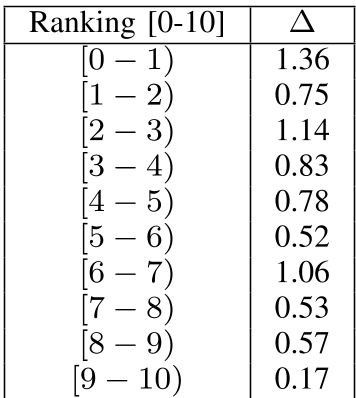 Table III: Comparison of models with and without trust. Note the significant jump in Recall when trust is included.
Key Result Analysis
- Recall Improvement: The average Recall jumped by nearly 9%. This indicates that trust metrics are excellent at discovering "interesting" tweets that content-based filters (like Bag-of-Words) might miss due to short text snippets.
- Precision/AUC: These remained relatively stable, suggesting that trust acts as a powerful "relevance filter" that expands the candidate set without introducing excessive noise.
Critical Insight & Conclusion
This work challenges the standard academic assumption that social trust is inherently transitive. On platforms like Twitter, "trust" is more akin to "attention alignment."
Takeaway for Engineers: If you are building a social feed, don't just rely on text similarity. Simple Markovian propagation of interactions can serve as a computationally cheap yet effective feature for ranking, even if the underlying social graph is chaotic. However, be wary of deep propagation (high ); trust values tend to lose accuracy quickly beyond 2-3 hops in a social context.