
MSNTM: Leveraging Small World Theory to Secure Digital Content Sharing
A trust model for multimedia social networks
This paper introduces the Multimedia Social Networks Trust Model (MSNTM) based on small world theory to secure digital content sharing. It leverages a direct trust window mechanism and a multi-strategy recommendation algorithm to dynamically assess user credibility and identify malicious actors in distributed environments.
TL;DR
With the explosion of multimedia social networks (MSNs), the unauthorized distribution of copyrighted content and the spread of malicious files have become critical threats. This paper introduces MSNTM (Multimedia Social Networks Trust Model), a framework that applies the "Six Degrees of Separation" logic to evaluate user credibility. By combining a sliding window for direct interactions with a multi-strategy recommendation engine, it effectively isolates malicious users while facilitating seamless content sharing for legitimate peers.
Background: Why Traditional DRM is Failing
Traditional Digital Rights Management (DRM) relies heavily on Identity Authentication (ID), Encryption, and Digital Watermarking. While effective in closed systems, these are "hard" security measures that struggle in open, distributed MSNs like YouTube or GoogleVideo. In these environments, the problem isn't just access—it’s behavior. Prior trust models were often too computationally heavy or failed to account for "trust decay" (the fact that a good deed five years ago shouldn't fully mask a malicious act today).
Methodology: The Small World Approach
The genius of MSNTM lies in its alignment with Small World Theory (Watts-Strogatz), which posits that most nodes in a social network can be reached via a small number of steps.
1. The Direct Trust Window
Instead of calculating trust based on an infinite history, MSNTM uses a Sliding Window Mechanism (). This solves several issues:
- Computation: It only looks at the most recent sessions.
- Sensitivity: A sudden shift to malicious behavior is caught quickly as old "honest" sessions rotate out of the window.
- Context: It factors in User Share Similarity (), recognizing that we trust people with similar hobbies (hobbies are represented as multi-component vectors).
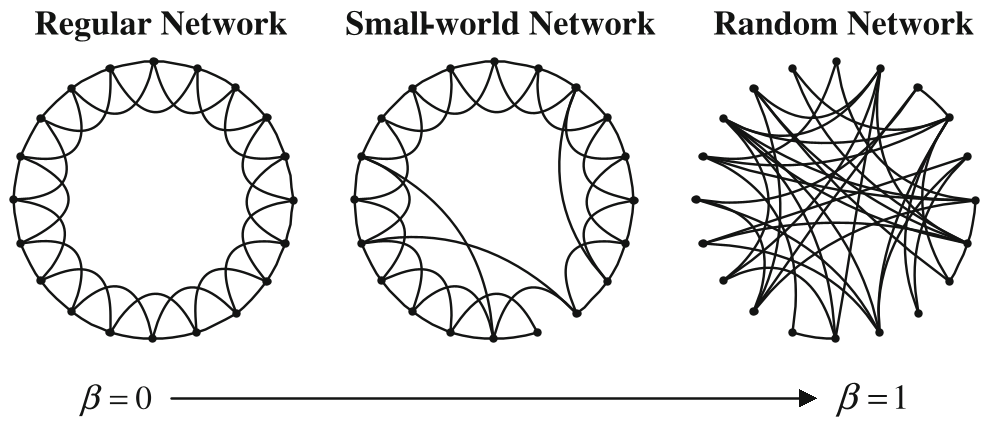 Figure 1: Comparison between regular/random networks and the proposed Small World Trust Network.
2. The Recommendation Engine
When two users have no history, the model searches for a path. Following the "Six Degrees" logic, it sets a maximum path length (). To synthesize these paths, the authors propose three "Risk Personas":
- Risk-Averse: Takes the minimum trust value from all paths (Extremely cautious).
- Risk-Neutral: Takes the average value.
- Risk-Tolerance: Takes the maximum value (Optimistic/Opportunity-focused).
Experimental Insights
The researchers simulated a virtual community of 300 nodes across two Small World Trust Networks (STNs).
The "Trust is Fragile" Phenomenon
The simulation showed that while it takes many "honest" sessions to build a trust value toward 1.0, a single malicious injection causes a sharp decline. Crucially, the model demonstrates a punitive impact: even if a user starts behaving well again, their trust value does not recover immediately, reflecting the social reality that "trust is hard to build but easy to destroy."
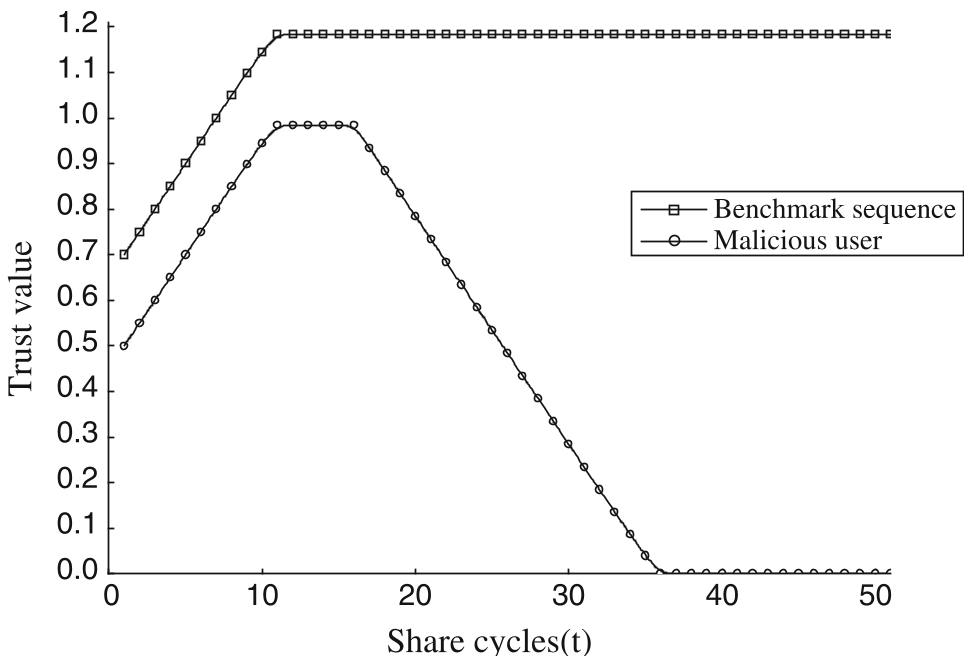 Figure 2: (A) The visible drop in trust after malicious sharing; (B) The terminal decline of a consistently malicious user.
Strategy Comparison
The experiment validated that the Risk-Averse strategy acts as a powerful filter, maintaining the lowest trust values to protect users from even minor threats. Conversely, the Risk-Tolerance strategy provides 20-30% more sharing opportunities but at a higher risk of content abuse.
Critical Analysis & Conclusion
Takeaway
MSNTM successfully bridges sociology and information technology. By integrating Time Decay () and Windowing, it provides a dynamic, real-time score that is far more practical for high-speed networks than static CA-based certificates.
Limitations
- Cold Start: While the paper suggests an initial trust value of 0.5, new users are still a "blank slate" which sophisticated attackers might exploit.
- Anti-Attack Capacity: The paper touches on this but does not deeply simulate "Sybil Attacks" (where one user creates many fake accounts to boost their own recommendation trust).
Future Outlook
The next logical step for this research is the integration of Subjective Logic or Fuzzy Sets to better handle the "gray area" of feedback, combined with decentralized ledgers to ensure that the "Trust Window" history cannot be tampered with.
Keywords: Social Networks, Small World Theory, Trust Evaluation, DRM, Direct Trust Window.