
Deciphering Digital Trust: A Formal Framework for Interpersonal, Sensor, and Social Networks
Trust networks: Interpersonal, sensor, and social
This paper presents a foundational framework for modeling and managing trust across interpersonal, sensor, and social networks. It introduces a formal trust ontology and leverages Beta Probability Distribution Functions (Beta-PDF) for robust, dynamic trustworthiness inference and update mechanisms.
TL;DR
In an increasingly digitized world, the distance between service providers and consumers is growing, making Trust Management a critical infrastructure requirement. This paper provides a comprehensive blueprint for trust, moving away from vague psychological definitions toward a rigorous mathematical and ontological assessment. By utilizing Beta-PDF for reputation and a structured 6-tuple ontology, the authors offer a scalable way to glean trustworthiness from raw observations in social and sensor networks.
The Motivation: Why Trust isn't Just a "Feeling"
Trust is often viewed as a subjective commitment, but in technical systems—like a tornado warning sensor or an e-commerce platform—it must be quantifiable. The authors identify three core drivers for formalizing trust:
- Predicting future behavior: Will this sensor fail during the next storm?
- Incentivizing "good" behavior: Discouraging malicious actors in social networks.
- Detection: Identifying compromised nodes before they subvert the entire system.
The fundamental challenge is that trust is context-dependent (Scope). You might trust a neighbor to watch your house, but not to perform surgery.
Methodology: The Ontology and the Math
1. The Trust Ontology
The authors move beyond simple binary "trust/distrust" values. They define a trust relationship as a 6-tuple:
(Trustor, Trust Type, Trust Value, Trust Scope, Trust Process, Trustee)
A key insight here is the split between Functional Trust (trust in performance) and Referral Trust (trust in an agent's ability to recommend others). This distinction is vital for "Trust Chaining," where you might not know the source but you trust the person who recommended them.
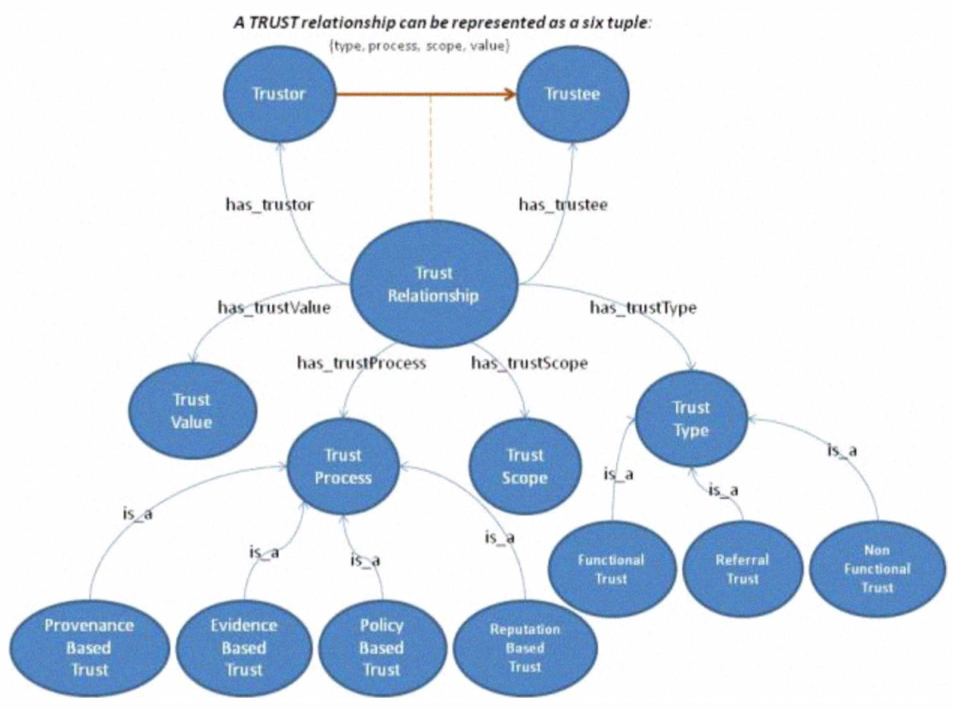 Figure 1: Illustration of a Trust Network where nodes represent agents and edges represent specific trust types and scopes.
2. Beta-PDF: The Mathematical Engine
To handle the Update Problem (how to change trust based on new data), the paper utilizes the Beta Distribution.
- Intuition: If you have
rsuccessful interactions andsfailures, your trust value is modeled as . - The Benefit: It provides a mean value for "Expectation" while the shape of the curve represents "Certainty." As the number of observations increases, the variance shrinks, representing higher confidence in the trust score.
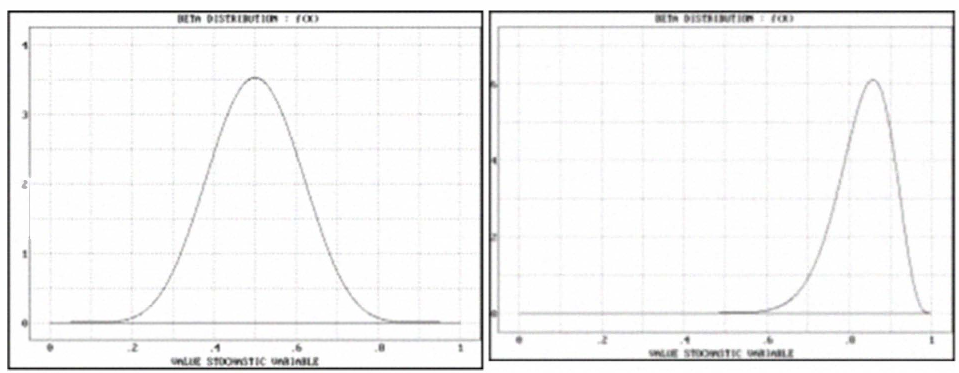 Figure 2: Beta-PDF curves showing how trust distribution narrows and shifts as more observations (correct vs. erroneous) are collected.
Trust Propagation: Chaining and Aggregation
When direct experience is missing, we rely on Indirect Trust. The paper explores two algorithmic approaches:
- Top-down (e.g., TidalTrust): Trust is inherited from the source's trusted parents.
- Bottom-up: Trust is aggregated from the target's trusted neighbors.
The authors note that these methods can lead to different conclusions in complex graphs, necessitating an axiomatic basis for propagation. For instance, Rule 1 states that concatenation should never increase trust; you cannot trust a "friend of a friend" more than you trust the friend themselves.
Experiments: The Weather Sensor Case Study
The authors applied their framework to a Weather Ontology using the Mesowest dataset. By treating sensor quality flags as observations, they could dynamically update the "Reputation" of individual weather stations.
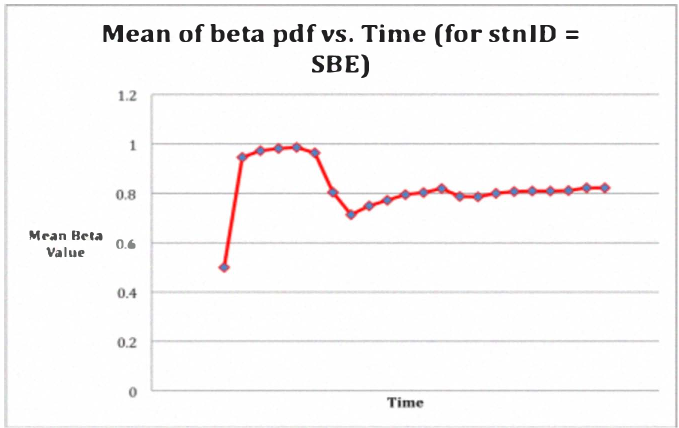 Figure 3: Sensor trustworthiness as a function of time, demonstrating the system's ability to react to sensor malfunctions.
Critical Insights & Future Work
While the Beta-PDF model is elegant, the paper acknowledges its limitations in the face of Sybil attacks (fake identities) and Sleeper attacks (agents who behave well for a long time to build trust before attacking).
Key Takeaways for Future Systems:
- Cross-Domain Integration: The real potential lies in combining social data (e.g., expert reviews) with physical sensor data to create "Situational Awareness."
- Sentiment Analysis: In social networks, purely numeric ratings are insufficient. We must look at the sentiment of reviews to detect if a 1-star rating was actually a "hidden positive" or a misunderstanding.
Conclusion
This work transitions trust from a "soft" social concept to a "hard" system property. By combining a rigid ontology with the flexible mathematics of the Beta distribution, it provides a scalable framework for everything from detecting faulty sensors to building safer e-commerce recommendation engines.