
H-SCAN: Navigating Complexity in Contextual Social Trust Networks
Discovering Trust Networks for the Selection of Trustworthy Service Providers in Complex Contextual Social Networks
The paper introduces a Social Context-Aware Trust Network discovery model and the H-SCAN algorithm to identify trustworthy service providers in complex Online Social Networks (OSNs). By integrating multiple social impact factors and a novel "Quality of Trust Network" (QoTN) metric, the method achieves significant SOTA performance in both network extraction quality and computational efficiency.
TL;DR
Evaluating trust in Online Social Networks (OSNs) is a bottleneck for service recommendation. This paper tackles the NP-Complete challenge of Trust Network Discovery by introducing H-SCAN. By blending social psychology insights—like preference similarity and residential proximity—with a high-performance heuristic search, the authors achieve a 48x improvement in network utility and a 50x speedup over traditional methods.
The Problem: The "Black Box" of Trust Paths
Most trust evaluation models (inference, transitivity, etc.) start with a major assumption: the trust network already exists. However, in a massive social graph (like LinkedIn or Facebook), finding the "best" network of intermediate nodes between a consumer and a provider is computationally expensive.
Existing search strategies fail because:
- Flooding (BFS): Hits an "exponential wall" in large graphs.
- Random Walks: Lack direction and ignore social nuances.
- High-Degree Search: Follows popular nodes but often misses the target.
The fundamental issue is that trust is context-dependent. You might trust a friend for a movie recommendation but not for legal advice.
Methodology: Bridging Social Psychology and Graph Theory
1. Complex Contextual Structure
The authors move beyond simple node-link graphs by defining five Social Contextual Impact Factors:
- Trust (T): Domain-specific belief.
- Social Intimacy (SI): The strength of the relationship.
- Community Impact (CIF): Expert status or social influence.
- Preference Similarity (PS): Shared interests.
- Residential Location (RLD): Geographical proximity.
2. The H-SCAN Algorithm
To solve the NP-Complete search, the Heuristic Social Context-Aware trust Network (H-SCAN) algorithm was developed. It models social interaction probability using a Normal Distribution, assuming people are more likely to interact if they share high contextual similarity.
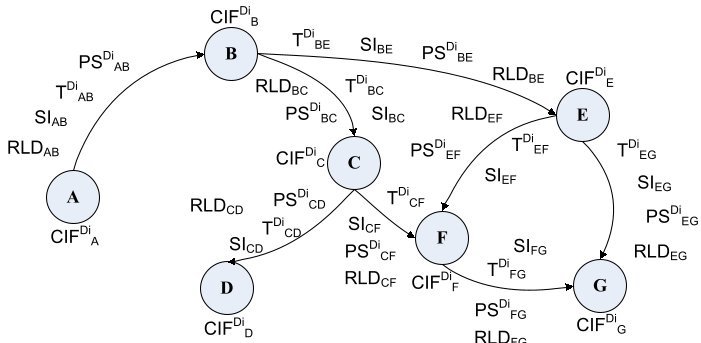
Key Innovations in H-SCAN:
- KBFS Framework: Expands only the 'K' most promising nodes at each hop.
- Strategy 1 (Pruning): It immediately ignores "dead-end" nodes (nodes with incoming links but zero outgoing links), preventing wasted computation.
- Strategy 2 (Memoization): It avoids re-investigating nodes already reached in previous search hops.
Experimental Results: Speed and Quality
Testing on the Enron Email Dataset (approx. 87k nodes and 300k links), the results were stark:
- Utility Superiority: H-SCAN delivered trust networks with drastically higher quality (Utility) compared to Random Walk (RWS) across different constraint sets.
- Efficiency: While Flooding (TTL-BFS) took over 5 hours to converge, H-SCAN provided results in seconds.
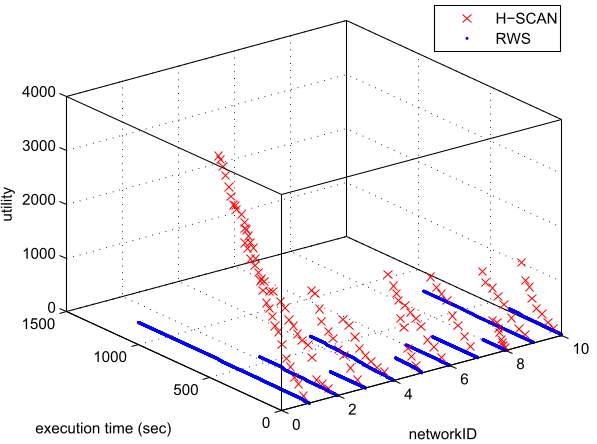
The data suggests that contextual awareness acts as a heuristic anchor, guiding the search algorithm toward reliable paths much faster than "blind" structural algorithms.
Critical Insight & Conclusion
This work demonstrates that "Quality of Trust Network" (QoTN) is not just a subjective metric but a functional constraint that can be used to optimize graph search. By defining what a "good" path looks like from a social perspective, we can prune the search space of massive graphs effectively.
Limitations: The paper relies on generated values for some social factors due to data privacy/availability. Future iterations would benefit from real-world datasets where intimacy and preference are explicitly labeled rather than being mined or simulated.
Future Outlook: As we move toward decentralized service environments (Web3/P2P), algorithms like H-SCAN will be vital for building "Trust-as-a-Service" layers that don't rely on a central authority.