
Trust is Nuanced: Why "Average Similarity" Fails Social Networks
Trust and nuanced profile similarity in online social networks
This paper investigates the relationship between trust and nuanced profile similarity in online social networks. It introduces a multifaceted approach to predict trust by moving beyond simple "average similarity" and incorporating specific behavioral signals like agreement on extreme opinions.
TL;DR
Similarity is often used as a proxy for trust in digital systems, but not all similarities are created equal. This research by Jennifer Golbeck reveals that our trust in others is shaped by "nuanced" factors—specifically, how much we agree on topics we are passionate about (extreme ratings) and how much we are repelled by a single major disagreement. By modeling these nuances, trust prediction accuracy can be boosted by over 36%.
The Problem with Being "Average"
In the world of Collaborative Filtering (CF) and Social Recommender Systems, we typically assume that if Alice and Bob both like the same 10 movies on average, Alice should trust Bob’s recommendations.
However, the author points out two fatal flaws in this logic:
- The Isolated Node Problem: In real systems like FilmTrust, over 58% of users have no friends. Network-based trust propagation (like EigenTrust) simply doesn't work for them.
- The Passion Gap: If Alice loves "A Clockwork Orange" (10/10) and Bob hates it (1/10), Alice may lose all trust in Bob’s cinematic taste, even if they agree on 20 other "average" movies. Standard algorithms ignore this "Maximum Difference" effect.
Methodology: Identifying the "Trust Killers"
The study was conducted in two phases: a controlled survey with 59 subjects and a validation phase using real-world data from the FilmTrust platform.
The Nuanced Features
The author isolated three specific profile features that drive trust:
- (Overall Error): The standard average difference in ratings.
- (Maximum Difference): The single largest "miss" between two users. A single 9-point gap on a 1-10 scale can destroy trust regardless of other overlaps.
- (Extreme Agreement): Agreement on items rated 1-2 or 9-10. We value "soulmates" who share our strongest loves and hates more than those who agree on mediocre 5/5 middle-ground items.
- (Trusting Propensity): An individual's baseline tendency to be skeptical or trusting.
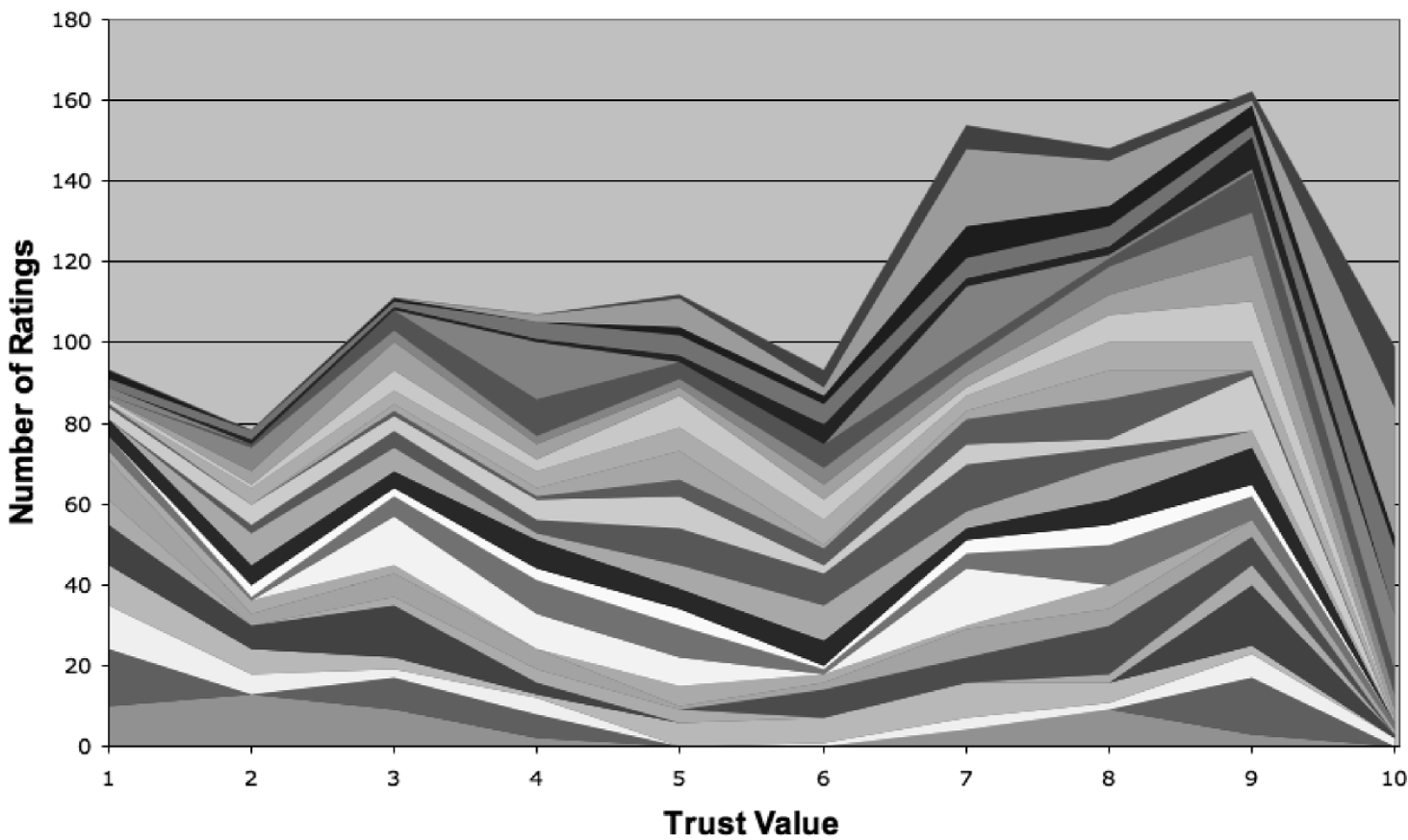 Figure: The distribution of trust ratings across different subjects shows that "propensity to trust" is a highly individual trait.
Experiments and Results
The findings were striking. In the controlled experiment, holding the average difference constant while increasing the Maximum Difference () led to a significant drop in trust. We are, it seems, very sensitive to "deal-breakers."
When these features were coded into a predictive formula (Equation 3) and tested on the FilmTrust network, the results outperformed standard Pearson Correlation significantly:
| Metric | Overall Similarity | Nuanced Model (Eq 3) |
|---|---|---|
| Correlation with Trust | 0.24 | 0.73 |
| Mean Absolute Error (MAE) | 1.91 | 1.22 |
| Standard Deviation | 1.95 | 0.95 |
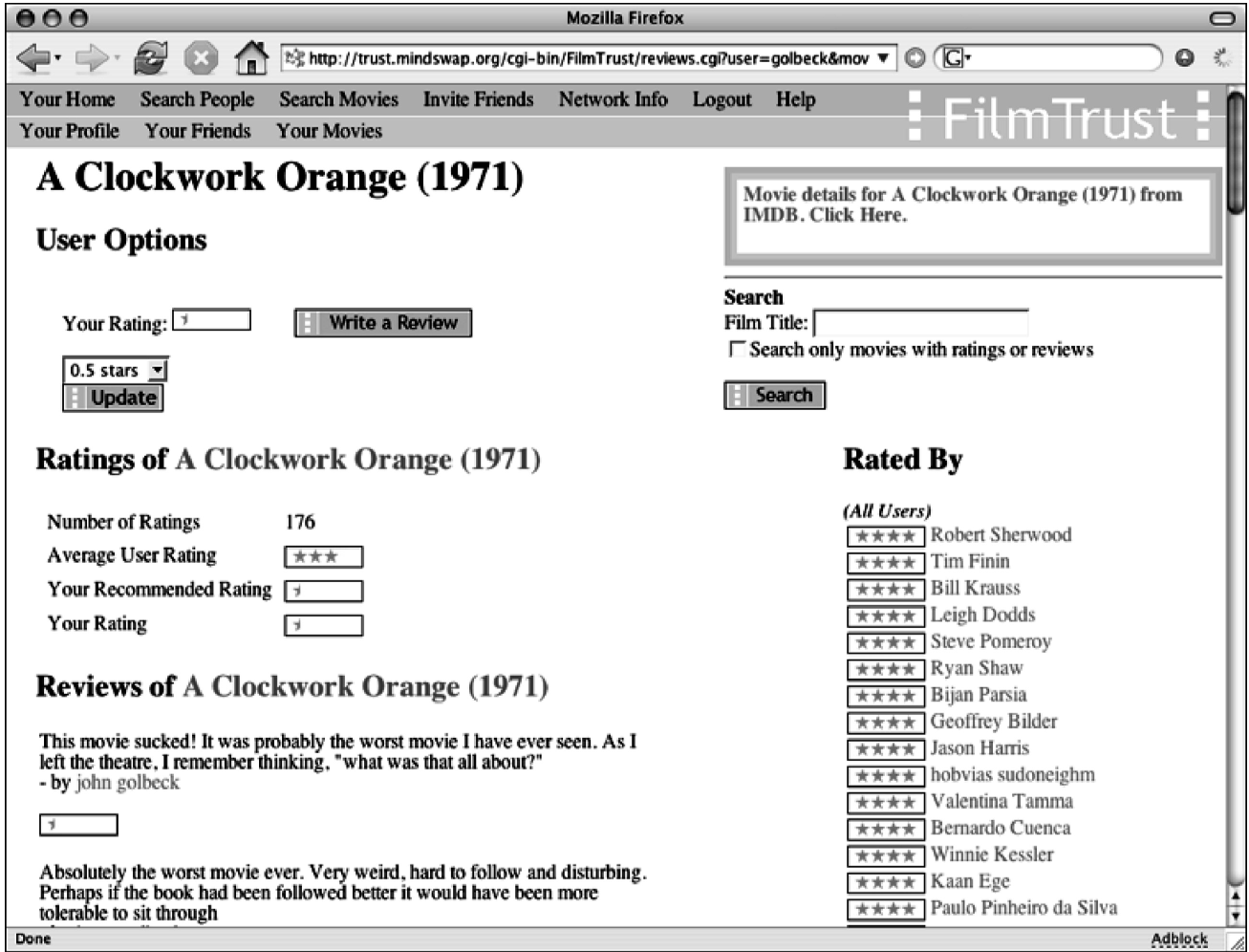 Figure: The FilmTrust interface where personalized "Recommended Ratings" are generated based on trust scores.
Deep Insights & Takeaways
The core takeaway for AI and UX researchers is that trust is asymmetrical and non-linear.
- The Weight of Extremes: If you want to build a better recommender system, don't just look at the most popular items. Look at the items the user feels most strongly about. Agreement there is worth 10x more than agreement on "average" content.
- The Power of One: A single "offensive" recommendation or a massive disagreement on a core belief can negate a hundred small agreements.
Limitations
The study acknowledges that personal history and offline relationships (which are invisible to the web) still play a massive role in trust. However, for "cold-start" users with no social links, these nuanced profile features provide the best available proxy for building a "socially intelligent" system.
Conclusion
By moving from "How similar are these two users?" to "How do these users agree on what matters most?", Golbeck provides a roadmap for creating digital spaces that feel more human and more trustworthy.