
Trust Optimization: The Missing Link in Task-Oriented Social Networks
Trust optimization in task-oriented social networks
This paper introduces a pioneering framework for trust maximization and optimization within Task-Oriented Social Networks (TOSN). It proposes the Trust-Maximization algorithm and four optimization variants (Trust-First, Cost-First, and Domain-Value Optimizations) to balance interpersonal trust with communication costs, achieving near-linear performance in team formation tasks.
TL;DR
Collaborative success in social networks isn't just about who has the skills; it's about how much they trust each other. This paper presents a novel algorithmic framework to maximize trust and optimize communication costs in Task-Oriented Social Networks (TOSN). By shifting the focus from simple connectivity to "Trust Realms," the authors provide a way to build expert teams that are both efficient and reliable.
Contextual Positioning
In the landscape of social computing, we have moved beyond simple browsing to complex collaboration. While previous SOTA focused on Trust Inference (predicting if A trusts C via B), this work is a pioneering effort in Trust Optimization. It treats trust as a critical objective function in the "Team Formation Problem," a field traditionally dominated by cost-minimization logic.
The Core Challenge: Trust vs. Efficiency
Current team formation algorithms often treat humans as interchangeable blocks of skills. The prevailing logic is: Find the smallest communication cost to get the job done.
However, the authors argue that:
- Trust is Asymmetric and Transitive: If Alice trusts Bob, Bob might not trust Alice equally.
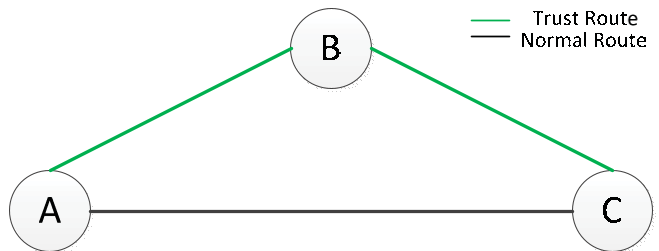
- Trust Routes != Shortest Paths: The most "cost-effective" path (minimum hops) might involve individuals who do not trust each other, leading to team failure.
- Computational Complexity: Finding the optimal team in a large network is NP-complete, requiring efficient heuristic approximations.
Methodology: Mapping to the Trust Realm
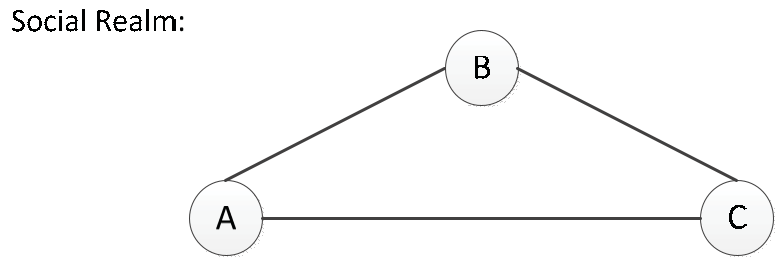
The researchers propose a transition from the Social Realm (undirected communication edges) to the Trust Realm (directed, weighted edges representing trust values [0,1]).
1. Trust Maximization
The algorithm identifies the "Rarest Skill" required for a task and uses it as a pivot. It then finds the maximum trust routes from this pivot to other required specialists using a multiplication-based inference model: .
2. Extreme-Value Optimization (EVO)
To resolve the tension between trust and cost, the authors introduce:
- Trust-First: Identifies maximum trust routes and then picks the one with the lowest cost.
- Cost-First: Identifies the shortest communication paths and then selects the one with the highest trust.
Experimental Insights
The study utilized two distinct datasets:
- Academic Dataset: 27 professors categorized by research skills and historical collaboration.
- Amazon Vendor Dataset: 500 vendors and 300 merchandise types, mapping "trust" to vendor ratings and "cost" to product prices.
Performance Benchmarks
The results confirm that the algorithms are highly scalable. For a network of 500 nodes (Amazon dataset), the execution time was approximately 104ms to 110ms.
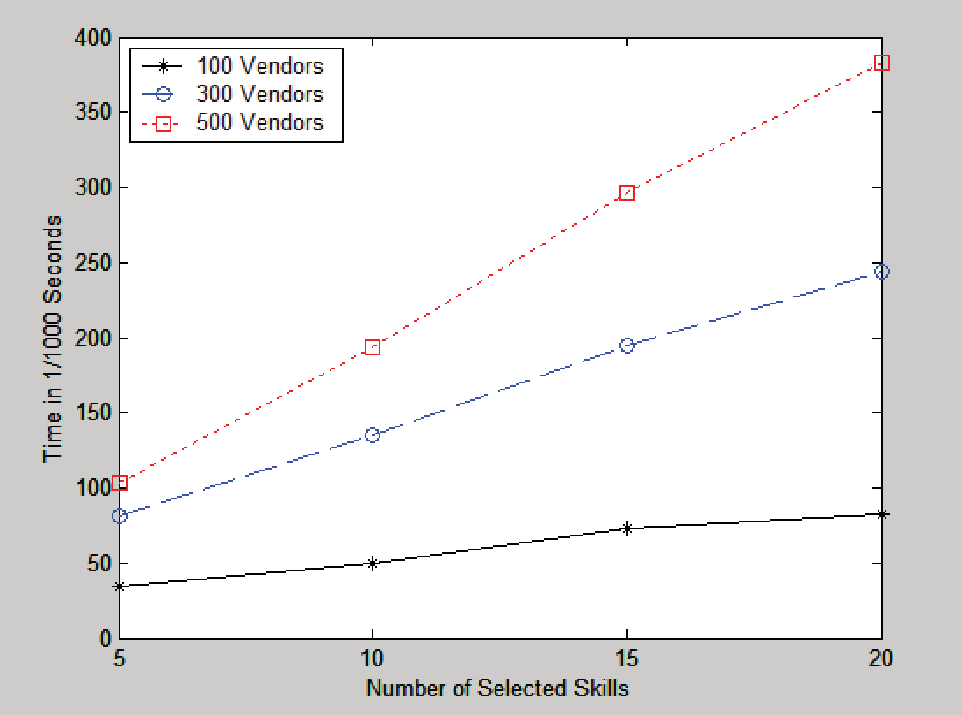 Figure: Comparative analysis showing near-linear scaling as the number of vendors (nodes) increases.
Critical Analysis & Conclusion
Takeaway
This work successfully mathematicalizes a "human-related phenomenon." By providing Domain-Value Optimization (DVO), the authors offer managers the flexibility to set trust "thresholds" rather than just chasing theoretical maximums, making the methodology highly applicable to real-world HR and project management.
Limitations
The use of the multiplication method for trust inference carries an inherent bias: longer paths exponentially decrease trust values. In large-scale networks, this might unfairly penalize diverse teams that require multiple "hops" to connect unique experts. Future work could incorporate more sophisticated Bayesian inference to mitigate this decay.
Future Outlook
As decentralized work and P2P professional networks grow, these algorithms could serve as the "backend" for automated talent-sourcing platforms, ensuring that formed teams have the "social glue" (trust) necessary to succeed.