
The Epistemic Shield: Why Being Overconfident is Actually Rational
Trust and the value of overconfidence: a Bayesian perspective on social network communication
This paper presents "Laputa," a Bayesian framework for modeling trust and communication in social networks. It demonstrates through multi-agent simulations that "overconfidence"—defined as overestimating one's own inquiry reliability—can be epistemically beneficial by preventing "spirals of distrust" that occur when agents encounter accidental strings of misleading data.
In the world of Bayesian epistemology, the "rational agent" is often pictured as a perfectly calibrated machine—a calculator that assigns probabilities to the world with surgical precision. However, human beings are notoriously overconfident. We consistently think we are more reliable than we actually are. While psychologists often label this a "bias" or a "flaw," a provocative study by Aron Vallinder and Erik J. Olsson suggests that overconfidence might actually be an essential survival mechanism for the truth-seeking mind.
TL;DR
Using a multi-agent Bayesian simulation named "Laputa," researchers found that overestimating your own reliability (overconfidence) prevents you from falling into a "spiral of distrust." When you encounter a fluke string of bad data, being overconfident keeps you on the path toward the truth, whereas a "perfectly calibrated" agent might give up on their own senses too early.
The Problem: The Fragility of Calibration
If you are perfectly calibrated, your degree of trust in your own senses matches your objective reliability. If you are 60% accurate, you believe you are 60% accurate.
The problem arises with surprising information. If you are 60% accurate but accidentally hit a streak of 5 wrong results in a row (a statistically likely event over time), a perfectly calibrated Bayesian will lower their trust in themselves. This creates a feedback loop: you see a "bad" result, you trust yourself less, which makes the next "good" result look like a fluke, leading you to trust yourself even less.
The authors identify this as a Spiral of Distrust.
Methodology: The Laputa Model
The authors modeled trust not just as a feeling, but as second-order probability.
- Credence: Your belief that a proposition is true.
- Trust: Your belief about the probability that a source (including yourself) is telling the truth.
By using the "Principal Principle"—the idea that our subjective beliefs should follow objective chances—they built a simulation where agents update both their belief in the facts and their trust in the sources simultaneously.
Note: The Laputa model uses Formula (C2) and (C3) to determine how an agent updates credence in based on the expected value of the trust function .
The Results: The Value of Ego
The most striking finding was the disparity between Inquiry Trust (trusting yourself) and Communication Trust (trusting others).
1. Overconfidence as a Shield
As shown in the researchers' data, the "Veritistic Value" (how close the group got to the truth) actually increased when agents overestimated their inquiry reliability.
- Low Reliability (0.6): Overconfidence yields a 70% increase in truth-attainment.
- High Reliability (0.8): The benefit drops to 9%, but remains positive.
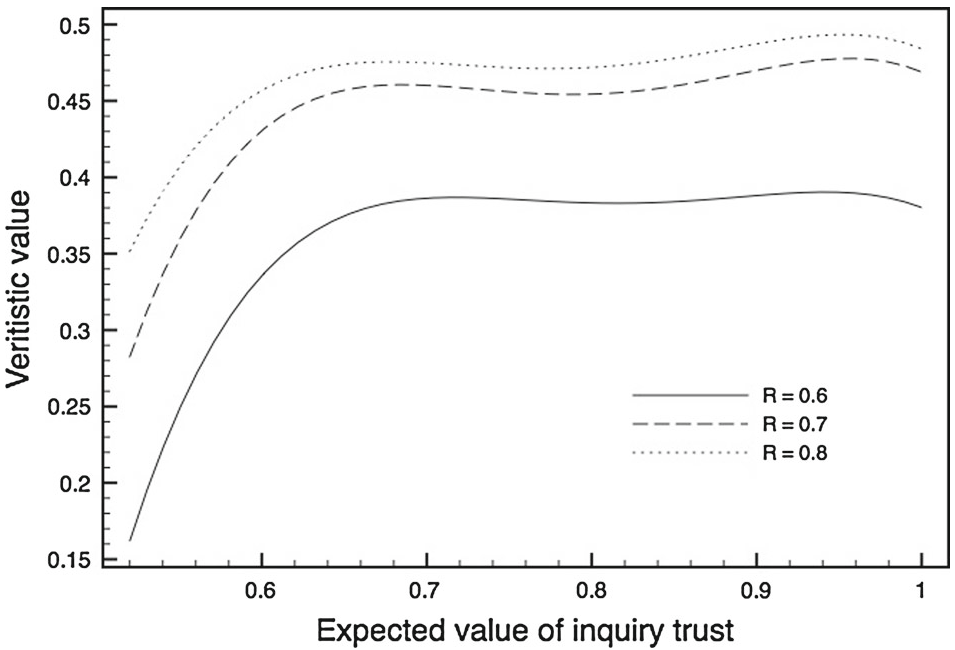 Fig 1: Veritistic value rises dramatically as inquiry trust exceeds actual reliability, especially for barely-reliable agents.
2. The Danger of Trusting Others Too Much
Interestingly, the same benefit does not apply to trusting peers. Overestimating others' reliability often led to worse outcomes.
Why? Because communication is "noisy." Other people's reports are based on their own biased initial beliefs. If you trust a noisy neighbor more than your own (even fallible) senses, you are more likely to be led astray.
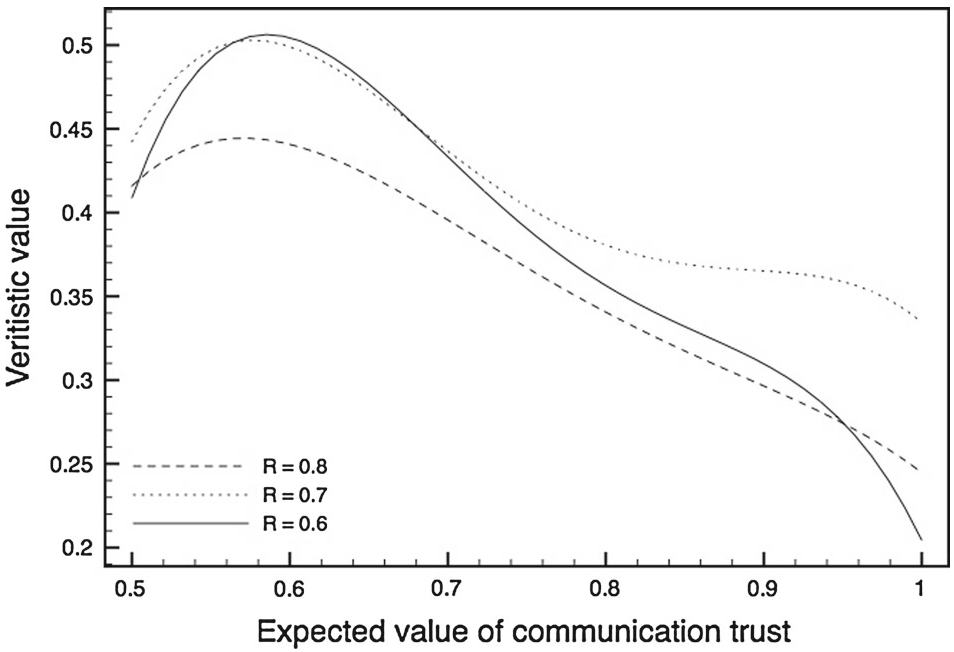 Fig 2: Unlike inquiry trust, communication trust has an optimal peak (usually around 0.5-0.6) before performance degrades.
Critical Insight: The "Steadfast View"
This research provides a mathematical backbone for the "Steadfast View" in social epistemology. It suggests that when peers disagree with you, you are often epistemically justified in sticking to your guns.
The Takeaway: Overconfidence isn't just an ego trip; it’s a buffer. It protects the agent from the volatility of small sample sizes. By the time an overconfident person finally admits they are wrong, they have usually collected enough evidence to ensure they aren't just reacting to a statistical anomaly.
Conclusion & Limitations
The study focuses on "skeptical" environments—like communication between strangers online—where social norms of trust don't exist yet. In a close-knit group (like a family), norms might override these Bayesian calculations.
However, the core takeaway remains: To find the truth in a noisy world, you might need to believe in yourself just a little bit more than the facts strictly allow.