
JMF: Solving the Trust Prediction Sparsity via Heterogeneous Network Aggregation
Trust prediction via aggregating heterogeneous social networks
This paper introduces Joint Manifold Factorization (JMF), a transfer learning framework that aggregates heterogeneous social networks (trust graphs and rating graphs) to predict missing links. By leveraging shared user-group structures between domains, JMF achieves SOTA performance in trust prediction and recommendation tasks.
TL;DR
Trust prediction in social networks is notoriously difficult due to "data cold starts" and extreme sparsity. This paper introduces Joint Manifold Factorization (JMF), a method that treats trust not as an isolated graph, but as a behavior correlated with other activities (like movie ratings). By "transferring" user group structures from rating data to trust data and maintaining individual graph manifolds, JMF significantly improves prediction accuracy in both domains.
The Motivation: Why Trust and Ratings Are Two Sides of the Same Coin
Traditional trust prediction relies on Trust Propagation (e.g., "If I trust Bob, and Bob trusts Alice, I might trust Alice"). However, when only ~3% of potential trust links are present, the "paths" of trust are broken.
The researchers' core insight is grounded in sociology: Homophily (birds of a feather flock together). People in the same social circle exhibit similar behavior and tastes. Therefore:
- A user's trust network and their rating history (behavior) should share a latent group-level structure.
- By learning these "latent groups" () from both networks simultaneously, we can fill in the gaps in the trust graph using patterns found in the rating graph.
Methodology: Joint Manifold Factorization (JMF)
The JMF model is an evolution of standard Matrix Factorization. It minimizes the reconstruction error of two different matrices simultaneously:
1. The Shared Latent Space ()
In the equation above, represents users. Because is used to reconstruct both the Trust Graph () and the Rating Graph (), it forces the model to find a user representation that is valid for both social and behavioral contexts.
2. Handling Domain Heterogeneity ()
Trust votes are often binary (0/1), whereas ratings might be 1-5. The scalar is a clever addition that automatically adjusts the scale inconsistency, allowing the model to bridge disparate data types.
3. Preserving Geometry (Manifold Regularization)
To ensure the unique characteristics of each graph aren't lost, the authors add Laplacian Regularity terms (). This ensures that if two items are "close" in the original feature space, they remain close in the latent factor space.
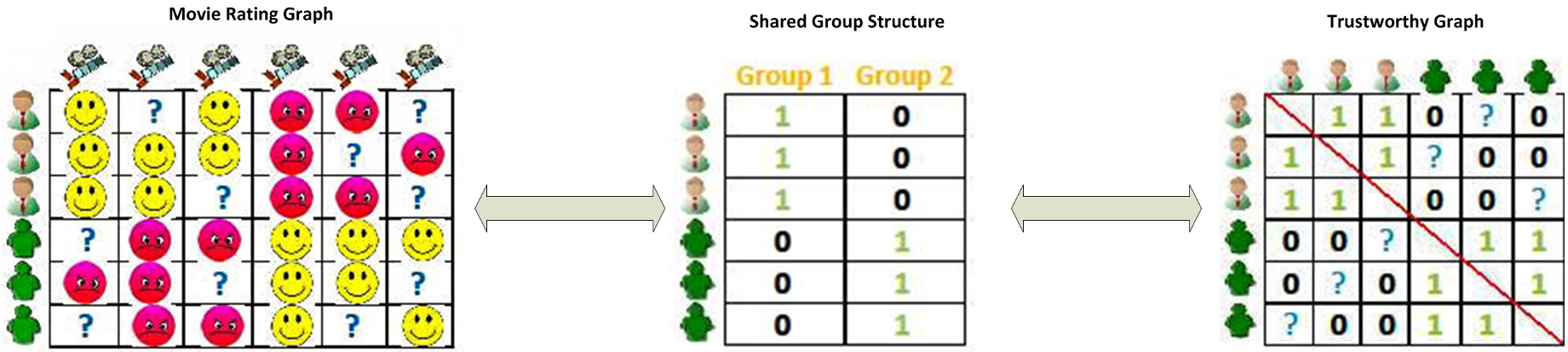 Figure 1: The architecture shows how the shared Group Structure Matrix () is jointly informed by the Trust Matrix and Rating Matrix.
Experimental Results: Breaking the Sparsity Barrier
The authors tested JMF on the Epinions dataset, which contains real-world trust statements and item reviews.
Key Performance Highlights:
- Trust & Distrust Prediction: JMF achieved a superior AUC (Area Under Curve) compared to standard KNN and SVD. For distrust links, the AUC reached a remarkable 0.992.
- Recommendation Accuracy: In the rating domain, JMF lowered the MAE (Mean Absolute Error) to 0.772, outperforming the sophisticated Matrix Completion (MC) baseline (0.828).
| Method | Trust AUC | Distrust AUC | Rating MAE |
|---|---|---|---|
| JMF (Proposed) | 0.215 | 0.992 | 0.772 |
| SimRank | 0.185 | 0.916 | 0.832 |
| SVD | 0.123 | 0.583 | 0.924 |
The results prove that "Naive" transfer learning (like stacking matrices) is insufficient; one must explicitly model the shared structure and individual manifolds.
Critical Analysis & Conclusion
The Takeaway
JMF successfully addresses the sparsity problem by moving from a single-network view to a heterogeneous multi-network view. It proves that trust is not just a topological property, but a behavioral outcome that can be inferred from ancillary data.
Limitations
- Computational Complexity: The iterative multiplicative updating rules (derived via KKT conditions) are mathematically sound but can be computationally expensive for massive, billion-node graphs.
- User Overlap: The model assumes a significant number of "identical users" exist in both domains. In cross-platform scenarios (e.g., matching Twitter users to Amazon users), this remains a major hurdle.
Future Outlook
As we move toward "Super-Apps" that combine social networking, commerce, and entertainment, JMF-like architectures provide a blueprint for building unified trust/recommendation engines that thrive on diverse, multi-modal data.