
Beyond Traditional SOA: Trust and Privacy-Enabled Service Composition in the Social Era
Trust and Privacy Enabled Service Composition Using Social Experience
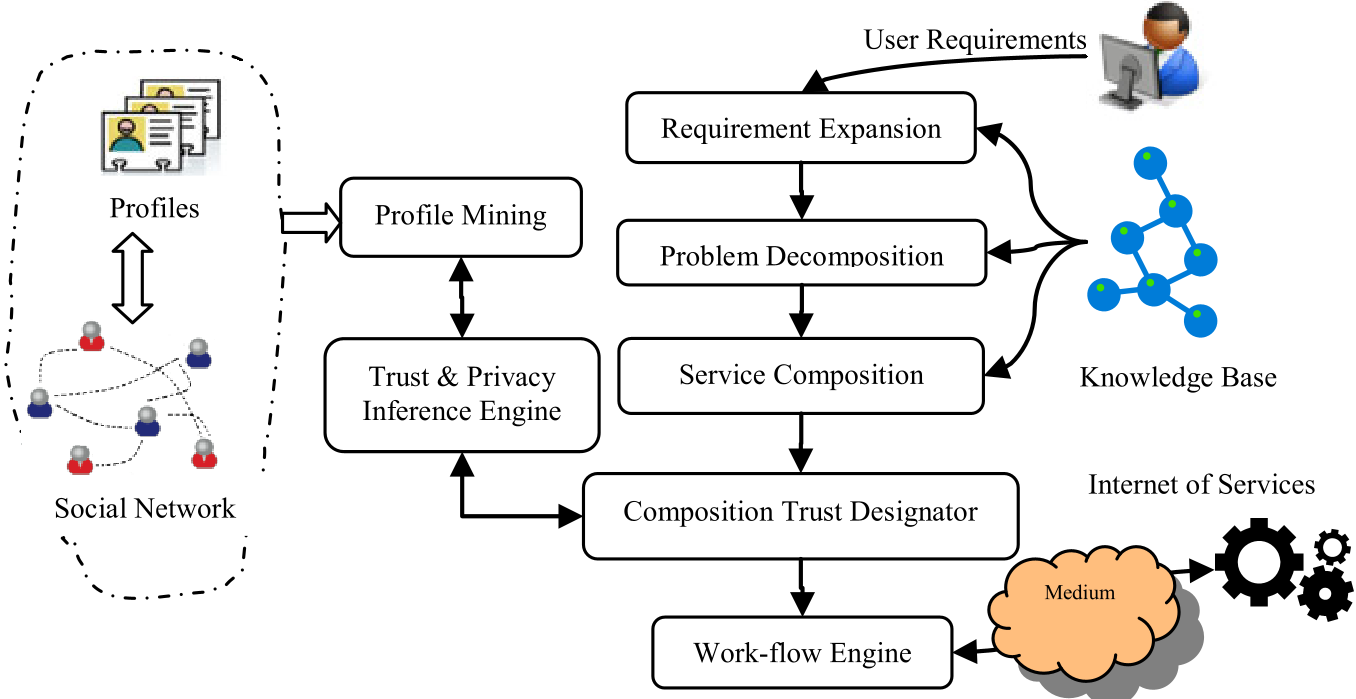
The paper proposes a framework for automatic Web Service Composition (WSC) that utilizes service reputation derived from social network user profiles. It introduces a novel privacy-inference model that prunes social networks to ensure that only trustworthy and privacy-compliant user experiences are used to calculate the Quality of Service (QoS).
TL;DR
As the Internet of Services (IoS) matures, selecting the right service from a sea of functionally equivalent options is a challenge. This paper introduces a framework that leverages Social Network (SN) data—specifically user ratings and trust relationships—to rank service compositions. Its unique contribution is a Privacy Inference Model that dynamically hides user profiles from untrusted seekers, ensuring that "social experience" doesn't come at the cost of personal data leaks.
The "Service Overload" Problem
In a world of redundant Web Services, how do you choose? Provider-side QoS is often biased, and individual experience is too sparse. The industry has looked toward Web 2.0 (social feedback) to fill this gap. However, most existing service composition engines treat user data as public, ignoring the crucial fact that not every user wants their service usage history visible to every random composer.
Methodology: Trust as the Filter, Privacy as the Shield
1. The Multi-Segment Profile
The authors extend the FOAF (Friend Of A Friend) ontology. Each profile contains:
- Trust Assertions: (0-1) How much do I trust my friends?
- Privacy Assertions: (0-1) How much do I want to hide my history?
- Past Experience: Actual numerical ratings of services.
2. The Privacy Inference Model
The core innovation is the intuition that privacy concerns decrease as trust increases. They propose a discrete-value inference formula:
privacy(s, u) = α(1 - trust(s, u)) + βp_s
If its trust in you is low, its privacy wall against you goes up. The system calculates an "Inferred Privacy" score for every node in the network relative to the person searching for a service.
3. Social Network Pruning
Before calculating service reputation, the system runs a Pruning Algorithm. If a user's inferred privacy score toward the composer exceeds a "Max-Privacy" threshold, that user's data is wiped from the calculation. They remain in the graph only as a "connector" node to preserve network topology.
Quantifying Reputation
Once the network is pruned, the trustworthiness of a service from the perspective of user is computed by a weighted average of ratings , where the weights are the trust levels between the composer and the raters:
This ensures that the "opinion" of a close, trusted friend carries more weight than that of a distant acquaintance.
Critical Insight & Evaluation
The paper effectively bridges the gap between Social Computing and Service-Oriented Architecture (SOA).
- Strategic Flexibility: The framework supports three composition strategies: Overly-Cautious (focus on the weakest link), Overly-Optimistic (focus on the strongest link), and Average.
- Dynamic Privacy: Unlike static privacy settings (e.g., "Friends Only" on Facebook), this model allows for a gradient of visibility based on inferred trust paths.
 The formula above represents the core logic of the Privacy Inference Engine.
Conclusion and Future Outlook
While this paper lays a solid theoretical foundation for privacy-aware social service discovery, the authors acknowledge that experimental validation on large-scale real-world datasets (like Facebook or App Store data) is the next frontier.
The ultimate takeaway for the industry is clear: Trust is the currency of the Internet of Services, and managing that currency requires a sophisticated understanding of the trade-off between data utility and user privacy. Future iterations may need to address the "Malicious User" problem—where users collude to manipulate reputation scores—potentially through decentralized consensus or more robust anomaly detection in the SN pruning phase.