
Trust or Trap? How Institutional "Rule of Law" Determines Whether Cooperators Prosper
Accessing the Role of Trust Profiles for the Economic Growth of Societies: A Stochastic Rule-Based Simulation Using the Prisoner’s Dilemma Game
This study utilizes a Rule-Based Model (RBM) and stochastic simulation to investigate the impact of trust profiles on the economic growth of New Zealand and Argentina. By employing the Prisoner’s Dilemma Game (PDG) with empirically derived parameters, it demonstrates that societal prosperity is inherently tied to the interaction between individual trust levels and institutional frameworks.
TL;DR
Is trust the "magic ingredient" for economic success? Not always. Using stochastic rule-based simulations of New Zealand and Argentina, researchers found that while high-trust societies generally perform better, being a "High Truster" in a society with weak legal protections is a recipe for financial ruin. This study proves that the Rule of Law is the essential shield that allows social capital to convert into material prosperity.
Problem & Motivation: The Missing Context in Social Capital
For decades, social scientists like Robert Putnam have argued that trust is a proxy for "social capital"—the lubricant that makes the wheels of the economy turn. However, most empirical studies are snapshots in time. They don't show the process of how a High Truster (HT) survives in a world full of "Cheaters" (Low Trusters, LT).
The authors identify a critical gap: evolutionary simulations often use abstract survival scores and fixed rules. In the real world, the "payoff" for social interaction is determined by institutions. If the police are corrupt and contracts aren't enforced, the cost of being cheated (the "sucker’s payoff") becomes so high that cooperation becomes a liability rather than an asset.
Methodology: Simulating Two Different Worlds
The research team used a Rule-Based Model (RBM), a sophisticated alternative to traditional Agent-Based Modeling. Unlike agents with internal goals, RBM agents react to environmental rules, making it ideal for simulating complex social systems.
1. The Data Foundation
The simulation didn't use guess-work. It utilized the Global Trust Inventory (GTI) data from:
- New Zealand (NZ): Represents a high-trust, developed economy (28.3% High Trusters).
- Argentina (ARG): Represents a developing economy with lower trust (only 7.3% High Trusters).
2. The Payoff Matrices (The "Rules of the Game")
The researchers tested two scenarios:
- Predator’s Paradise: High reward for cheating (+10) and a devastating penalty for being cheated (-10). This mimics societies where the Rule of Law is weak.
- Rule of Law: Low reward for cheating (+2) and a mild penalty for being cheated (-2). This mimics societies where legal institutions protect the "sucker."
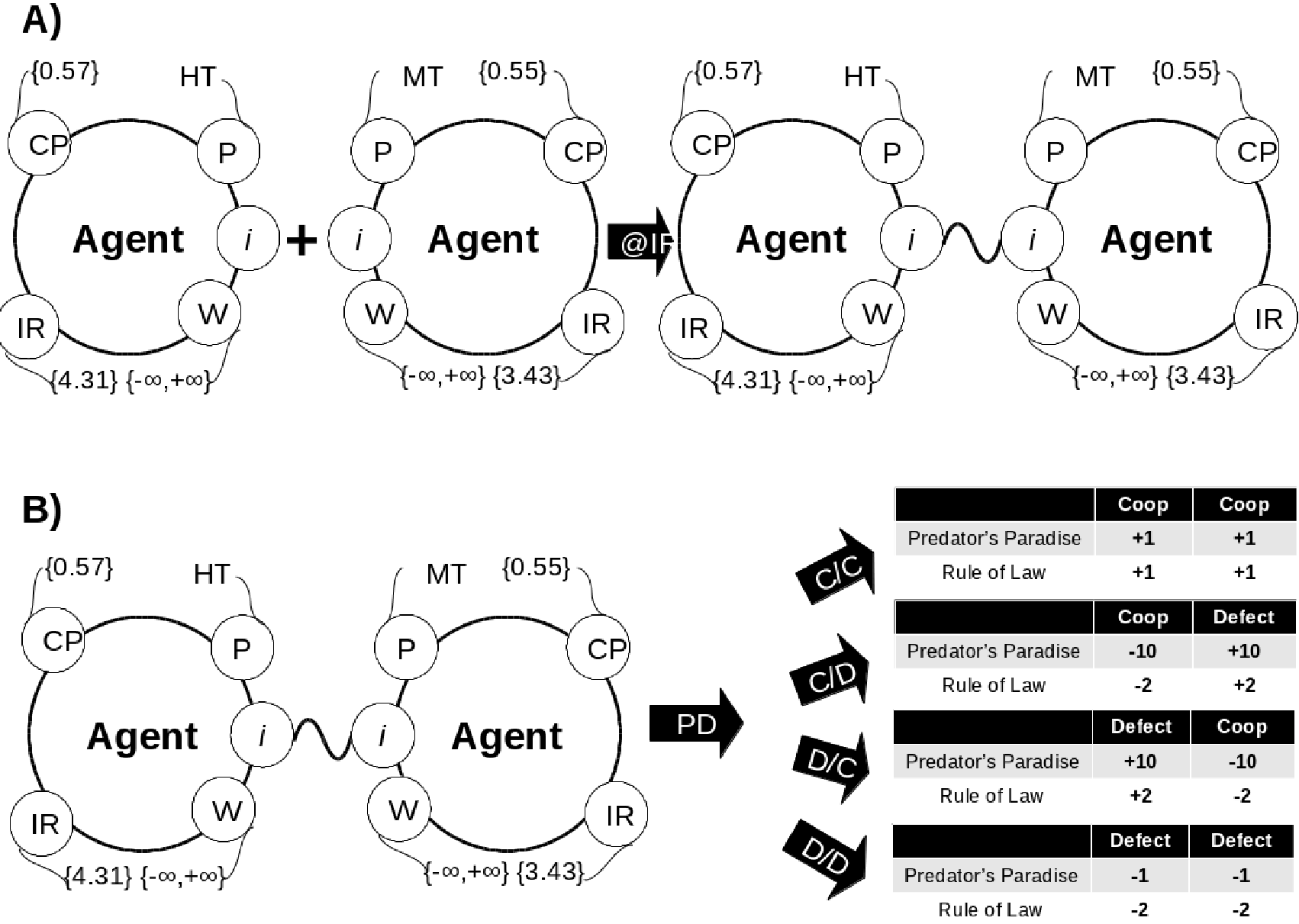 Fig 1: The rule-based framework where agents play the Prisoner's Dilemma based on empirically derived trust profiles.
Experiments & Results: Why Argentina Lost Despite Being "More Social"
The results provided a fascinating contradiction. Initially, Argentina seemed to have a higher total GDP because Argentinians interact much more frequently than New Zealanders. However, when normalized per interaction, New Zealand’s economic efficiency was far superior.
The "Sucker's" Tragedy
In the Predator's Paradise scenario for Argentina, High Trusters (HTs) didn't just earn less—they lost money. They were exploited by the more common Low Trusters (LTs) who thrived massively by cheating.
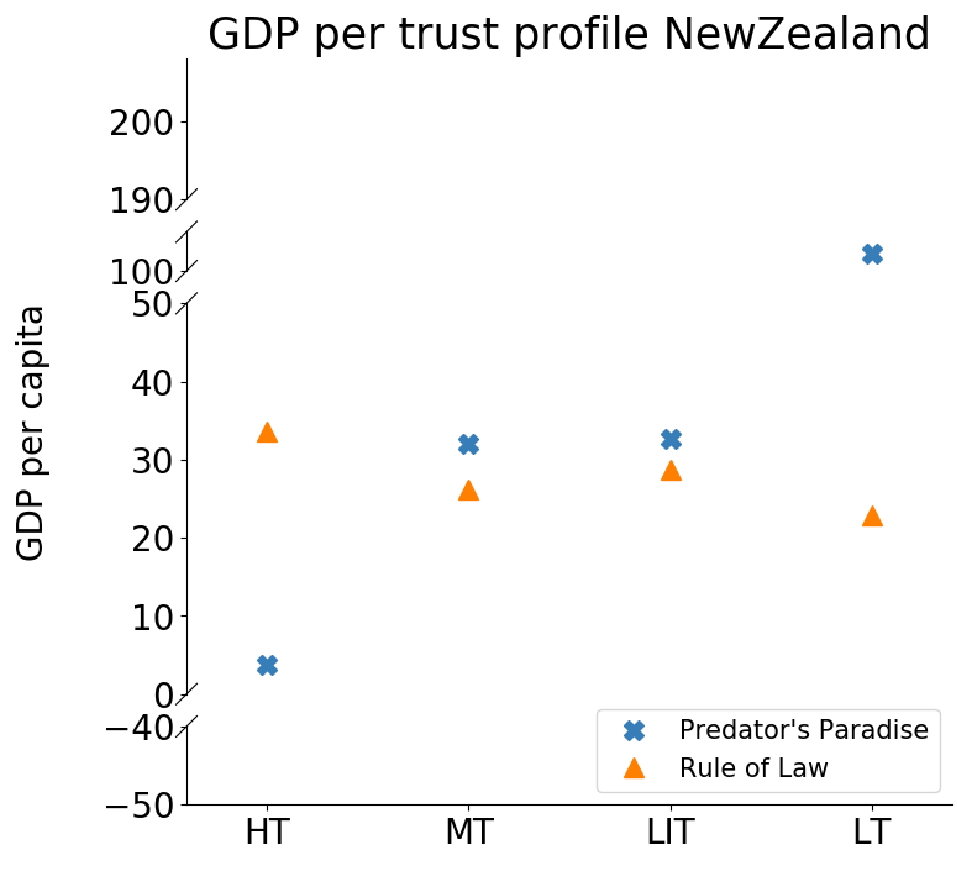 Fig 2: Comparison of GDP when controlled for interaction frequency. New Zealand's high-trust environment yields more "mutual reward" outcomes.
In contrast, in New Zealand under the Rule of Law, the HT profile actually achieved the highest per capita income. Even without "social intelligence" (the ability to remember who cheated them), being a cooperator was the winning strategy because the environment was safe enough to allow the benefits of mutual cooperation to compound.
Critical Insight: It’s the Environment, Not Just the Individual
This study offers a powerful critique of the "just be more trusting" narrative. It suggests that:
- Trust is Situational: A High Truster is an economic asset in Wellington, but a "glutton for punishment" in a society where the sucker's payoff is -10.
- Institutional Shielding: The Rule of Law isn't just about catching criminals; it's about lowering the risk of cooperation so that High Trusters don't go extinct.
- Critical Junctures: Small initial differences in the percentage of trusters can lead a society down a path of prosperity or a "predator's trap."
Conclusion
The study concludes that for developing nations like Argentina, simply increasing trust isn't enough. Without strengthening institutions (Rule of Law) to protect cooperators, any increase in trust will simply provide more "prey" for predators. For a society to grow, it must make it safe to be a "good person."
Future Work: The authors plan to introduce "Social Intelligence" to agents, allowing them to learn and remember cheaters, which may further tip the scales toward trust-based prosperity.