
Trust in the Network: Navigating Opinion Dynamics and GDM Frameworks
A review on trust propagation and opinion dynamics in social networks and group decision making frameworks
This paper provides a comprehensive review of trust propagation, reputation systems, and opinion dynamics within social networks and Group Decision Making (GDM) frameworks. It categorizes existing methodologies, including the seminal EigenTrust and Guha’s trust/distrust propagation models, and explores how these metrics are integrated into consensus-reaching processes in fuzzy GDM environments.
TL;DR
In an era of digital anonymity, how do we know who to believe? This paper reviews the evolution of Trust and Reputation Systems (TRS), moving from simple eBay-style counting to complex Opinion Dynamics and Group Decision Making (GDM). It explores how trust propagates through social "small-worlds" and how these measures can be mathematically fused to reach a group consensus even when knowledge is uncertain or malicious actors are present.
Background: The Trust Deficit in Virtual Societies
The Internet allows for interactions without prior real-world relationships. While platforms like Amazon and Airbnb use reputation to foster cooperation, the lack of strong governance makes these systems vulnerable to viruses, fake news, and malicious ratings. The authors posit that the ideal solution is a "Web of Trust"—a predictor of future behavior based on past interactions, modeled through local trust and global reputation.
Exploring the Mechanics: How Trust Flows
The paper breaks down the structural "Inductive Bias" of social networks, highlighting two critical archetypes:
- Small-World Networks: Characterized by high clustering (your friends are likely friends with each other) and short average path lengths.
- Scale-Free Networks: Dominated by a few "hubs" with massive connections, where Eigenvector Centrality (Definition 1) defines social power—you are powerful if powerful people choose you.
Methodology: Trust Propagation
How do you trust a stranger? Through Transitivity. If Agent A trusts B, and B trusts C, we can estimate A's trust in C. The authors review Guha et al.’s four types of atomic propagation:
- Direct Propagation: A → B → C.
- Co-citation: If A and B both trust C, they might trust each other.
- Transpose Trust: If A trusts B, B might have some level of trust in A.
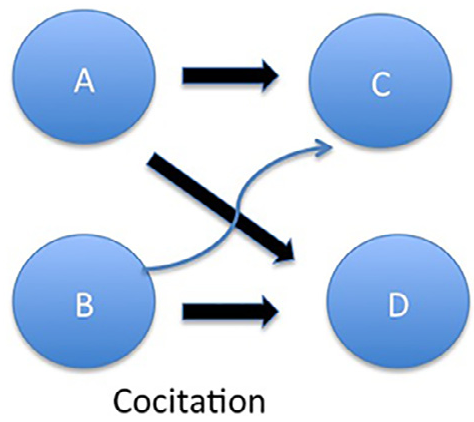
The survey delves into Guha’s Model, which uniquely accounts for distrust, using algebraic notions like "the enemy of my enemy is my friend."
From Trust to Decision: The GDM Framework
A core contribution of this review is the integration of trust into Group Decision Making (GDM). In complex scenarios (like e-health or e-democracy), experts don't just vote; they influence each other.
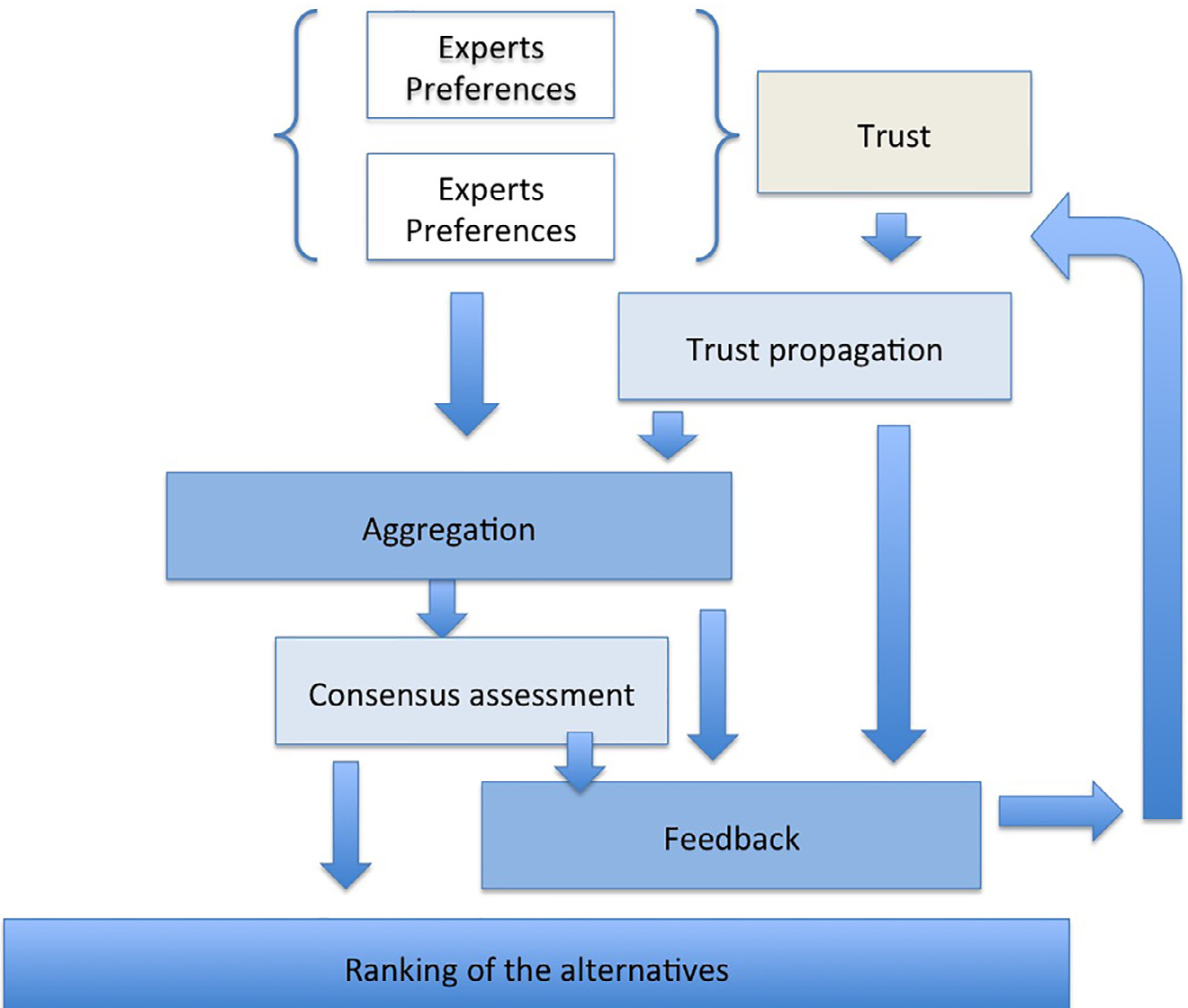
The authors outline a 4-stage GDM process:
- Preference Elicitation: Handling fuzzy, incomplete linguistic opinions.
- Opinion Aggregation: Here, trust is used to weight expertise. Higher trust equals more weight in the final pool.
- Consensus Calculation: Measuring how close the group is to an agreement.
- Feedback Loop: Suggesting changes to agents to bring them closer to the group consensus.
Opinion Dynamics: The Physics of Persuasion
The paper compares the DeGroot Model (simple weighted averaging of neighbor opinions) with the Friedkin and Johnsen (FJ) Model. The FJ model is more realistic as it accounts for an individual's "initial prejudice" or susceptibility to influence, preventing total assimilation in every interaction.
Bounded Confidence
The authors highlight Hegselmann-Krause (HK) and Deffuant-Weisbuch (DW) models, which introduce a threshold . If two users' opinions are too far apart (exceeding ), they won't influence each other at all—a mathematical explanation for the "echo chambers" observed in modern social media.
Critical Insights & Future Challenges
The review identifies several "Open Frontiers":
- Implicit Trust Extraction: We need to move beyond explicit ratings (stars) to recognizing trust patterns from behavior and social context automatically.
- Malicious Defense: Utilizing Game Theory and OWA (Ordered Weighted Averaging) operators to mitigate strategic manipulation.
- Heterogeneous Networks: Integrating trust between different profiles, such as doctors and patients in e-health, where the "relevance" of an opinion depends on the context of the relationship.
Conclusion
This survey acts as a roadmap for the next generation of social platforms. By moving from simple counts to sophisticated mathematical models like Uninorm Trust Propagation, we can build systems that are not only more secure but also more human, reflecting the nuanced shades of trust we use in the physical world.
Takeaway: Trust is the currency of the digital economy. The transition from binary trust to gradual, transitive trust based on social influence is the key to achieving consensus in a fractured digital landscape.