
Beyond the Follower Count: Human-Centric Trust Protocols in the Age of Bots
A Trust Rating Method for Information Providers over the Social Web Service: A Pragmatic Protocol for Trust among Information Explorers and Information Providers
This paper proposes a trust rating method for information providers on social web services using a meta-level communication protocol and hard evidence of ability. Moving beyond simple graph-based metrics like PersonaRank, the author introduces a "commitment network" to distinguish human expertise from automated bots and malicious actors.
TL;DR
Quantifying "trust" on social media has traditionally relied on popularity metrics similar to Google's PageRank. However, this paper argues that such methods are fundamentally flawed because they are easily gamed by bots. The author proposes a shift toward a metacommunication protocol where trust is built on explicit commitments and verified evidence of ability, applied specifically to a job-hunting ecosystem for IT engineers.
The "PersonaRank" Trap: Why Follower Counts Lie
The initial research intuition was simple: if we treat a "Follower-Followed" relationship as a recommendation, we can apply the PageRank logic. If a valuable person follows you, your value increases.
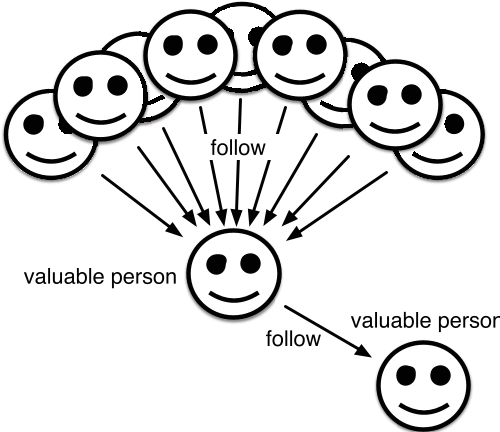
The author tested this "PersonaRank" on nearly 30,000 Twitter users. The result? The system broke. The highest "trust" scores didn't go to experts; they went to software bots. Bots are better at mimicking "lifestyle similarity" and reciprocal following than humans. This realization led to a fundamental shift: trust isn't a statistical probability; it is a social commitment.
Methodology: The Three Pillars of Real Trust
To move past the bot problem, the author defines a new protocol for trust rating that requires more than just a hyperlink.
1. Proof of Ability (Evidence-Based)
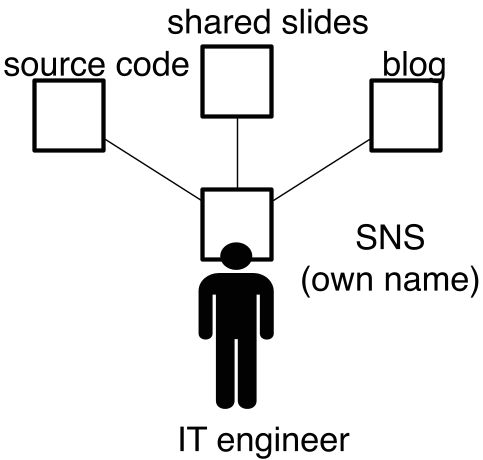
Instead of just looking at who someone follows, the system aggregates external footprints—code repositories, slide decks, and technical blogs. For an IT engineer, this "Integrated Web Content" serves as the physical proof of their competence.
2. The Meta-Communication Handshake
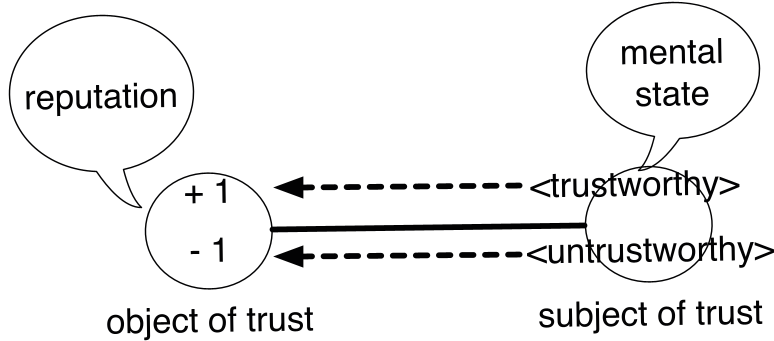
Trust requires an explicit "I will trust you" / "All right" exchange. This changes the mental state of the parties involved. In this system, reputation only flows once this commitment is established. If the object of trust fails, the subject markers them as "untrustworthy," dragging down their global reputation.
3. Structural Resistance to Herd Mentality
A major threat to reputation systems is Information Cascading—the "herd effect." If your friends say someone is good, you are likely to agree without checking. The author proposes a mathematical threshold for safety:
- The 7-Friend Rule: Information cascading is significantly reduced when evaluators have at least 7 high-quality connections.
- Minority Weighting: Giving higher value to "minority opinions" to prevent the system from becoming a popularity contest.
Experiments and Insights
The paper utilizes the IT job-hunting market as a primary case study. By turning the evaluator into a stakeholder (an employer or a peer engineer), the "motivation" to be honest is baked into the system. If an evaluator consistently recommends poor engineers, their own reputation as a "reliable judge" suffers.
Critical Analysis & Conclusion
The core contribution of this work is the rejection of "passive trust" (followers) in favor of "active trust" (commitments).
Takeaways:
- Bot-Proofing: Purely graph-based algorithms will always be gamed. Verified external evidence is the only current defense.
- Context Matters: Trust in a general sense is hard to measure; trust in a task (like coding) is measurable.
Limitations: The system relies heavily on the "Integrated Web Content" of users. In a world where AI (like GPT) can generate convincing code and blogs, even this "hard evidence" may eventually be susceptible to the same bot-driven inflation that ruined the author's first Twitter experiment. Future work must bridge the gap between AI-generated artifacts and human-verified achievements.