
Fortifying the Social IoT: A Machine Learning Approach to Defeating Advanced Trust Attacks
Trust-Related Attacks and Their Detection: A Trust Management Model for the Social IoT
This paper proposes a decentralized trust management model for the Social Internet of Things (SIoT) utilizing an incremental Support Vector Machine (iSVM). The method incorporates social relationship factors and dynamic behavior scores to achieve state-of-the-art (SOTA) detection across a comprehensive taxonomy of trust-related attacks.
TL;DR
As the Internet of Things (IoT) evolves into the Social Internet of Things (SIoT), devices now form autonomous relationships to trade services. However, this "social" autonomy opens the door to sophisticated trust-related attacks. This paper introduces a decentralized trust model powered by incremental Support Vector Machines (iSVM). By tracking behavioral constellations—Goodness, Usefulness, and Perseverance—the model can sniff out even the most "strategic" attackers who try to game the system by acting good just long enough to stay under the radar.
The "Social" Vulnerability: Why Current Models Fail
In a SIoT environment, "things" aren't just passive sensors; they are agents. They can be friends (owned by the same person), coworkers (located in the same office), or acquaintances. Conventional security focuses on encryption, but trust management focuses on behavior.
The problem? Most existing trust models are "sitting ducks" for smart attackers. If a model only looks at average ratings, an attacker can perform an On-Off Attack (behaving well to build credit, then attacking). If a model relies too heavily on "friends' opinions," it falls prey to Ballot Stuffing (colluding nodes lying to boost each other).
The authors argue that a robust model must be subjective (every node decides for itself) and dynamic (capable of learning shifts in behavior in real-time).
Methodology: The iSVM Engine
The core innovation is the Dynamic Knowledge () parameter. While initial trust is built on social ties (like "Parental" or "Ownership" relationships) and computational profiles, the long-term evaluation is handled by an incremental SVM.
The Three Behavioral Pillars
To feed the iSVM, the authors defined three distinct scores that capture the "temporal physics" of trust:
- Goodness Score: A long-term tally of successful vs. failed interactions.
- Usefulness Score: A short-term window () using a geometric distribution to give more weight to the very latest transactions.
- Perseverance Score: A "loyalty" metric that rewards or punishes consecutive behavior. This is the "kryptonite" for On-Off attackers.
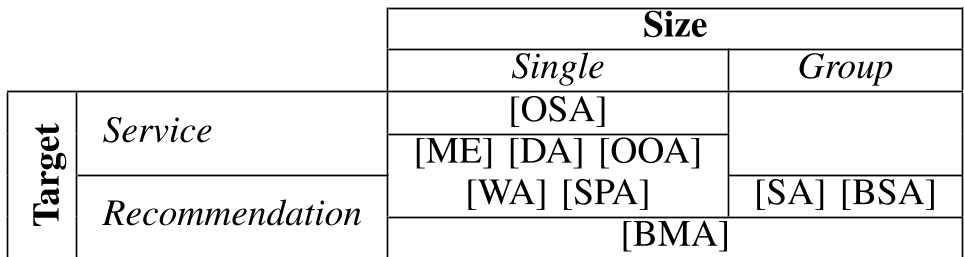 Table 1: Classification of trust-related attacks by target (Service vs. Recommendation) and size (Single vs. Group).
By using an incremental SVM, nodes don't need massive server-grade hardware to update their internal "trust maps." They can update their intelligence with every new feedback loop.
Experimental Results: Slaying the "Smart" Attacker
The researchers tested their model against two industry benchmarks (Nitti et al. and Chen et al.) using a real-world dataset from Santander, Spain.
Rapid Detection
In On-Off Attacks, the proposed model was the fastest to react. It recognized a benevolent node turning malicious in just 3 transactions, whereas legacy models took 5 and ended up with "uncertain" trust values (around 0.5). Our iSVM pushed the malicious node's trust down to 0.09, effectively blacklisting it.
Mixed Attack Resilience
In a "chaos scenario" where 30% of the network consisted of a mix of all known attacks (Malicious with Everyone, Discriminatory, On-Off, etc.), the proposed model maintained a 95% transaction success rate.
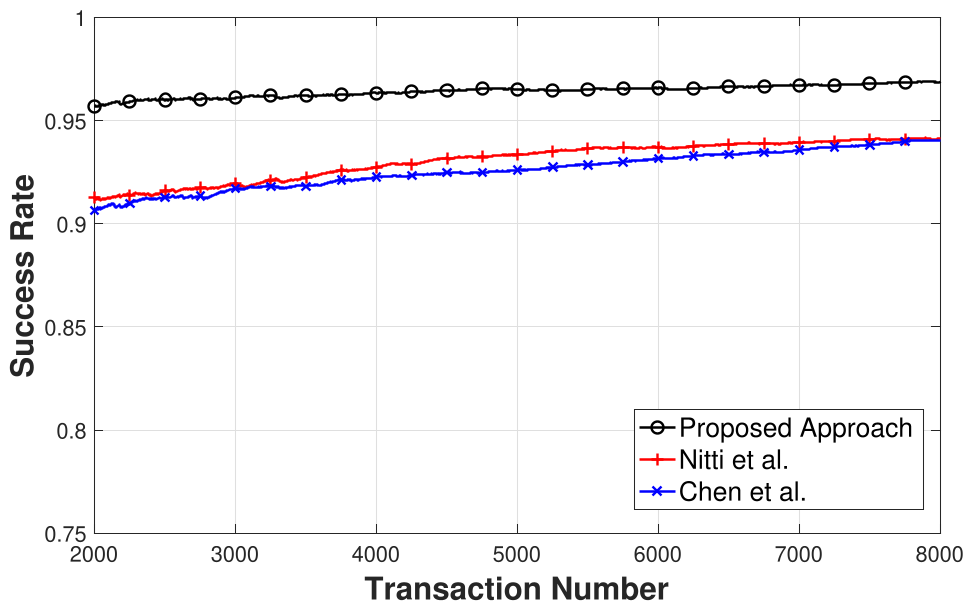 Figure 8: The proposed model (top line) converges faster and maintains higher success rates than SOTA baselines in a heterogeneous attack environment.
Critical Insight & Conclusion
The standout takeaway is the Perseverance Score. In many IoT models, a 50% success rate looks the same regardless of the pattern. However, the iSVM distinguishes between a "flaky" benevolent node (random errors) and an "intentional" On-Off attacker (consecutive malicious bursts).
Limitations: The model does require a "training phase" () where it relies on social relationships and external opinions. During these first few transactions, the system is slightly more vulnerable than legacy models, but this is a deliberate trade-off for significantly higher steady-state security.
For future IoT deployments, this research suggests that the history of behavior is just as important as the identity of the device. In the Social IoT, trust isn't just given; it's earned, tracked, and—if necessary—swiftly revoked.