
Modeling the "Word-of-Mouth": A Graphical Approach to Trust in E-Commerce
Trust Relationship Modelling in E-commerce-Based Social Network
This paper proposes a graphical representation approach to model and reconstruct trust relationships in multi-agent e-commerce social networks. By leveraging "trust commonsense" from the physical world, it formalizes trust transitivity and introduces a network graph (G) to evaluate seller trustworthiness via referral chains.
TL;DR
In the anonymous world of e-commerce, how can a buyer trust a stranger? This paper introduces a formal graphical representation method that mirrors human social networks. By treating trust as a transitive property—if A trusts B and B trusts C, then A can derive trust in C—the authors provide a framework to map and reconstruct complex trust networks in multi-agent environments.
Context & Motivation: The Virtual Trust Gap
In physical markets, trust is built through face-to-face interactions or long-standing reputations. In virtual e-marketplaces, agents (acting for humans) enter and exit freely. This "blind and boundless" nature creates a breeding ground for dishonest sellers.
The authors argue that current solutions are either too abstract (like the Solar Trust Model) or too rigid (like UML diagrams). They propose that the solution lies in reconstructing the social grapevine digitally.
Methodology: The Anatomy of Trust
The paper breaks down the "trust ecosystem" into specific mathematical entities and flow types to provide a unified language for trust modeling.
1. Entity Classification
- Source (s): The buyer evaluating trust.
- Target (t): The seller being evaluated.
- Mediate Agents (m): The "middlemen" who provide referrals. These are further categorized into Direct Trust Agents (who know the seller) and Referral Trust Agents (who know someone who knows the seller).
2. Trust Flow Architectures
Trust doesn't just move in a straight line. The paper identifies three fundamental patterns:
- Serial: A simple chain of recommendations.
- Parallel: Multiple independent sources recommending the same seller.
- Compound: A complex web of overlapping serial and parallel referrals.
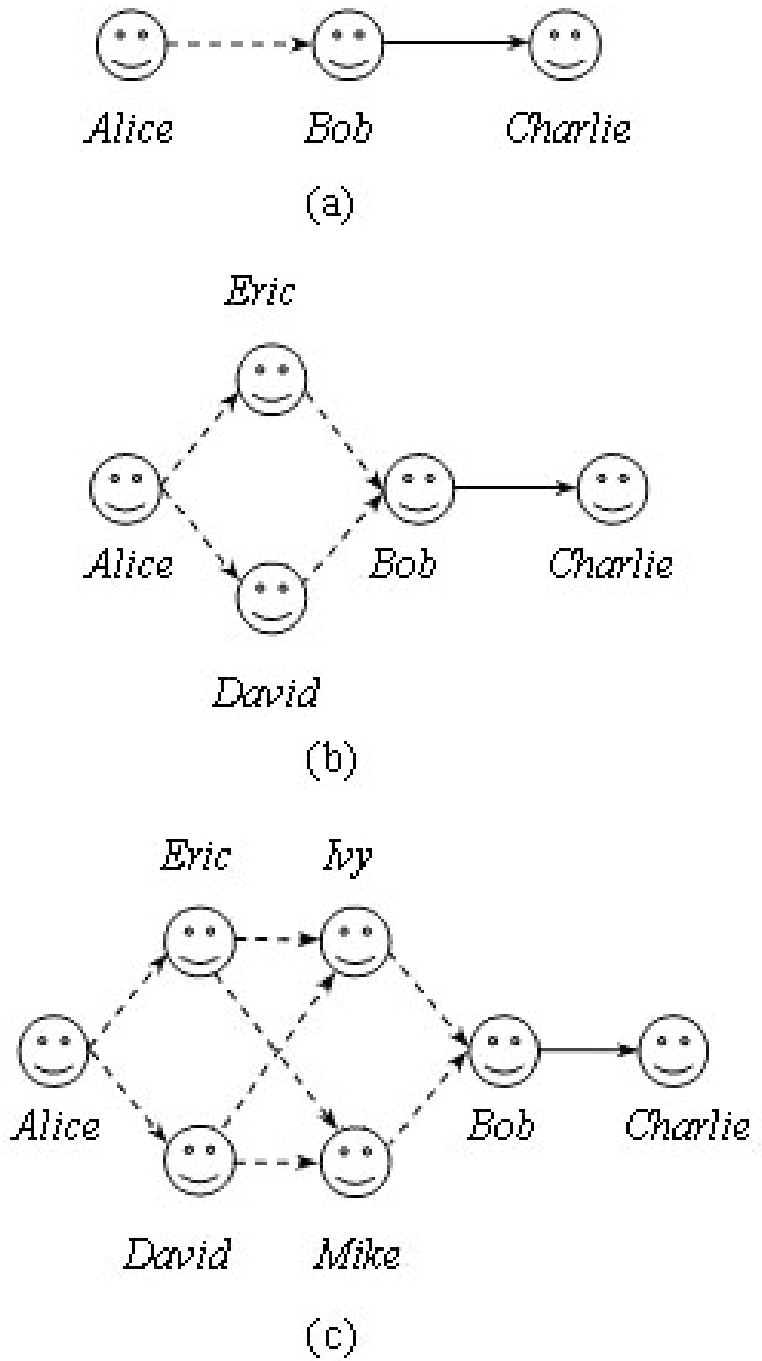 Figure 1: Comparison of Serial, Parallel, and Compound trust transitivity flows.
Graph Reconstruction & Logic
The core innovation is the transition from a simple list of reviews to a connected graph (G).
- Nodes: Represent agents.
- Edges: Represent direct relationships (Solid lines for transaction experience, broken lines for existing social trust).
The paper defines Path Distance and Accessibility as the primary metrics. For instance, a shorter path distance () typically suggests a more reliable trust derivation because there are fewer "links" where information could be distorted.
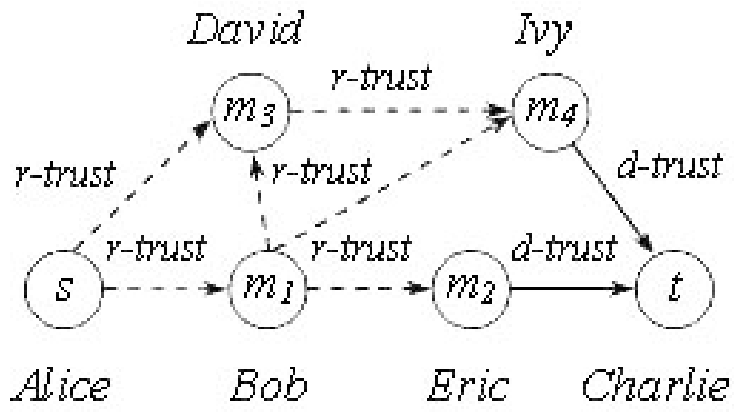 Figure 2: A reconstructed compound trust network showing multiple referral paths between Alice (Source) and Charlie (Target).
Deep Insight: Why This Works
The brilliance of this model is its grounding in Social Network Analysis (SNA). By utilizing the "shortest path" logic, the model inherently prioritizes the most direct "word-of-mouth" evidence. Furthermore, the ability to model Parallel Trust means the system can increase its confidence level—much like a human feels more secure when three different friends recommend the same mechanic.
Critical Analysis & Future Outlook
While the paper provides a robust structural framework, it leaves some "heavy lifting" for future work:
- Trust Decay: Does trust weaken as the path gets longer? (The distance metric is defined, but the "decay" logic is not fully explored).
- Conflict Resolution: How does the system handle a situation where one path says "Trust" and another says "Distrust"? The authors acknowledge this as a limitation to be addressed in subsequent research.
- Automation: Currently, these graphs are largely conceptual or manually constructed. Moving toward an automated, mobile-agent-based system is the next logical step for real-time e-commerce.
Conclusion
This work bridges the gap between sociology and computer science. By formalizing the way humans naturally trade recommendations, it lays the groundwork for a safer, more transparent virtual marketplace where "reputation" is a quantifiable, navigable map rather than a nebulous star rating.