
TSA-Clustering: Bridging the Gap Between Trust and Logic in Large-Scale Decision Making
A trust-similarity analysis-based clustering method for large-scale group decision-making under a social network
This paper proposes a Trust-Similarity Analysis (TSA)-based clustering method for Large-Scale Group Decision-Making (LSGDM) within social networks. It integrates two distinct attributes—opinion similarity and trust relationships—into a unified framework using a trust-similarity matrix and visual TSA plots to partition large groups into manageable subgroups.
Executive Summary
TL;DR: This paper introduces a novel clustering framework called Trust-Similarity Analysis (TSA) designed for Large-Scale Group Decision-Making (LSGDM). By mapping decision-makers (DMs) onto a 2D plane of "Trust" and "Similarity," the method moves beyond simple distance-based clustering. It allows decision-makers to be grouped not just because they think alike, but because they trust each other enough to reach a consensus efficiently.
Academic Positioning: This work fills a critical gap in Decision Science by merging Social Network Analysis (SNA) with traditional clustering. It is a methodological evolution that addresses the multi-dimensionality of human interaction in digital social contexts.
The Core Friction: Why "Same Opinion" Isn't Enough
In traditional Large-Scale Group Decision-Making (LSGDM), we usually group people based on Opinion Similarity. If Person A and Person B both rate a project 8/10, they go in the same bucket.
However, the authors argue this is insufficient in the era of social networks. If Person A and Person B have similar scores but distrust each other, their subgroup will likely collapse during the consensus-reaching phase. Conversely, two people with slightly different opinions but high mutual trust are far more likely to compromise and find a middle ground.
The Challenge: How do we mathematically balance these two often-contradictory attributes?
Methodology: The Trust-Similarity Analysis (TSA)
The authors propose a two-stage workflow to resolve this friction.
1. The Trust-Similarity Matrix
Instead of a single value, every pair of DMs is assigned a Trust-Similarity Function (TSF) tuple: , where is the trust score and is the similarity degree (derived from Euclidean distance).
2. The TSA Plot & Joint Threshold
This is the "Physical Intuition" of the paper. By plotting every relationship on a 2D graph, the authors define four quadrants:
- Q1 (Ideal Area): High Trust + High Similarity.
- Q2 (Similarity-priority): Low Trust + High Similarity.
- Q4 (Trust-priority): High Trust + Low Similarity.
To decide who gets clustered, they introduce the Joint Threshold (JT) Arc.
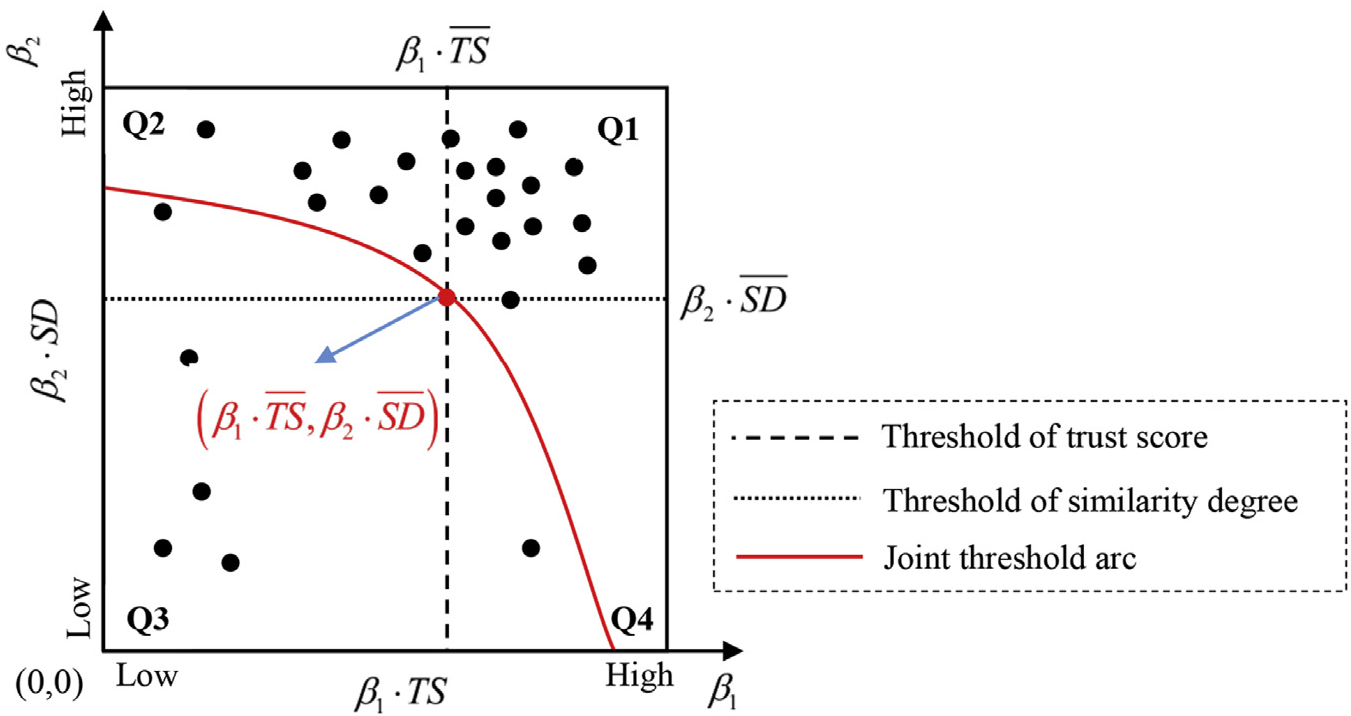 Fig 1: The Joint Threshold Arc act as a dynamic filter, allowing DMs to be clustered if their combined "Closeness" (a weighted quadratic mean) exceeds the arc's radius.
Algorithmic Flexibility
The paper doesn't offer a "one-size-fits-all" solution. Instead, it provides four algorithms based on the "Strictness" of the Joint Threshold:
- Basic JT: Only the combined "Closeness" matters.
- Trust-priority JT: Closeness must be high, AND trust must exceed a specific floor.
- Similarity-priority JT: Closeness must be high, AND similarity must exceed a floor.
- Strong JT: Both trust and similarity must independently be high (The most restrictive).
Experimental Insights: Trust vs. Time
The paper includes a robust simulation comparing TSA to K-means and other SOTA methods.
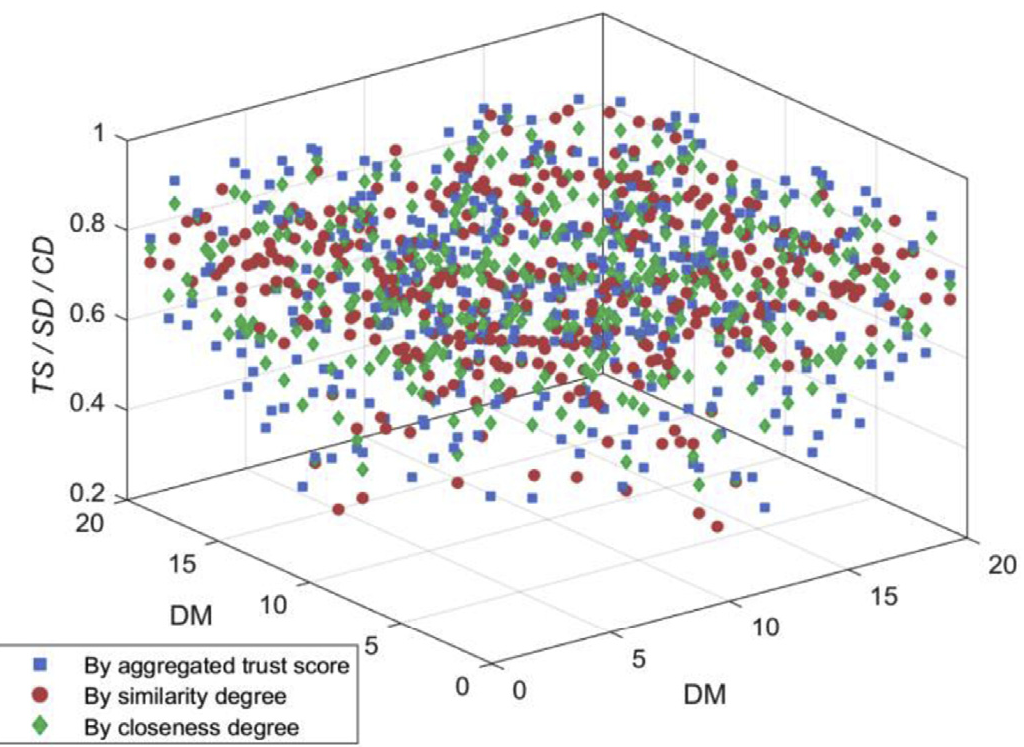 Fig 2: Distribution of results using different measurement attributes, showing how TSA provides a more nuanced partitioning than single-attribute methods.
Key Takeaway on Strategy:
- Time-Critical? Give more weight to Trust (). High trust allows for faster "leader-follower" dynamics, cutting down on endless deliberation rounds.
- Conflict of Interest? Give more weight to Similarity (). In sensitive public policy cases, trust might actually represent "collusion" or "alliances." High similarity ensures the group is actually logically aligned.
Critical Analysis & Future Outlook
Strengths: The method is highly visual and intuitive. By using the UTWA (Uninorm Trust Weighted Average) operator, it handles the inherent asymmetry of trust (I might trust you, but you might not trust me) elegantly.
Limitations:
- Computational Complexity: The "Strong JT" algorithm has a time complexity of , which is prohibitively expensive for truly "Large-Scale" groups (e.g., thousands of DMs).
- Cold Start: For new social networks where trust data is "sparse" or "zeroed," the model essentially reverts to traditional similarity clustering.
The Road Ahead: As we move toward AI-assisted governance, the ability to cluster human agents based on "Relational Logic" (Trust) rather than just "Data Logic" (Similarity) will be essential for building stable, consensus-driven systems.