
Trust Traversal: Navigating the Reliability Maze in Massive Social Networks
Trust Traversal: A trust link detection scheme in social network
This paper introduces "Trust Traversal," a novel trust link detection scheme designed to identify reliable and close relationships in large-scale social networks. By integrating subjective trust, objective reputation, and a probabilistic traversal mechanism, the method successfully classifies links into strong, weak, or untrusted categories with high accuracy.
TL;DR
In the era of information overload and malicious bots, knowing who to trust is a computational nightmare. This paper presents Trust Traversal, a scheme that identifies "strong trust links" by simulating how humans naturally navigate social circles—relying on local reputations and interaction history rather than global maps. It provides a robust framework to filter out frauds while maintaining high inference efficiency.
The Core Challenge: Knowledge vs. Scale
Traditional trust evaluation (like EigenTrust) assumes we can see the whole graph. But in a social network with millions of nodes, calculating global trust is too slow. Moreover, "Trust" isn't a binary 0 or 1; it captures the nuance of reliability (objective reputation) and closeness (subjective intimacy). Existing SOTA models often fail to distinguish between a celebrity everyone follows and a close friend you actually trust.
Methodology: The Three Pillars of Trust
The authors break down their solution into three distinct modules:
1. The Reputation Model (Objective)
Reputation is defined as collective objective trust. The paper innovates by adding:
- Time Attenuation: Older interactions matter less.
- Effective Accumulation: Feedback from a high-reputation user carries more weight (using a "qualification" factor).
- Community Factor: Trust is often topic-specific.
2. The Link Category (Nature of Connection)
Links are classified based on Mutual Trust and Interaction Activity.
- Strong Link (): High mutual trust and frequent interaction.
- Weak Link (): One-way trust or infrequent interaction.
- Untrusted Link (): Mutual mistrust or high risk.
3. The Traversal Scheme (Discovery)
Instead of brute-force searching, the algorithm uses a "Random Walk" variant. It moves from node to node based on Trust-based Probability.
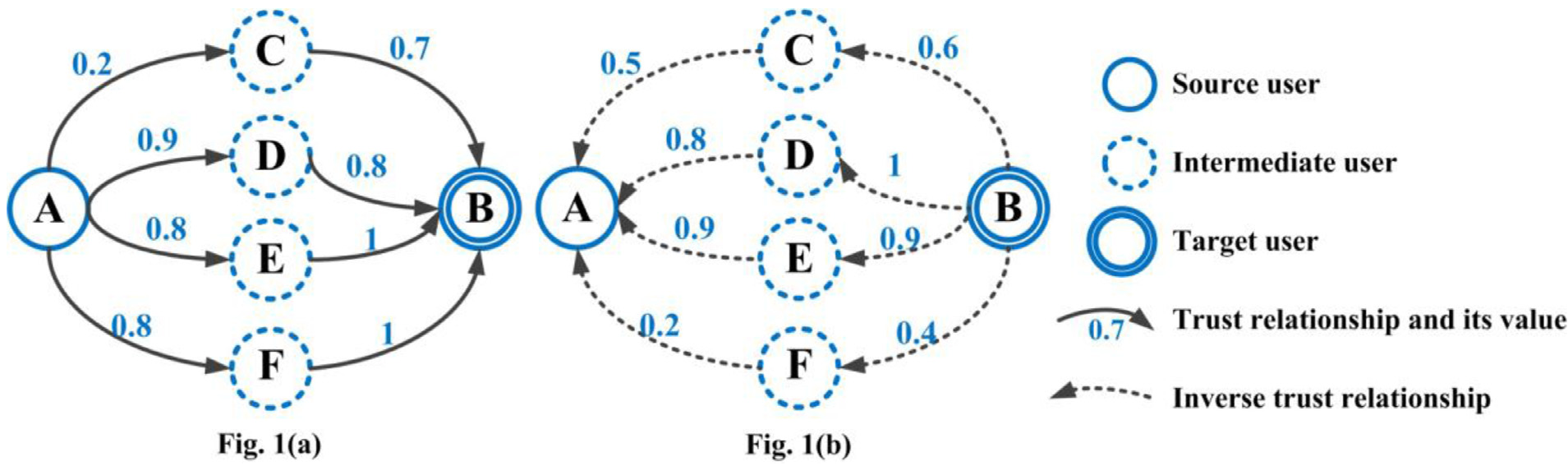 The figure illustrates how a traversal path chooses the next hop based on the local trust schema, effectively pruning untrusted nodes early.
Why it Works: Mathematical Intuition
The "Secret Sauce" lies in the Indirect Link Calculation. The authors introduce a level attenuation rule: . This reflects the physical intuition that trust weakens as the chain grows longer. By combining this with a reputation-weighted transitivity rule, the model ensures that the "noise" of long-distance strangers doesn't pollute the reliability of the link.
Experimental Proof: Sina Micro-blog Analysis
The researchers tested their prototype on real-world data from Sina (China's largest micro-blogging site), featuring over 170,000 interaction records.
Performance vs. Baseline
Compared to classic methods like EigenRep (ER) and Average Judgment (AJ), the Trust Traversal Scheme (STTS) provided significantly higher accuracy in identifying trolls and malicious users.
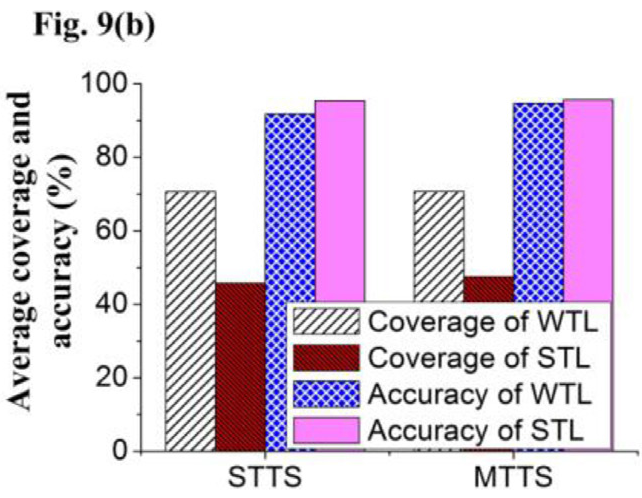 As seen in the graphs, STTS maintains a high coverage rate (finding most trustable friends) while keeping the error rate (identifying a fraud as a friend) below 1%.
Critical Insight: The Value of "Partial" Information
The most striking takeaway is that global topology is unnecessary. By relying only on the "origins" and "neighbors," Trust Traversal mimics human social intelligence. This local-only approach reduces computation from exponential complexity to a relatively linear cost (averaging only 238 steps per target in a large graph).
Limitations & Future Outlook
While highly effective, the model relies on pre-defined thresholds () for link classification, which may need tuning for different platforms (e.g., LinkedIn vs. Twitter). For future work, the authors look toward Auto-clustering communities to make the trust evaluation even more topic-aware.
Final Takeaway
Trust Traversal bridges the gap between massive social graphs and the human need for authentic connection. For developers building recommendation engines or security layers, this probabilistic, local-first approach is the new blueprint for high-performance trust.