
Trust2Privacy: Reshaping Access Control in Mobile Social Networks via Fuzzy Trust
15111_Trust2Privacy A Novel Fuzzy Trust-to-Privacy Mechanism for Mobile Social Networks.
The paper introduces Trust2Privacy, a trust-based access control mechanism for Mobile Social Networks (MSNs) that provides personalized privacy protection post-information publication. It leverages a multi-dimensional fuzzy trust evaluation model integrating online interactions and offline location semantics to achieve fine-grained privacy levels.
TL;DR
Mobile Social Networks (MSNs) often leave users vulnerable once information is posted. Trust2Privacy is a novel framework that transforms the fuzzy concept of "trust" into a concrete privacy shield. By analyzing both online behaviors and offline location patterns, it assigns a dynamic trust level to requesters, ensuring that only those with a high-fidelity relationship can access sensitive shared content.
The "Post-Posting" Vulnerability Gap
In current platforms like Facebook or Twitter, privacy is a "set-and-forget" permission. Once you click "Post," you lose control over who the algorithm recommends your content to. In the high-mobility world of MSNs, this is dangerous. A user might be physically close to you (offline) but be a total stranger or malicious actor (online). Existing models fail because they don't account for the asymmetry of trust (I follow you, but you don't follow me) and the fuzziness of human relationships—where is the line between a "friend" and an "acquaintance"?
Methodology: The Architecture of Trust
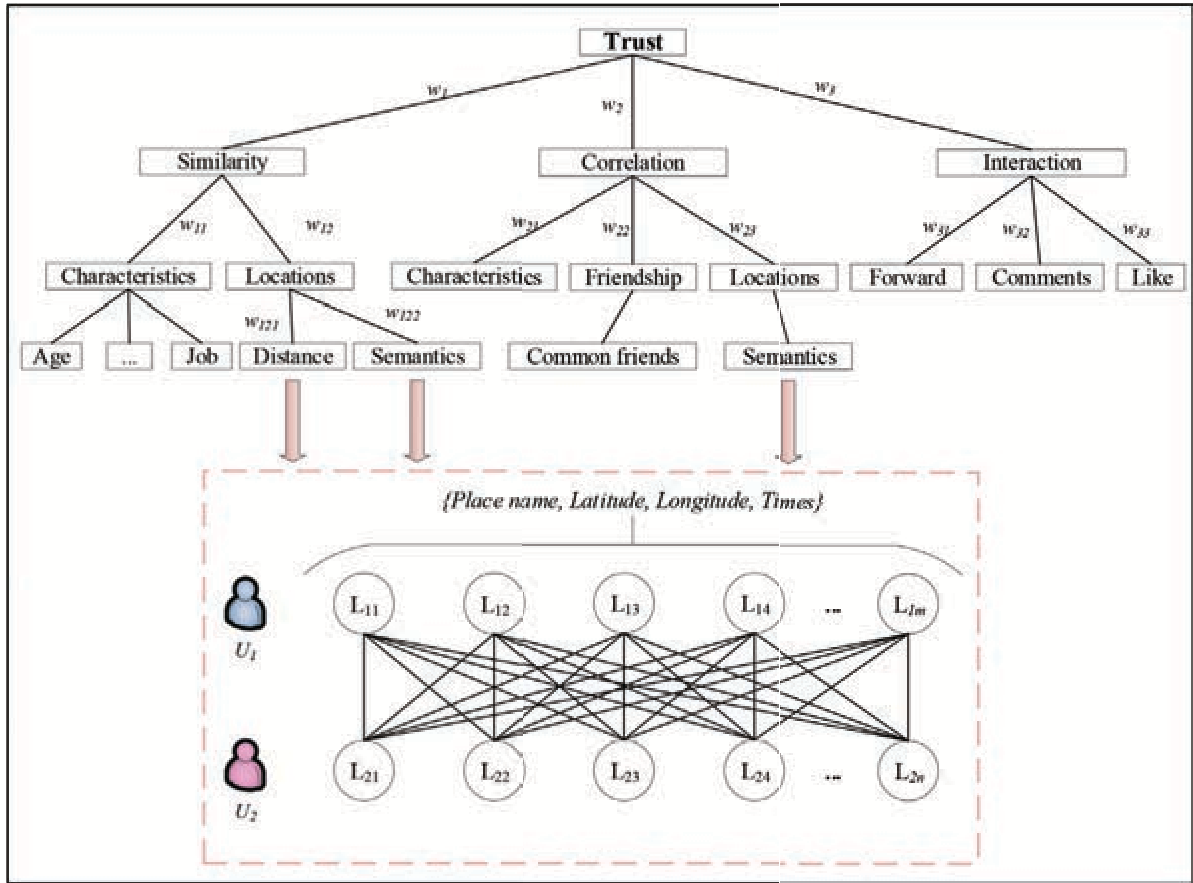
The Trust2Privacy mechanism operates on a multi-dimensional feature tree, moving away from simple numerical thresholds to a more nuanced Fuzzy Comprehensive Evaluation.
1. Multi-Dimensional Feature Extraction
The model looks at four core pillars to determine trust:
- Similarity: NLP skip-gram algorithms map attributes like profession and age into vector spaces to find common ground.
- Correlation: Analyzing mutual friend networks and shared interests.
- Interaction: Real-time updates based on likes, comments, and shares to ensure trust isn't stale.
- Offline Social Circle: This is a key innovation. It analyzes location logs (latitude, longitude, and place names) to determine if two users share the same "vibe" or social habits (e.g., both frequenting Japanese restaurants) rather than just being physically close.
2. Trust-to-Privacy Mapping
Instead of a "Yes/No" access gate, Trust2Privacy implements a Fuzzy Mapping. If the fuzzy trust evaluation returns "High," the user might access Level 3 (Private) info; if "Medium," they might only see Level 1 (General) info. This is enforced via cryptographic keys managed by Local Service Providers (LSPs).
Experimental Results: Why Distance Isn't Enough
Using the Weeplaces dataset, the authors proved that "proximity" is a poor proxy for trust.
- Semantics vs. Distance: Many users are physically close but have zero semantic correlation.
- By incorporating location semantics, the system filtered out "accidental neighbors" and prioritized "true potential friends" who shared social habits.
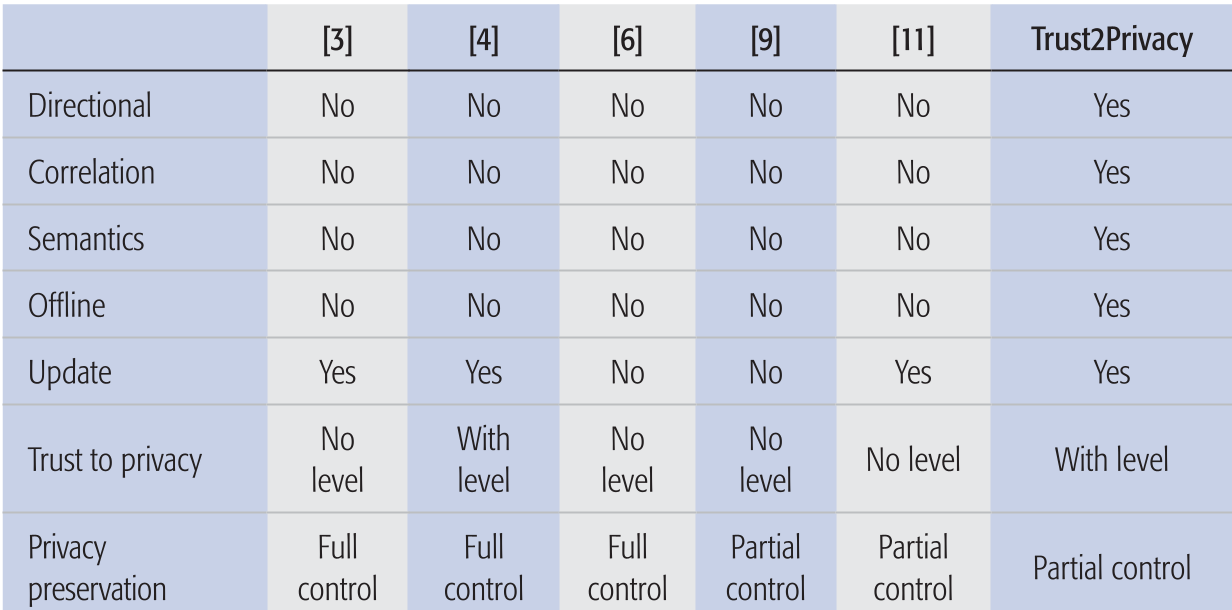
The table above highlights that Trust2Privacy is the only mechanism that concurrently addresses directionality, semantics, and offline updates while maintaining flexible privacy levels.
Critical Insight & Conclusion
The genius of this work lies in its recognition that trust is not a scalar value; it is a vector. By utilizing fuzzy logic, the authors bridge the gap between hard system permissions and soft human relationships.
Limitations: The reliance on a "Trusted Service Provider" to manage keys remains a centralized bottleneck. Future iterations could benefit from Decentralized Identifiers (DIDs) or blockchain-based key management to truly put the user in control without relying on a third party.
Future Outlook: As we move toward the Metaverse and more immersive MSNs, the integration of "Online-to-Offline" trust evidence will be the cornerstone of authentic and secure digital interaction.