
TDAL: Revolutionizing Emotion Recognition with Trust-Aware Crowdsourcing
Trustability-Based Dynamic Active Learning for Crowdsourced Labelling of Emotional Audio Data
This paper introduces Trustability-based Dynamic Active Learning (TDAL), a novel framework for emotional audio annotation that integrates an annotator trustability score into a dynamic active learning pipeline. By combining crowdsourcing via the gamified platform iHEARu-PLAY with adaptive query strategies, the method achieves SOTA performance on the FAU Aibo Emotion Corpus, surpassing the INTERSPEECH 2009 challenge winners.
TL;DR
Building high-quality emotional audio datasets is notoriously difficult due to the subjectivity of the task and the high cost of expert labor. This paper introduces Trustability-based Dynamic Active Learning (TDAL), an intelligent system that filters out "noisy" crowdworkers and dynamically decides when a sample has enough reliable labels. The result? A 90.5% reduction in annotation costs and a performance boost that beats previous world-record benchmarks on the FAU Aibo Emotion dataset.
The Core Conflict: Quality vs. Scale
In the world of Affective Computing, supervised learning is only as good as its labels. While we have "Big Data," we lack "Big Labels." Standard solutions usually involve one of two paths:
- Passive Learning (PL): Randomly label everything (Incredibly expensive).
- Crowdsourcing: Get cheap internet labor (High risk of "noise" and spammers).
- Active Learning (AL): Only label samples the model is "confused" about (Efficient in volume, but assumes all workers are equally good).
The authors identify a critical gap: Existing Active Learning algorithms are "worker-blind." They don't account for the fact that some annotators are inherently more reliable than others.
Methodology: The Trustability Secret Sauce
The brilliance of TDAL lies in how it quantifies human reliability into a mathematical score (). This score isn't just a badge; it's a weight used in the training loop.
1. Calculating Trustability
The system tracks three pillars:
- Consistency (): Does the user give the same label when shown the same audio clip twice?
- Accuracy (): How much does the user's label deviate from the majority of other users?
- Control (): Does the user fall for "trap" questions?
2. Dynamic Stopping (The Efficiency Engine)
Traditional systems might ask 5 people to label a clip to get a majority vote. TDAL is smarter. It asks for labels until the sum of the trustability scores of the agreeing users hits a threshold (). If a "Super User" with a perfect score labels it, the system might stop after just one vote. If a new, untested user labels it, the system asks for more.
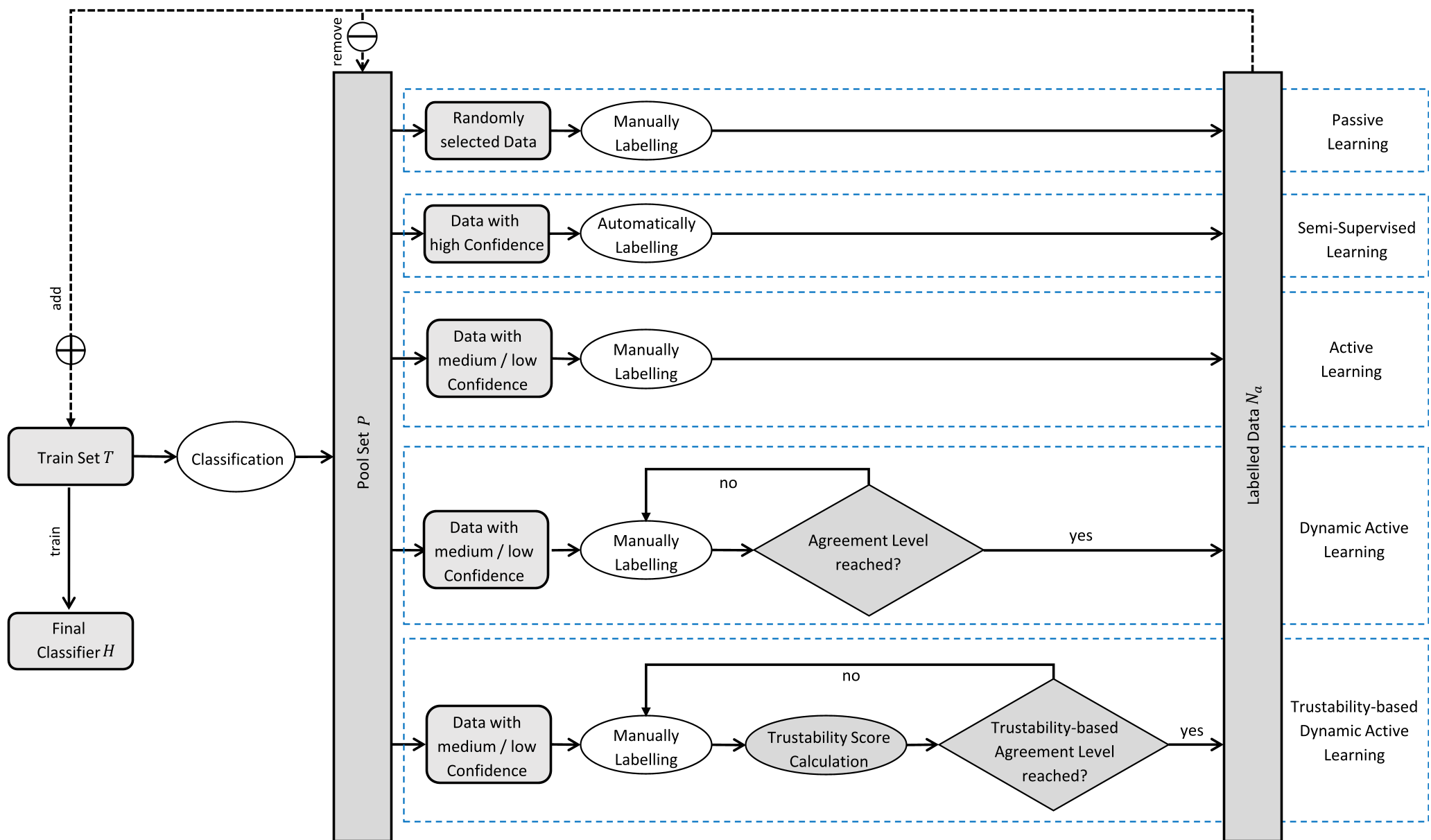 Figure 1: The TDAL workflow integrating the iHEARu-PLAY platform, Trustability calculations, and the SVM training loop.
Experimental Showdown: Results that Matter
The researchers tested TDAL on the FAU Aibo Emotion Corpus (recordings of children interacting with a robot). They compared it against Passive Learning and standard Dynamic Active Learning.
- Performance Spike: TDAL reached a peak 73.71% Unweighted Average Recall (UAR). For context, the winner of the INTERSPEECH 2009 Emotion Challenge only achieved 70.29%.
- The "90% Discount": On pure Active Learning tasks, TDAL achieved its best results while requiring only 4,549 annotations, compared to the 48,265 required by the baseline—a cost saving of over 90%.
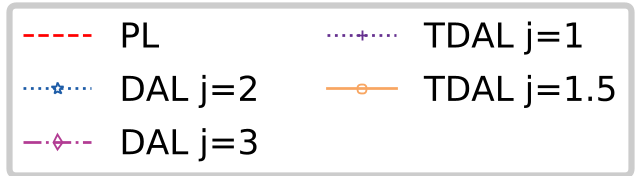 Figure 2: Comparison of learning curves. Notice how the TDAL curves (j=1, j=1.5) achieve high UAR much faster (with fewer annotations) than the Passive Learning baseline.
Critical Insight: Why This Works
TDAL succeeds because it treats uncertainty at two levels:
- Model Uncertainty: Choosing the right samples to label (Active Learning).
- Annotator Uncertainty: Choosing the right labels from the right people (Trustability score).
By joining these two, the model avoids the "garbage in, garbage out" trap of standard crowdsourcing. It essentially "hires" the best workers for the hardest tasks and trusts them to finish quickly.
Conclusion & Future Horizon
The paper proves that we don't need expert labs to build high-performing emotion AI; we just need smarter algorithms to manage the "crowd." While this study utilized SVMs and a specific audio dataset, the logic of Trustability-based Dynamic Active Learning is highly portable. It could easily be adapted for Large Language Model (LLM) Reinforcement Learning from Human Feedback (RLHF), where worker quality is currently a major bottleneck for companies like OpenAI and Anthropic.
Final Takeaway: To scale AI, we must stop treating all human feedback as equal. Trust is a metric, and TDAL shows us how to calculate it.