
Trustable Service Rating: Shielding Social Consensus via Peer Prediction
Trustable service rating in social networks: A peer prediction method
This paper introduces a private-prior peer prediction (PPP) mechanism to ensure trustable service ratings in social networks. By leveraging strictly proper scoring rules and a novel "unreliability index," the system filters out malicious reports and low-quality feedback to achieve highly accurate service evaluations.
TL;DR
Trusting online service ratings is difficult due to "trash-in, trash-out" data caused by malicious shills or incompetent reviewers. This paper proposes a Private-Prior Peer Prediction (PPP) system that uses game theory to incentivize truth-telling and introduces an Unreliability Index to filter out uncertain reports, ensuring that only high-quality consensus forms the final service rating.
Background: The Cost of Dishonesty
In modern social networks, we rely on collective feedback to choose services (like payment gateways or e-commerce). However, current rating systems face two major threats:
- Malicious Users: Strategic actors who intentionally report false data to manipulate ratings.
- Unreliable Users: Well-meaning users who simply have high "judgement error" rates (e.g., mistaking a high-quality service for a low one).
Standard reputation systems often fail because they lack an incentive compatibility mechanism—there is no inherent cost to lying when the "ground truth" isn't immediately verifiable.
Methodology: The Power of Peer Prediction
The core innovation lies in treating the rating process as a game of prediction. Instead of just asking "Is this service good?", the system asks users to predict what others will say.
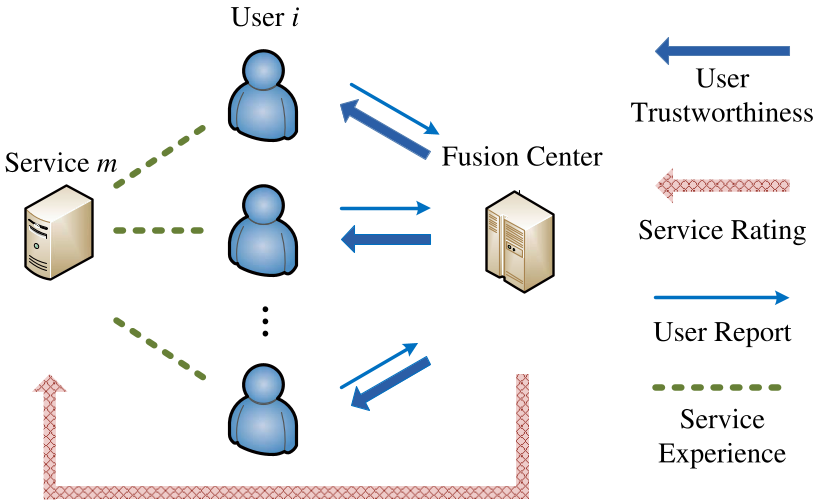
1. The Reporting Flow
- Prior Belief (): Before using the service, User reports the probability that their Peer will rate the service as "high quality."
- Posterior Belief (): After experiencing the service, User updates this probability based on their actual experience.
- Inferred Opinion: The Fusion Center (FC) compares these two reports. If , it infers the user saw a "high quality" signal.
2. Trustworthiness Scoring
The system employs a Strictly Proper Scoring Rule, specifically the Quadratic Scoring Rule. This ensures that a user's expected score is maximized if and only if they report their true beliefs.
3. The Unreliability Index
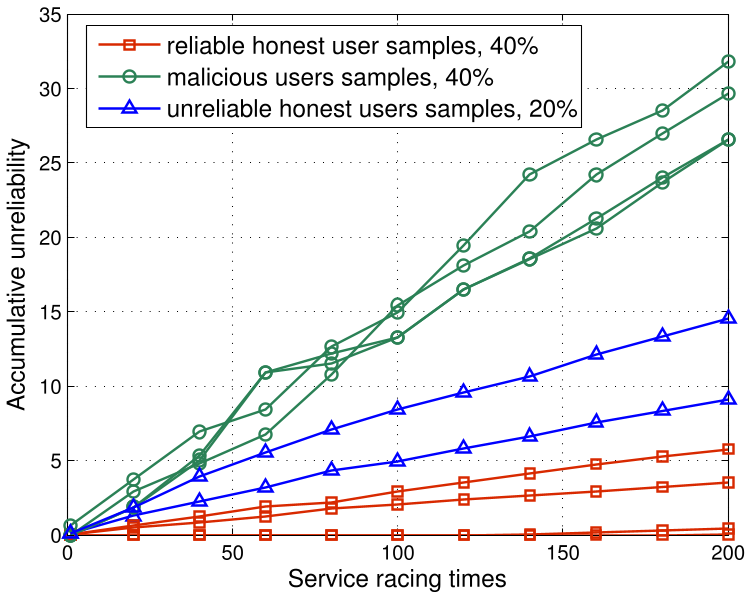
To bridge the gap between "liars" and "honest but confused" users, the authors introduce the Unreliability Index (). Malicious users typically try to minimize their score loss by reporting very small differences between and . The index captures this uncertainty; if the reports are too close or inconsistent, the user is flagged as unreliable.
Experimental Validation
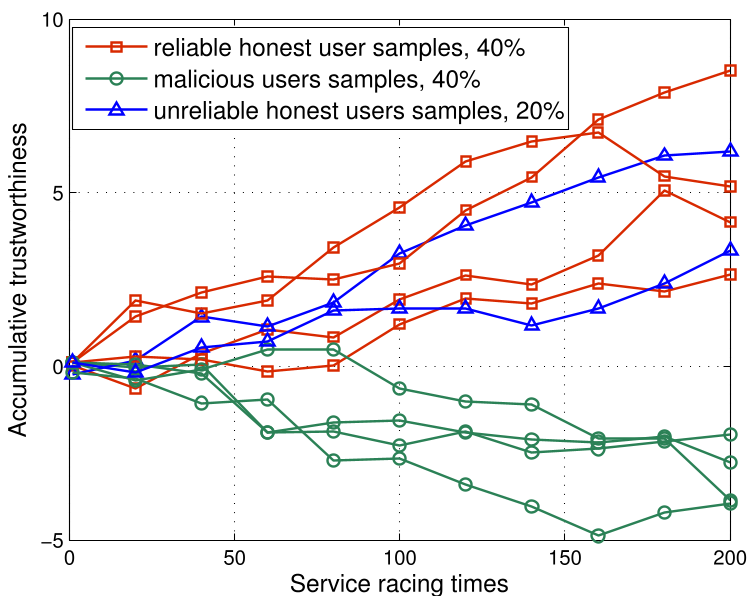
The researchers simulated a network of 1,000 users with a high presence of malicious actors (40%).
Identifying Divergent Behaviors
The results show a clear divergence over time. Reliable honest users see their accumulative trustworthiness grow linearly, while malicious users' scores drop into the negative.
Crucially, the Unreliability Index (Fig. 3) successfully catches "unreliable honest users" (those with high error rates) even when their trustworthiness remains relatively high. This allows the Fusion Center to purge noisy data without necessarily labeling the user as "evil."
Deep Insight & Conclusion
This paper shifts the focus from Retrospective Reputation (looking at what people did) to Mechanism Design (structuring the interaction so they cannot profit from lying).
The Takeaway: By combining peer prediction with an unreliability metric, the system creates a "dilemma" for attackers: they cannot achieve high trustworthiness and low unreliability simultaneously.
Limitations: The model assumes that malicious users are less than 50% of the total population. In environments where "Sybils" (fake accounts) can be generated infinitely, additional identity verification would be required to maintain the effectiveness of this peer-based consensus.