
Enhancing Vehicular Networks with Social Trust and Formal Rigor
Exploring Trusted Data Dissemination in a Vehicular Social Network with a Formal Compositional Approach
This paper proposes a framework for trusted data dissemination in Vehicular Social Networks (VSNs) by integrating social relationships with vehicle interactions. It leverages Performance Evaluation Process Algebra (PEPA) to formally model network behavior and resolve large-scale performance analysis via fluid flow approximation.
TL;DR
Vehicular Ad hoc Networks (VANETs) are evolving into Vehicular Social Networks (VSNs) where human-like trust governs data sharing. This paper introduces a method to quantify this trust using social metrics and utilizes PEPA (Performance Evaluation Process Algebra) to model network performance at scale, overcoming the computational limits of traditional simulations.
Background & Motivation: Moving Beyond Encryption
While traditional security in VANETs relies on Public Key Infrastructure (PKI) to ensure privacy, it does nothing to verify the veracity or trustworthiness of the data itself. A malicious node with a valid key can still broadcast harmful misinformation.
The author's core insight is that vehicular communication is essentially a social act. By mapping drivers' social relationships onto their vehicles, we can calculate a Trust Metric (TM) based on historical interactions and community reputation, effectively "screening" information before it is accepted.
Methodology: Trust Modeling meets Process Algebra
The paper defines a two-tier trust architecture:
- Direct Trust (DT): Based on point-to-point historical interactions (frequency, assessments, and recency).
- Indirect Trust (IT): A "reputation" score derived from the collective assessments of other nodes in the network.
To analyze how this trust-based network performs, the author utilizes PEPA.
The Power of PEPA and Fluid Flow
Modeling a network with thousands of vehicles usually leads to State Space Explosion, where the number of possible states becomes too large for computers to solve. The paper proposes using Fluid Flow Approximation within PEPA. Instead of tracking every individual vehicle's state, it uses state variables and Ordinary Differential Equations (ODEs) to represent the system as a continuous flow, making large-scale analysis mathematically tractable.
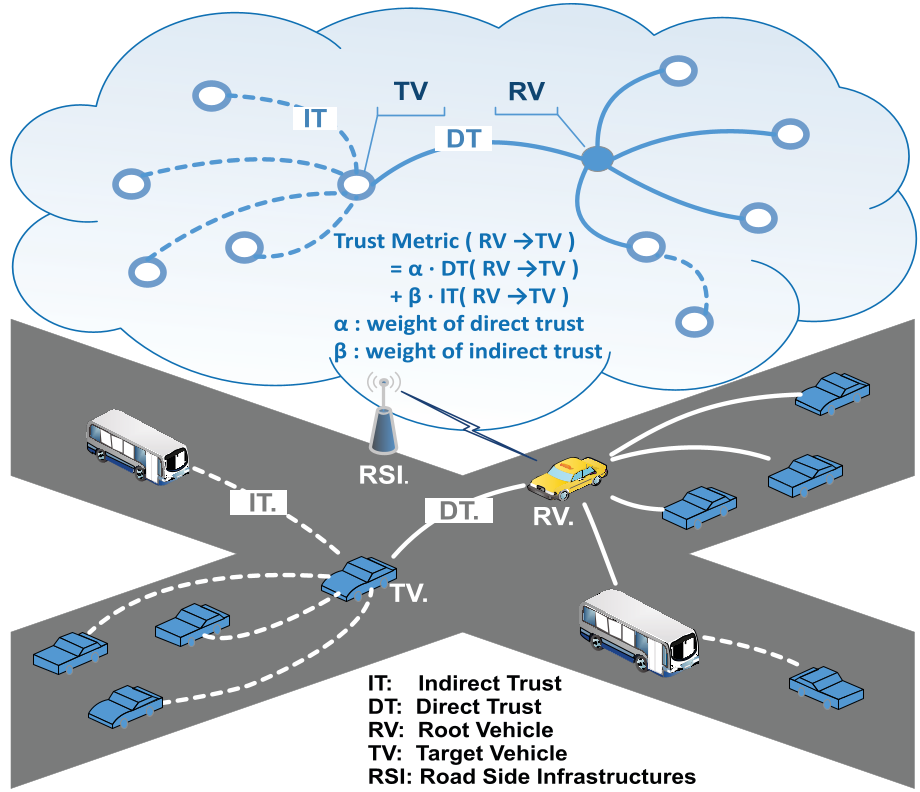 Figure 1: The architecture of a trusted VSN where nodes (Vehicles/Drivers) interact based on weighted trust links.
Formal Logic Example
The system uses prefixing and cooperation operators to define behavior. For instance, a vehicle and a base station must synchronize on a "use" action before transmission occurs, a logic elegantly captured by the PEPA syntax:
VSN = Vehicle <use> BaseStation
Experiments & Future Outlook
The paper sets a theoretical and formal foundation for future testing. By moving away from discrete event simulations which are computationally expensive, the PEPA-to-ODE pipeline allows researchers to predict how information will spread in a city-scale VSN in near real-time.
| Feature | Traditional PKI | Trusted VSN (Proposed) |
|---|---|---|
| Security Focus | Encryption & Identity | Information Veracity & Trust |
| Interaction Basis | Cryptographic Handshake | Social Relationship & Interaction History |
| Scalability Method | Discrete Simulation | PEPA Fluid Flow (ODEs) |
Critical Insight & Conclusion
The true value of this work lies in its Formal Compositional Approach. By treating a high-speed vehicular network as a "Social Network for Automobiles," it addresses the human element of technology.
Takeaway: Future 5G and 6G vehicular applications will likely rely on these "Reputation Engines" to filter data. The use of PEPA ensures that as these networks grow to millions of nodes, our mathematical models can actually keep up with the complexity.
Limitations: The paper is primarily architectural and formal. Real-world deployment will require specific mitigation strategies for "sybil attacks" where a single malicious user creates multiple social identities to artificially inflate their Indirect Trust.