
Game Theory in the Social Loop: Optimizing the OSN Privacy-Sharing Paradox
Trusted Online Social Network (OSN) services with optimal data management 5
This paper introduces a comprehensive framework for trusted data management in Online Social Networks (OSNs), proposing an optimization model to balance information sharing and privacy. It utilizes a Markov Decision Process (MDP) to determine optimal sharing levels and extends this into a two-player zero-sum Markov game to model the adversarial interactions between users and attackers.
TL;DR
Online Social Networks (OSNs) are built on the tension between the desire to share and the need to protect. This paper moves beyond simple "lock" icons, proposing a mathematical framework using Markov Decision Processes (MDP) and Zero-sum Markov Games to calculate the "Golden Mean" of information sharing—where social reward is maximized while keeping potential breach costs at bay.
Background: The Four States of Social Data
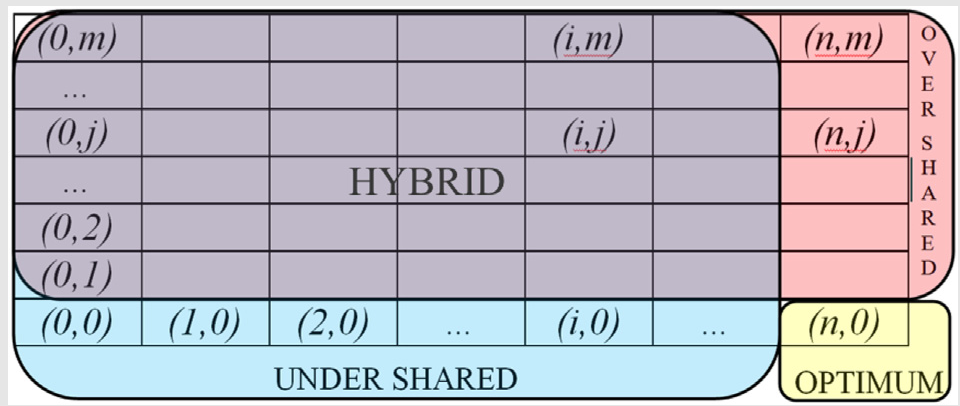
In the traditional view, privacy is binary: public or private. This paper argues that social data exists in a fluid "Footprint" that moves between four critical states:
- Optimal: Desired sharing equals actual sharing.
- Under-shared: You want to share, but the system or your fear blocks it (Utility Loss).
- Over-shared: You share more than intended (Privacy Breach).
- Hybrid: A murky mix of both, typical of complex modern platforms.
The author's insight is that users aren't just making one-off choices; they are navigating a state-transition landscape influenced by Facilitating factors (like social need) and Detracting factors (fear of fraud).
Methodology: The Math of Social Interaction
1. The MDP Tradeoff
The core methodology treats a user as a rational agent seeking to maximize a discounted reward function. The "Reward" is the social gain from sharing items, while "Cost" is the penalty if those items are compromised.
2. The Adversarial Markov Game
The paper takes it a step further by introducing an Opponent (Attacker). This transforms the problem into a two-player zero-sum game.
- User Actions: Share (S) or Mask (M).
- Attacker Actions: Conceal (C) or Expose (E).
The equilibrium is found using a Value Iteration Algorithm, which converges to a strategy where the user can maintain an optimal state even against a rational attacker.
Experimental Insights: Battleships and Insiders
The authors conducted simulation-based attack scenarios that provide critical "Defense Heuristics":
The "Battleship" Tactic
Attackers often use metadata (like folder names) to find "clusters" of private data. Much like the game Battleship, once one private item is found, the rest are easily picked off.
- Key Finding: Spreading private data across multiple logical clusters is an effective "structural" defense, drastically reducing the attacker's success rate compared to centralized storage.
The Insider Threat
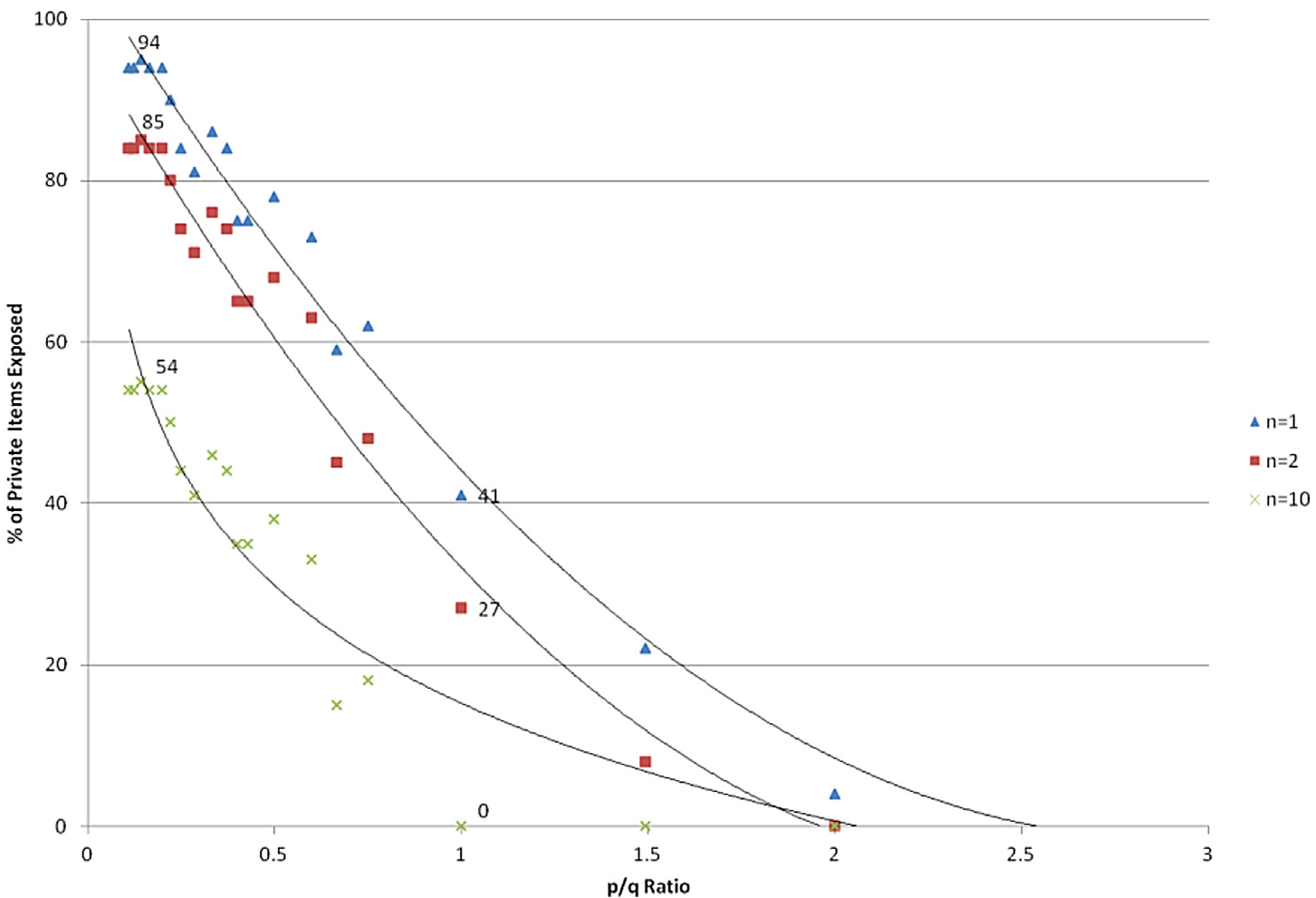
If an attacker has "Full Knowledge" (an insider), the number of rounds required to compromise a user drops exponentially.
Heuristic Defense
Surprisingly, for a random "blind" attacker, the user (Defender) has a massive natural advantage. Unless the attacker’s success probability is significantly higher than the defender's (ratio > 2.5), the "Optimal State" is remarkably stable.
Critical Analysis & Takeaways
The brilliance of this work lies in its shift from Enforcement to Optimization. It acknowledges that "Zero Sharing" is not a viable privacy strategy for OSN users.
Limitations: The model currently assumes all data items have equal sensitivity and are independent. In reality, a leaked Social Security Number is infinitely more "costly" than a leaked photo of a sandwich (Data Interdependency).
Future Outlook: The next logical step is integrating Honeytokens—digital decoys that increase the "search cost" for attackers, effectively polluting the game's payoff matrix to favor the legitimate user.
Conclusion
This research provides a rigorous mathematical bedrock for the next generation of "Privacy Assistants." Instead of asking "Do you want to share this?", future OSNs might say: "Based on your current network risks and desired social reach, sharing these 5 items offers the optimal reward-to-risk ratio."