
Breaking the Silos: When Network Engineering Meets Sociology
Trusted Priority Control Design for Information Networks Based on Sociotechnology
This paper proposes a sociotechnical approach to network design by integrating Information Technology (IT) with Social Network (SN) analysis. By utilizing centrality metrics from affiliation networks, the author introduces a "trusted priority control" method for Virtual Private Networks (VPNs) that aligns bandwidth allocation and reliability with actual human group dynamics.
TL;DR
Most network administrators prioritize traffic based on job titles or explicit user requests. This paper argues that such approaches are flawed. By merging Information Technology (IT) with Social Network (SN) analysis, the author proposes a system where traffic priority and link redundancy are automatically assigned to "real" influencers and "information brokers" identified through mathematical graph theory.
The Motivation: Why Your VPN Doesn't Care About Reality
The fatal flaw in modern traffic engineering is its blindness to social dynamics. We design networks based on physical topology (who is connected to which router) or organizational charts. However, research into sociotechnology reveals two critical constraints often ignored:
- Reed’s Law: The value of a network grows exponentially with the number of sub-groups, not just the number of nodes.
- Dunbar’s Limit: Human cognitive limits restrict meaningful group sizes to roughly 150 members.
Current networks lack the "social intelligence" to recognize that a low-ranking employee might actually be the central hub of an entire project's communication. If their link fails, the project dies—yet the network treats their traffic as "standard."
Methodology: Mining the Social Fabric
The paper introduces an Integrated Network Architecture that treats social and information planes as a single entity.
1. The Affiliation Network (Bipartite Graph)
Instead of a simple peer-to-peer map, the author uses a bipartite graph to represent users and the groups they belong to. This captures the "duality" of actors and organizations.
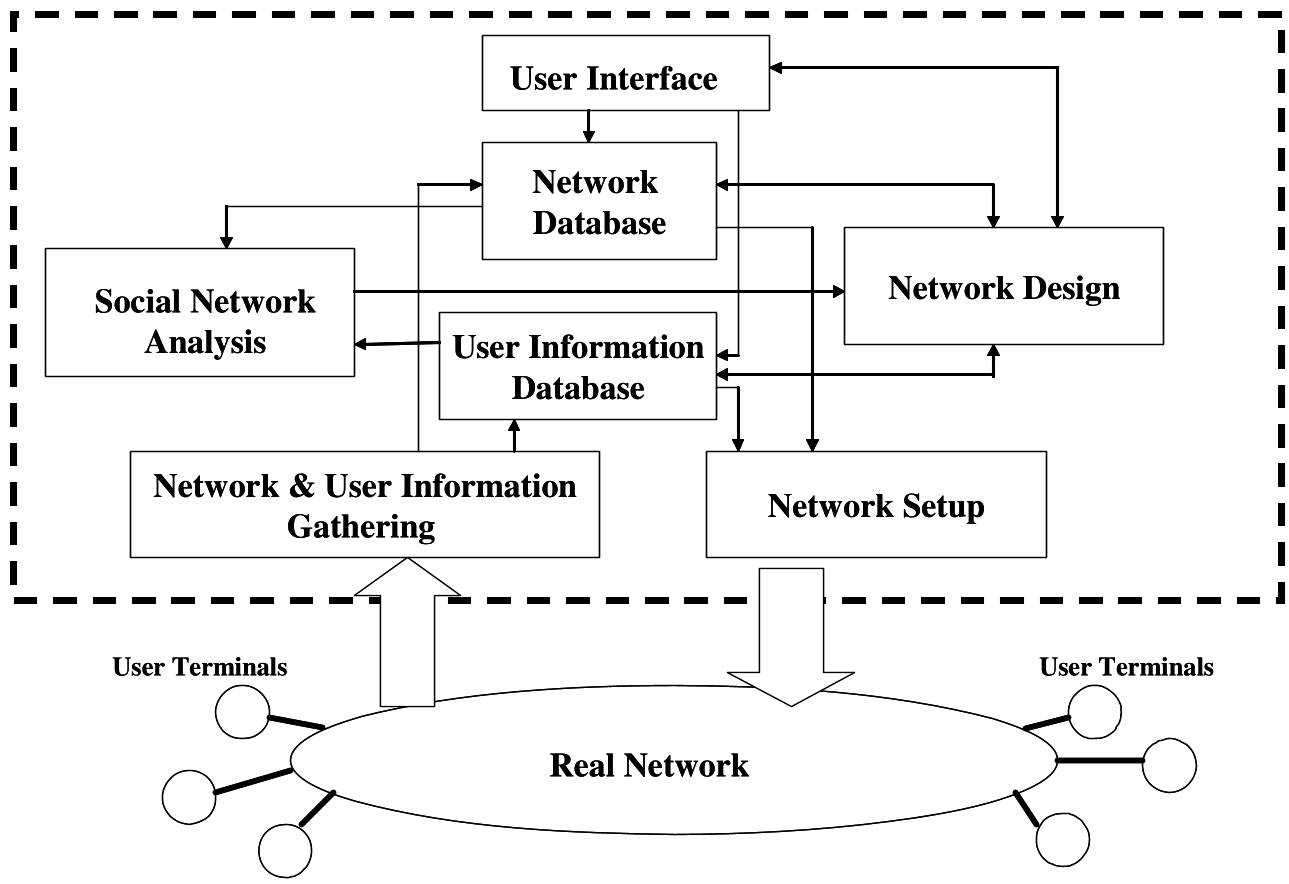 Figure: The proposed system integration where social analysis feeds directly into network reconfiguration.
2. Centrality as a Network Metric
The author applies three specific sociological metrics to determine network priority:
- Degree Centrality: Identifies the "Leader." Who is the most active node across the most groups?
- Betweenness Centrality: Identifies the "Broker." If this person is disconnected, does the communication between two different groups collapse?
- Flow Centrality: Attaches weights to links based on the volume and "importance" of the social interaction.
Case Study: Identifying Hidden Hubs
The paper simulates a network of 10 users. While traditional design might give users 3, 4, 8, and 10 equal priority because they have the same number of physical links, the Sociotechnical Model reveals a different story:
- User 10 emerged with the highest degree of "group activity," identifying them as the essential leader requiring high-capacity links.
- User 3 showed a massive Betweenness Centrality score (48.93), marking them as a critical broker. In an MPLS network, the system would automatically provision redundant paths for User 3 to prevent a single point of social failure.
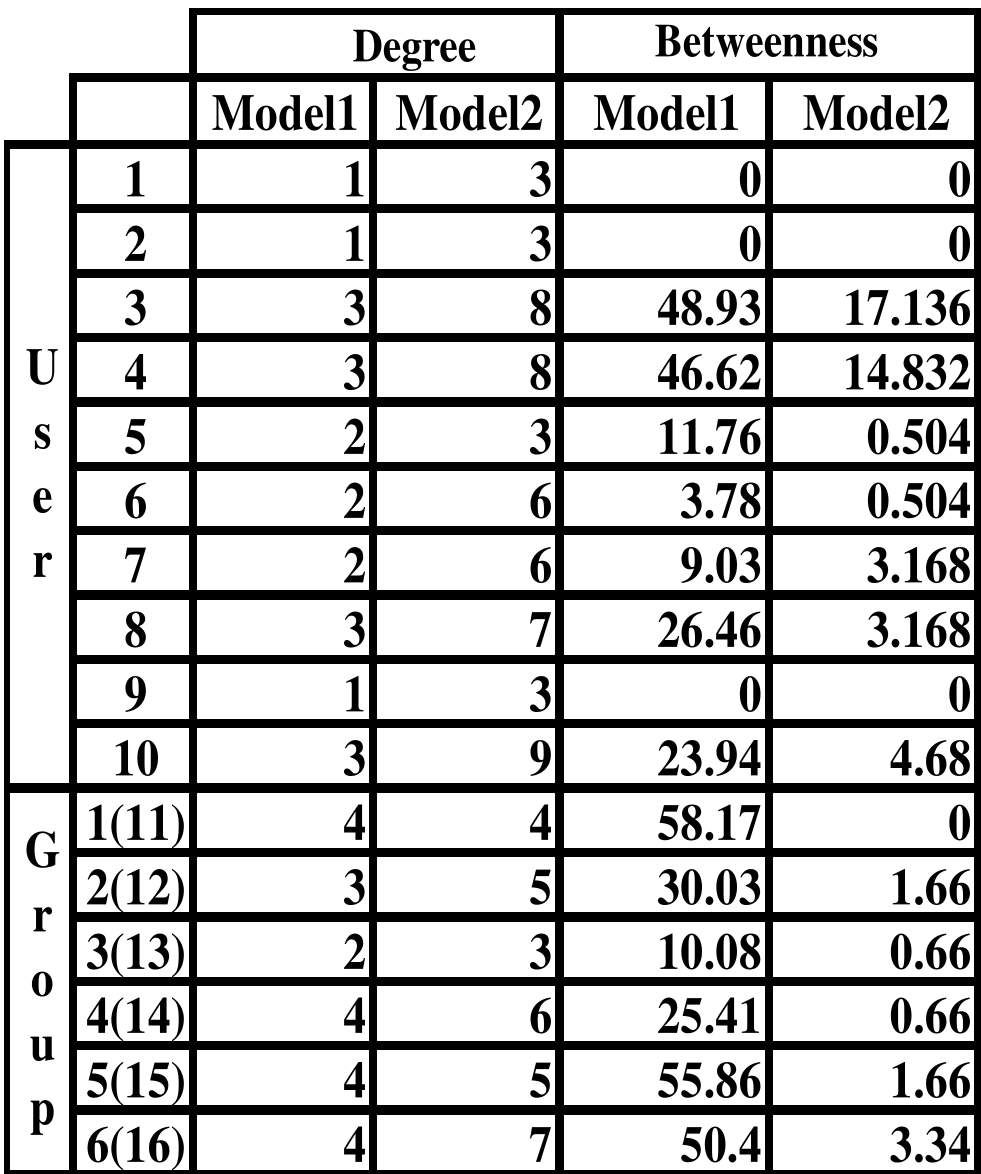 Table: Social metrics vs. Traditional link counts. Notice how Betweenness Centrality highlights critical nodes that link counting misses.
Implementation via MPLS
The practical outcome is the Trusted Priority Control. By mapping social centrality to MPLS labels, the network can:
- Route "Leader" traffic through high-speed, low-latency paths.
- Allocate mirror servers for "Brokers" to ensure data availability during outages.
- Dynamically shift bandwidth to "High-Rank Group" packets even if the sender has a low-ranking job title.
Critical Analysis & Future Outlook
This work is a pioneering bridge between the "soft" science of sociology and the "hard" science of packet switching. Its primary strength is the move away from static headers toward dynamic, behavioral importance.
Limitations & Challenges:
- Privacy: Monitoring email and blog content to determine "centrality" raises significant ethical and privacy concerns for employees.
- Complexity: Real-world social networks are much more chaotic than a 10-person graph; scaling these calculations in real-time for global enterprises remains a hurdle.
The Takeaway: As we move toward more autonomous and "intent-defined" networks, the most successful systems will be those that understand the social context of the data they carry. The network of the future isn't just a pipe; it's a map of human relationships.