
Safeguarding the Pulse of Social Health: Privacy and Trust in SMHNs
Enabling Trusted and Privacy-Preserving Healthcare Services in Social Media Health Networks
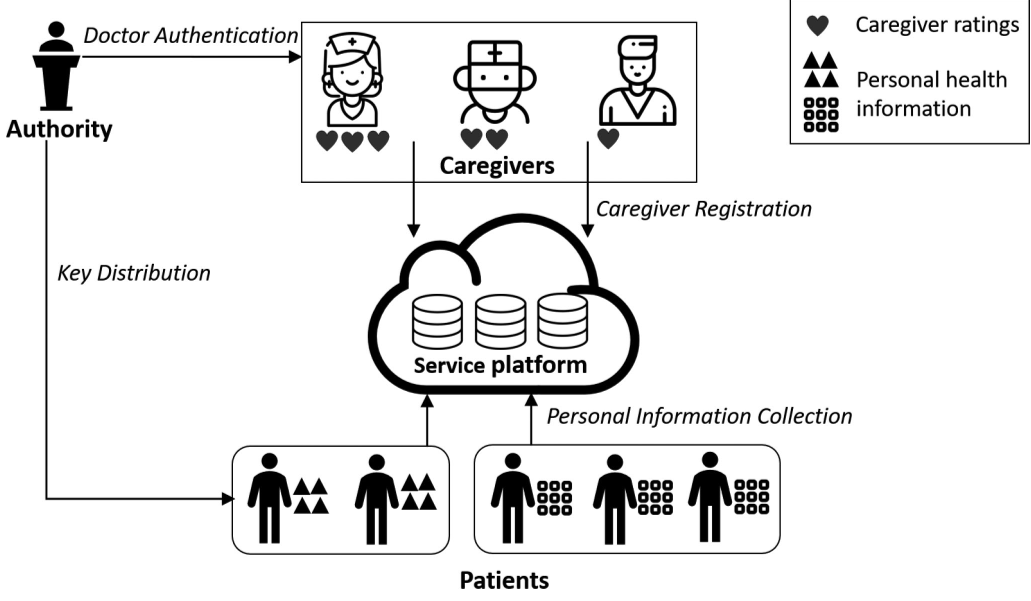
The paper proposes a personalized and trusted healthcare service approach for Social Media Health Networks (SMHNs). It integrates Bloom Filters with Locality-Sensitive Hashing (LSH) for privacy-preserving similarity matching and a Sybil attack detection scheme based on identity-based signatures.
TL;DR
As healthcare shifts from hospital-centered models to Social Media Health Networks (SMHNs), the dual challenges of data privacy and review authenticity have become paramount. This paper introduces a framework that uses Locality-Sensitive Hashing (LSH) for private patient matching and a specialized Signature-based linkage to exterminate Sybil attacks (fake reviews) with 100% accuracy.
The Trust Gap in Digital Healthcare
In a traditional clinic, trust is institutional; you trust the hospital's license. In SMHNs, trust is crowdsourced through ratings. However, this openness invites two specific failures:
- Privacy Paradox: To find the right specialist, you must share your symptoms. But sharing symptoms online exposes you to discrimination from insurance companies or intrusive targeted advertising.
- Sybil Sabotage: Malicious actors use multiple "sock-puppet" accounts (pseudonyms) to artificially inflate a doctor's reputation or destroy a competitor's, rendering the rating system useless.
Methodology: Privacy through Vectors, Trust through Linkage
1. Privacy-Preserving Matching (LSH & Bloom Filters)
The core insight is that symptoms don't need to be identical to be relevant. The authors use Locality-Sensitive Hashing (LSH) to map patient profiles into a Bloom Filter bit array.
- The Math: Instead of standard hashes where a single bit change results in a totally different hash, LSH ensures that similar inputs map to similar vectors.
- Encryption: These vectors are encrypted using a secret matrix . The service platform computes the inner product of these ciphertexts to determine similarity without ever "seeing" the actual symptoms.
2. Eliminating Fake Reviews (Sybil Detection)
To prevent one person from leaving ten reviews under ten names, the system employs Identity-Based Signatures.
- The "Trap": While a patient can use multiple pseudonyms (), their secret keys are mathematically derived from their one true identity ().
- Detection Logic: The platform performs a pairing-based check on the signatures. If two signatures from different pseudonyms target the same caregiver with the same content, the formula extracts the common identity factor . If they match, the Sybil attack is flagged immediately.
Experimental Results: Accuracy vs. Security
Personalized Matching Performance
The researchers tested the system on a urinary system diagnosis dataset. As the number of symptom attributes increases, the search time grows linearly, but the accuracy remains robust. Compared to a baseline random-recommendation model, the proposed collaborative filtering method showed a 4x improvement in finding the correct specialist.
Resisting the Sybil Tide
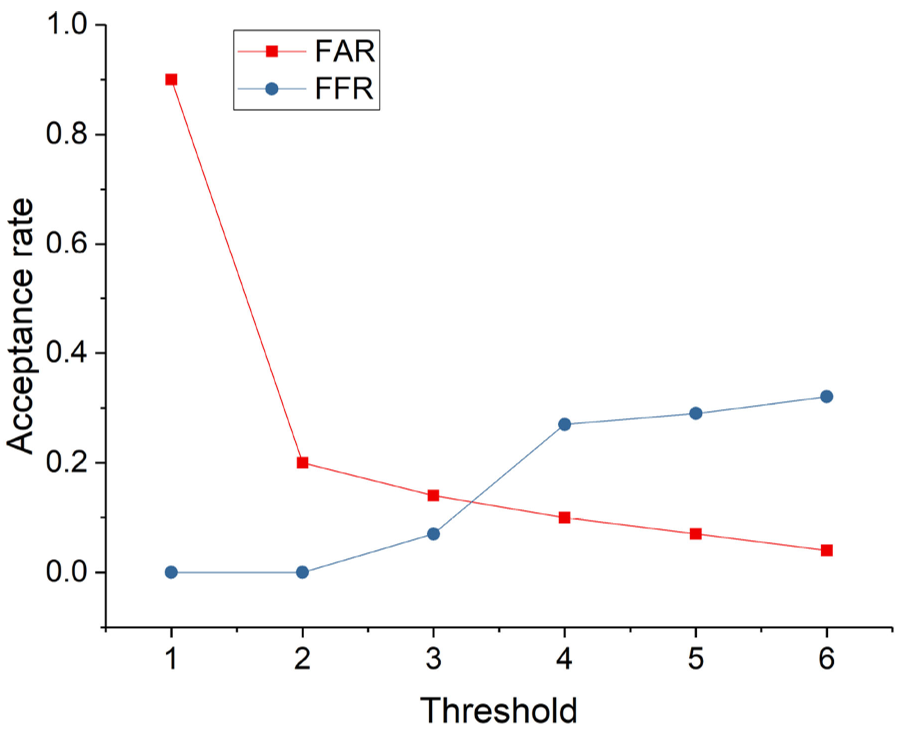
In the Sybil detection tests, the system's performance was evaluated against the number of total reviews versus false reviews. High-frequency attackers are actually easier to catch because the probability of finding a signature collision increases.
Unlike previous works that rely on IP addresses (which are easily spoofed via VPNs), this method achieves 100% detection accuracy because it is tied to the underlying cryptographic identity granted during registration.
Critical Insights & Takeaways
This work effectively bridges the gap between Personalization and Anonymity. By using LSH, the authors acknowledge that healthcare data is "fuzzy" and requires flexible matching, whereas by using identity-based signatures, they acknowledge that trust requires "hard" accountability.
Limitations: The current Sybil detection requires heavy pairing-based computations on the server side, which might introduce latency if a single caregiver receives thousands of reviews simultaneously. Future work should focus on optimizing these cryptographic primitives for real-time mobile environments.
Conclusion
The shift toward digital social health is inevitable. By ensuring that "finding a doctor who understands my condition" doesn't mean "selling my medical history," and ensuring that "five stars" actually means "good service," this paper provides a robust blueprint for the next generation of trusted healthcare networks.