
Enabling Trusted and Privacy-Preserving Healthcare: Tackling the Sybil Threat in Social Health Networks
Enabling Trusted and Privacy-Preserving Healthcare Services in Social Media Health Networks
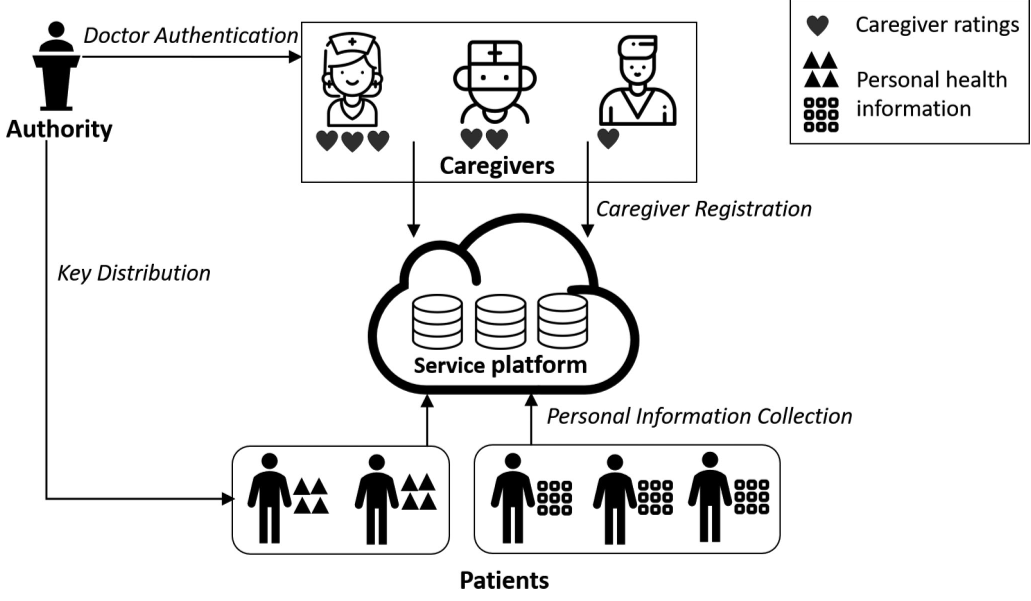
This paper proposes a personalized and trusted healthcare service framework designed for Social Media Health Networks. It integrates Collaborative Filtering (CF) for caregiver recommendations, Bloom Filters with Locality Sensitive Hashing (LSH) for privacy-preserving patient matching, and a unique identity-based signature scheme to detect and mitigate Sybil attacks with 100% accuracy.
TL;DR
With the rise of Social Media Health Networks (SMHNs), patients are moving away from offline hospitals toward efficient online consultation. However, two major hurdles remain: User Privacy and Review Authenticity. This paper introduces a framework that uses Bloom Filters and Collaborative Filtering to suggest the right doctors while employing a sophisticated "linkable" signature scheme to catch Sybil attackers who manipulate ratings using multiple fake accounts.
The Trust Gap in Online Healthcare
In a physical hospital, trust is backed by government regulation and institutional accountability. Online, anyone can claim to be a doctor or a satisfied patient. Current reputation-based systems are plagued by Sybil attacks, where a single malicious user creates dozens of pseudonyms to either "shill" a caregiver with fake praise or "smear" them with negative reviews.
The challenge is two-fold:
- Personalization vs. Privacy: To get a good recommendation, you need to find someone with similar symptoms. But how do you find "health twins" without exposing your private medical data to the platform?
- Anonymity vs. Accountability: Patients want to stay anonymous (pseudonyms), but this anonymity is exactly what Sybil attackers exploit.
Methodology: The Privacy-Preserving Matchmaker
The authors solve the personalization problem through a clever use of Locality Sensitive Hashing (LSH) and Bloom Filters.
1. Finding "Health Twins" in the Dark
Instead of uploading "Diabetes" or "Heart Arrhythmia" in plain text, symptoms are mapped into a bit array (Bloom Filter). By using LSH, similar symptoms are mapped to similar bit positions.
- The Secret Sauce: The patient encrypts this bit vector using a secret matrix. The platform can then compute the "Inner Product" (similarity) between two encrypted vectors without ever seeing the actual health status.
2. The Collaborative Filtering (CF) Recommendation
Once the platform finds patients with similar profiles, it looks at who they rated highly. It uses a weighted rating model that accounts for:
- Rating Preference: Adjusting for users who are naturally "harsh" or "easy" graders.
- Rating Frequency: Giving more weight to "expert" users who have provided many high-quality reviews.
Methodology: Cracking the Sybil Code
The most innovative part of the paper is the Sybil detection. Most systems try to block Sybils using IP addresses, but attackers can easily use VPNs or multiple devices.
The authors use Bilinear Pairings to create a mathematical link. When a patient signs a review, the signature is tied to their real identity in a hidden way. If the same user posts the same review content () under two different names (), the platform can run a verification equation: If the equation holds true, the system knows with 100% mathematical certainty that these two "different" users are actually the same person.
Experimental Results
The researchers tested their approach against real-world datasets, including acute inflammation data.
- Accuracy: Their personalized finding scheme achieved an 80% accuracy in finding the right caregiver category, vastly outperforming random recommendations (20%).
- Sybil Resilience: Unlike previous methods based on IP filtering, this scheme is immune to IP spoofing. Even if an attacker uses 20 different devices, their mathematical "identity fingerprint" remains detectable.
Critical Insight & Conclusion
The genius of this paper lies in the synergy between privacy and trust. Usually, if you increase privacy (anonymity), you decrease trust (accountability). This paper breaks that trade-off. It allows patients to remain anonymous to the public and the service provider, while still providing a "trapdoor" for a Trusted Authority to unmask attackers.
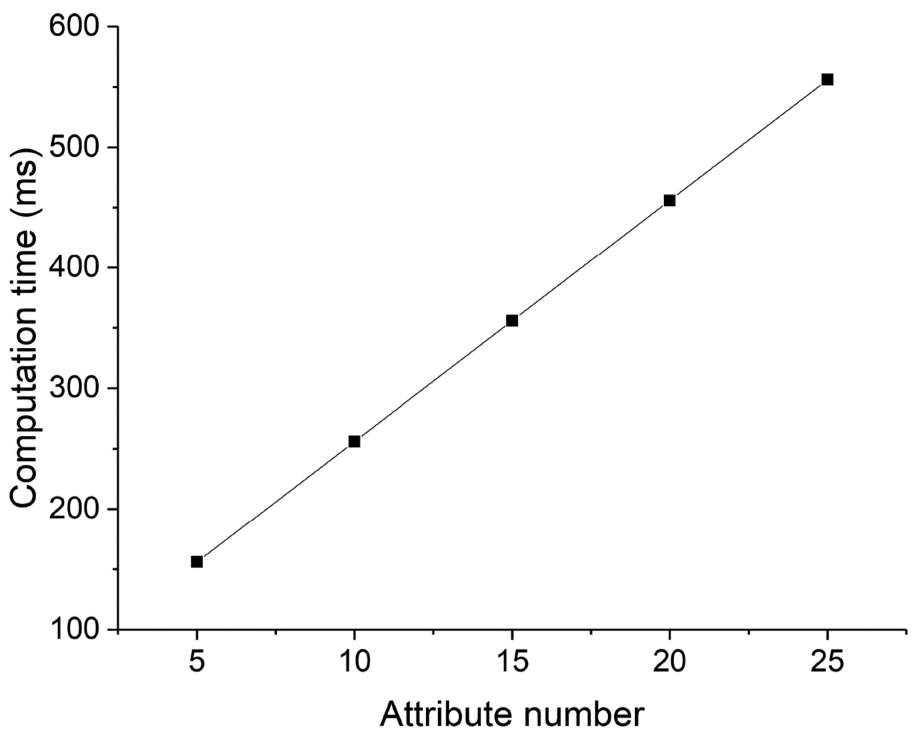
Limitations: The computational cost of Bilinear Pairings is higher than simple hashing. While 3.1 seconds for detection is "acceptable" for a review system, it might need further optimization for real-time high-traffic social networks.
In the future of digital health, this framework provides a blueprint for how we can build communities that are both deeply personal and mathematically honest.