
TrustSplit: Achieving Stealthy Confidentiality in Social Networks Without the Headache
TrustSplit: usable confidentiality for social network messaging
TrustSplit is a privacy-enhancing framework that introduces the Confidentiality as a Service (CaaS) paradigm for social network messaging. It utilizes a novel trust splitting approach and commutative encryption to protect private messages from both Social Network (SN) providers and the CaaS provider itself, achieving SOTA usability with near-zero configuration for end-users.
TL;DR
TrustSplit introduces "Confidentiality as a Service" (CaaS), a framework that allows you to encrypt Facebook messages so that even Facebook (and the encryption service itself) can't read them. Unlike PGP, it requires no manual key management, integrates directly into the browser via a plugin, and adds less than 200ms of latency to your chat experience.
The "Privacy Paradox" in Social Media
We live in a world where we value our privacy but sacrifice it daily for the convenience of Social Networks (SNs). The fundamental conflict is simple: SN business models rely on data mining, while users need confidentiality for private chats.
Existing solutions like PGP or Hushmail fail for two reasons:
- Usability: Nobody wants to manage public/private keys or "Webs of Trust" just to send a "Hello."
- Legal Vulnerability: If one provider holds both your encrypted data and the means to decrypt it (even if for convenience), they can be legally compelled to hand over your cleartext.
The Core Insight: Trust Splitting & Commutative Layers
The authors' "Aha!" moment is the CaaS Paradigm. By splitting trust between two entities—the Social Network (which stores the data) and a CaaS Provider (which manages the math)—neither party ever possesses enough information to compromise the user.
How it Works (The Math Intuition)
The system uses Commutative Layers (cLayers). Imagine a message wrapped in two different locks. Commutative encryption allows you to remove the inner lock without removing the outer one first.
Mathematically, it relies on the XOR property:
- Encryption: Alice encrypts locally CaaS Provider adds a layer Alice removes her local layer. The message sent to Facebook is only protected by the Provider's key.
- Decryption: Bob receives the message Adds his local layer CaaS Provider removes its layer Bob removes his local layer.
Throughout this process, the CaaS provider only sees data still "wrapped" in the user's secret layer.
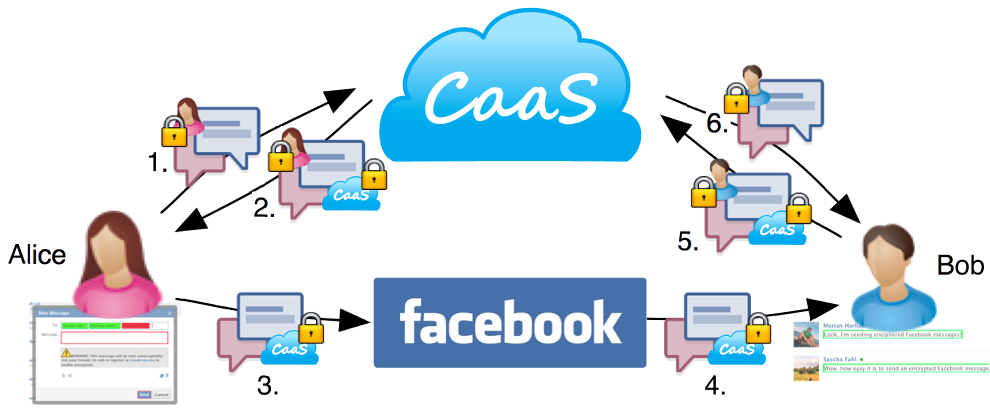 Figure 1: The dual-layer workflow ensuring neither Facebook nor the CaaS provider sees the plaintext.
Methodology: Invisible Integration
The implementation uses a Greasemonkey script (a browser extension) that hooks into the Facebook UI. It identifies if a recipient is a "CaaS user" and highlights them in green.
- Zero Key Management: Users just log in with a password. The system handles the heavy lifting of AES-CTR (Counter Mode) stream ciphers and HMAC-based Key Derivation (HKDF) in the background.
- Multi-Device Ready: Since keys are derived from a master secret and user authentication rather than physical files (like .asc files in PGP), users can access their secured history from any laptop.
Experimental Results: Security at the Speed of Chat
The authors didn't just write a theory paper; they built it. The results from their 20-person study prove that security doesn't have to be slow.
- Speed: Asynchronous decryption of a full message history (30 messages) takes roughly the same time as the page load itself.
- User Friction: The setup time of ~3 minutes is equivalent to creating a standard web account, a tiny price for total message confidentiality.
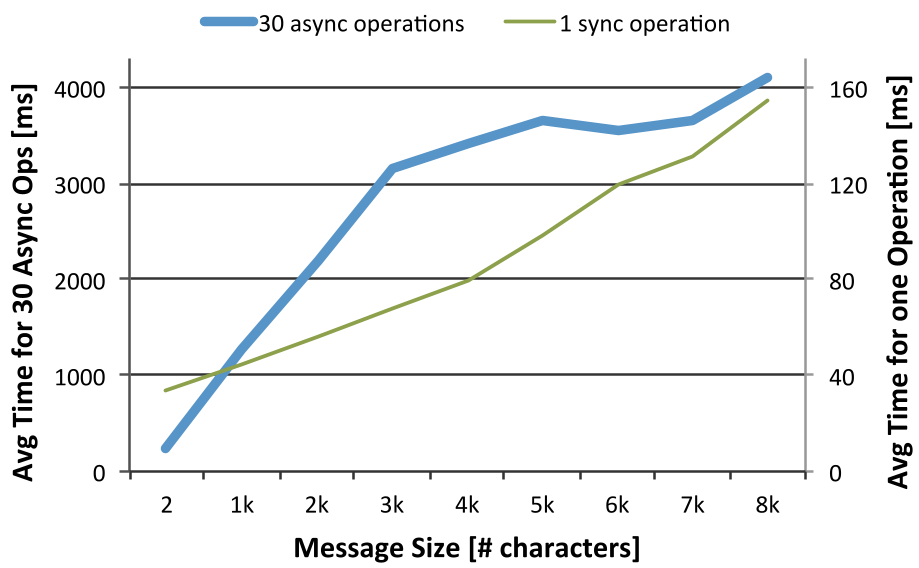 Figure 2: Response time vs. message length. Note the near-linear efficiency even with large payloads.
Critical Analysis & Takeaways
Why it matters: TrustSplit proves that the "Usability vs. Security" trade-off is often a design failure rather than a technical necessity. By using commutative encryption, we create a legal shield: since the CaaS provider never sees the plaintext, they cannot be forced to reveal it.
Limitations:
- The prototype relies on a browser plugin, which doesn't translate easily to native mobile apps (the dominant way SNs are used today).
- It assumes the SN provider won't "pre-register" fake CaaS accounts for its users (though the paper proposes a "binding" check to mitigate this).
Conclusion
TrustSplit is a landmark example of Human-Centric Security. It takes the burden off the user and places it on the protocol design. For future researchers, the lesson is clear: if you want people to use encryption, make it look like they aren't using it at all.