
Elevating MSN Reliability: Trust Management via the Power of the Hypercube
Trustworthiness-hypercube-based reliable communication in mobile social networks
The paper introduces a trustworthiness computation framework and a reliable routing algorithm termed THRC (Trustworthiness-Hypercube-based Reliable Communication) for Mobile Social Networks (MSNs). By mapping social features onto an n-dimensional hypercube (FPRG), it achieves resilient data delivery in the presence of malicious nodes, ensuring local optimal paths with high average trustworthiness and minimal length.
TL;DR
Mobile Social Networks (MSNs) are often plagued by malicious nodes that disrupt data delivery. This paper presents a novel approach by mapping social features into a Trustworthiness-Hypercube. By combining an efficient Trustworthiness Computing (TC) algorithm with a Reliable Communication algorithm (THRC), the authors enable secure, feature-based data routing that bypasses malicious entities with minimal computational overhead.
Context: The Social Fabric of Routing
In an MSN, data isn't just sent through wires; it is carried by people. Users move and interact based on shared interests or social features (hobbies, locations, affiliations). While this provides a natural structure for routing, it also opens the door for malicious groups to intercept or corrupt data. The challenge is: how do we calculate "trust" in a landscape that is both unstructured and mobile?
The Core Insight: Mapping Features to Geometry
The authors' prior work introduced the First-Priority Relation Graph (FPRG), which structures social groups into an n-dimensional hypercube (). In this model:
- Each dimension represents a specific social feature.
- Two groups are connected if they differ by exactly one feature (a 1-bit difference in their binary address).
This geometric abstraction allows the use of established combinatorial properties of hypercubes to solve complex networking problems.
Methodology: TC and THRC Algorithms
1. Trustworthiness Computing (TC)
Instead of just looking at history, the TC algorithm evaluates a group based on its neighbors and its internal-trustworthiness-ratio (ITR).
- The Intuition: If all your "neighbors" in the social feature space are compromised, your reliability score should drop.
- Complexity: Because it follows the hypercube structure, the algorithm converges in time, making it viable for resource-constrained mobile devices.
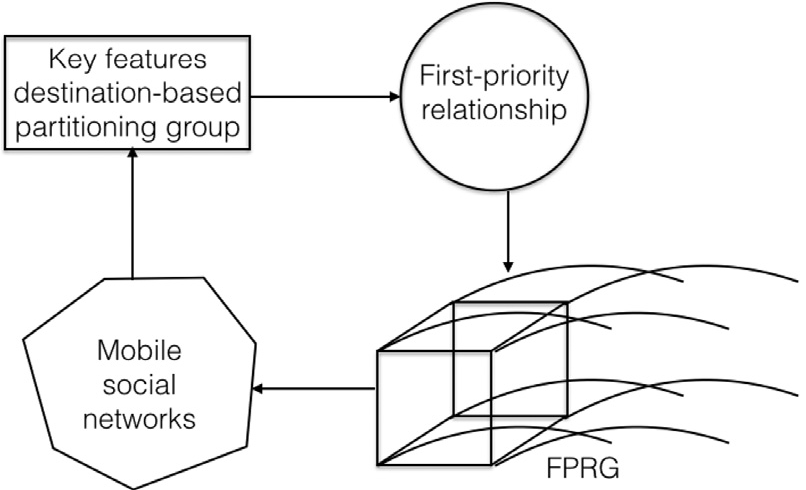 Fig 1: High-level illustration of the First-Priority Relation Graph (FPRG) mapping social features to a structured space.
2. Trustworthiness-Hypercube-based Reliable Communication (THRC)
The THRC algorithm doesn't just look for the shortest path; it looks for the Local Optimal Reliable Path. It uses a "Purpose Tree" to explore potential routes and evaluates them using a multi-objective cost function:
Where:
- : Average Trustworthiness of the path.
- : Path-length ratio.
- : A weight balancing security vs. efficiency.
Experimental Proof: Scenario Simulations
The authors validated the model using 4-dimensional hypercubes (representing 4 key social features).
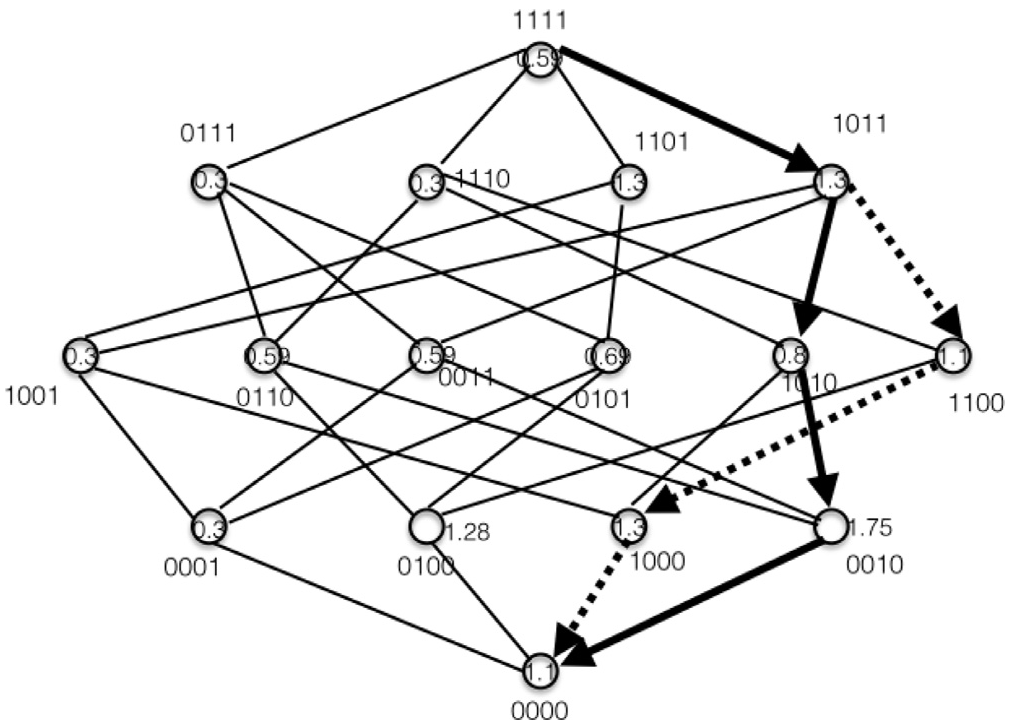 Fig 2: A scenario simulation showing how the THRC algorithm evaluates multiple paths to select the most reliable route (P1 vs P2).
In scenarios with multiple malicious groups (e.g., groups 0111, 0001, etc., having low ITR), the THRC successfully diverted traffic through "healthier" nodes. Even when the reliable path was slightly longer, the high score ensured that data integrity was prioritized.
Critical Analysis & Conclusion
The beauty of this work lies in its scalability. By extending the logic from a standard hypercube to a Generalized Hypercube (), the authors account for features with more than two possible values (e.g., a "Location" feature with multiple cities).
Limitations: The current model assumes that the source user can detect malicious users via a predefined algorithm (from prior work). In a real-world adversarial environment, the detection of "stealthy" malicious nodes that behave well initially remains a significant challenge.
Takeaway: This research bridges the gap between social science (human contact features) and discrete mathematics (hypercube theory), offering a robust blueprint for future "Socially-Aware" secure networking protocols.