
Trusting the Machine: Rethinking Reputation in the Social Internet of Things
Trustworthiness Management in the Social Internet of Things
This paper introduces the Social Internet of Things (SIoT) paradigm and proposes two distinct trustworthiness management models: a Subjective model based on social experience and an Objective model leveraging Distributed Hash Tables (DHT). Both models aim to identify and isolate malicious nodes to ensure reliable service discovery in decentralized IoT environments.
TL;DR
As billions of devices connect autonomously, the "Social Internet of Things" (SIoT) allows objects to form relationships like humans do. This paper introduces two trust management models—Subjective (local/experience-based) and Objective (global/DHT-based)—to isolate malicious actors. While the Objective model offers rapid convergence, the Subjective model proves superior at defending against complex, socially-aware "liars."
The Problem: The "Friend or Foe" Dilemma in IoT
The promise of the IoT is autonomous service discovery: your smart car talks to a neighbor’s sensors to find parking. But what if that sensor is malicious? It could provide wrong data or build a "fake" reputation by being honest with some and lying to others.
Existing P2P trust models (like those in BitTorrent) treat all nodes as anonymous peers, losing the rich context of ownership and long-term relationships. Conversely, social network models for humans don't account for the fact that a "smart" phone has more intelligence to cheat than a "dumb" thermometer.
Methodology: Two Paths to Trust
The authors suggest that trust should be multifaceted, incorporating seven factors including feedback, credibility, and "intelligence."
1. The Subjective Model: "I Trust You Because My Friends Do"
In this model, trust () is recalculated locally by every node. It uses:
- Direct Experience: Past interactions.
- Word of Mouth: Opinions from common friends weighted by their credibility.
- Relationship Factors: A "Parental" relationship (same manufacturer) is less trusted than an "Ownership" relationship (same owner).
2. The Objective Model: "The Network Knows Your Record"
This acts as a decentralized credit score.
- DHT Storage: Uses a Chord-based Distributed Hash Table.
- Pre-Trusted Objects (PTOs): Highly reliable nodes that manage and update the global trust values to prevent malicious clusters from hijacking the scores.
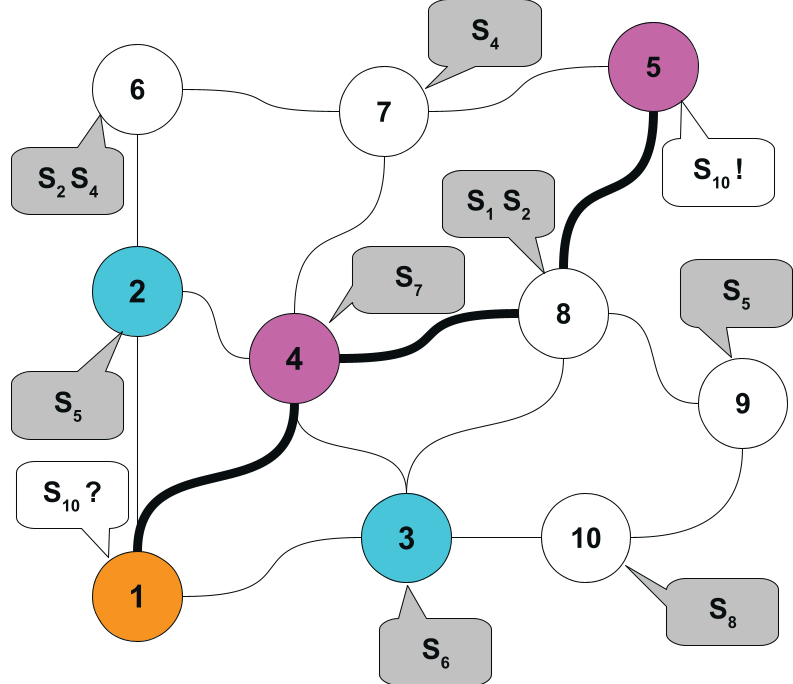 Figure 1: Path discovery and friendship set identification between a requester and a service provider.
Battle-Tested: Results from Real-World Traces
The models were tested using SWIM (synthetic mobility) and Brightkite (real-world location data).
- Efficiency: The Objective model is a "sprint" winner. It hits a near-perfect success rate (99.9%) very quickly because information is shared globally.
- Resilience: The Subjective model is the "marathon" winner. It is far better at detecting "Class 1" malicious nodes—devices that act benevolent toward friends but lie to strangers.
- Centrality Matters: The paper proves that nodes more central to the social graph (involved in more transactions/friendships) are statistically more reliable indicators of trust.
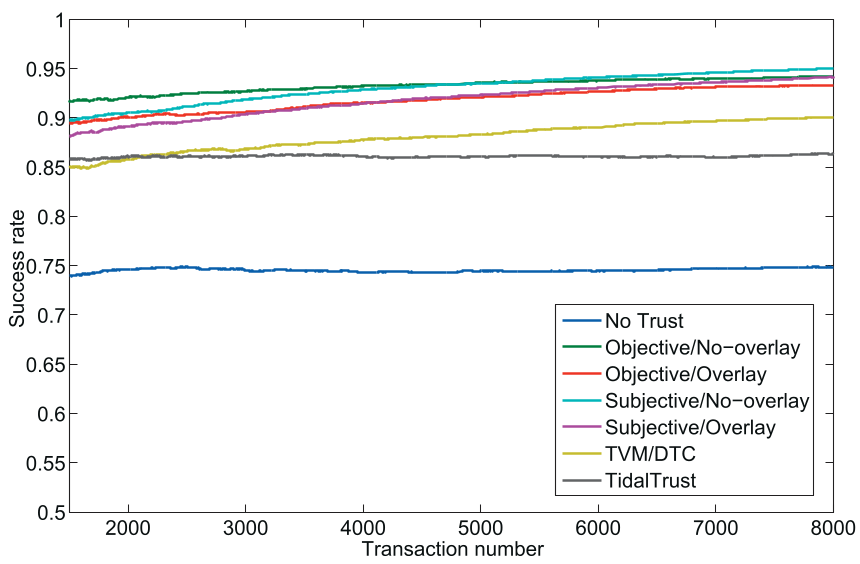 Figure 2: Performance under Class 1 malicious behavior. Note how the Objective model (red) is eventually overtaken by the Subjective model as nodes accumulate personal experience.
Critical Insight: The Personalization Paradox
An interesting finding is that the Subjective model becomes even more accurate in "shorter" networks (like Brightkite) where the average distance between nodes is smaller. This suggests that the more "social" our things become, the less we need centralized authorities to tell us who to trust.
However, the Objective model remains the best defense against "lazy" or "dumb" malicious nodes (Class 2) that lie to everyone indiscriminately.
Conclusion & Future Outlook
This work highlights that the future of IoT isn't just about connectivity; it's about reputation management. By leveraging the "Social" aspect of things, we can create self-healing networks that automatically prune out bad actors.
The next frontier? Integrating these logic-based trust scores with dynamic incentive systems, where nodes don't just gain "trust points" but actual resource priority or crypto-economic rewards for being honest members of the SIoT community.