
Trustworthy Edge Caching: Defending Mobile Big Data in Social Networks
Trustworthy caching for mobile big data in social networks
This paper proposes a trustworthy edge caching scheme for mobile big data in social networks, integrating a dual-layer trust evaluation mechanism with a one-to-many matching game. The framework effectively identifies malicious edge nodes and optimizes caching resource allocation to enhance user Quality of Experience (QoE).
TL;DR
As Mobile Social Networks (MSNs) transition into the Big Data era, edge computing has become essential for low-latency content delivery. However, the decentralized nature of edge nodes introduces severe security risks. This paper introduces a Trustworthy Edge Caching Scheme that uses a sophisticated trust evaluation mechanism and a matching game to ensure that big data is stored only on reliable nodes, significantly boosting the secure caching ratio compared to traditional methods.
The Trust Gap in Edge Computing
Edge computing moves content closer to the consumer, reducing backbone traffic. But there is a catch: edge nodes are often owned by third parties (like small businesses) rather than network operators. These nodes can be:
- Honest: provide secure services.
- Malicious: inject malware or destroy data.
- Speculative: fluctuate between honest and malicious behavior to maximize gain.
Prior work largely ignored this "Social Trust" dimension or failed to handle multiple contents generated concurrently. This paper fills that gap by asking: How can a user know which edge node to trust?
Methodology: The Two Pillars of Reliability
1. Dual-Layer Trust Evaluation
The authors define trust as a combination of first-hand experience and "word-of-mouth":
- Direct Trust (DT): Calculated via historical interaction quality (), caching size, and price. Crucially, it uses an exponential decay function—meaning recent behavior carries more weight than old behavior.
- Indirect Trust (IT): Uses recommendations from other users. To prevent "collusion attacks" (where malicious users lie for each other), the scheme weights recommendations by Social Similarity (Cosine similarity of peer ratings) and Social Relationship Degree.
2. The Matching Game for Resource Allocation
Once trust is established, how do we distribute data? The authors use a One-to-Many Matching Theory. Users (content generators) rank edge nodes based on a utility function that balances the Trust Degree, Caching Size, and Price.
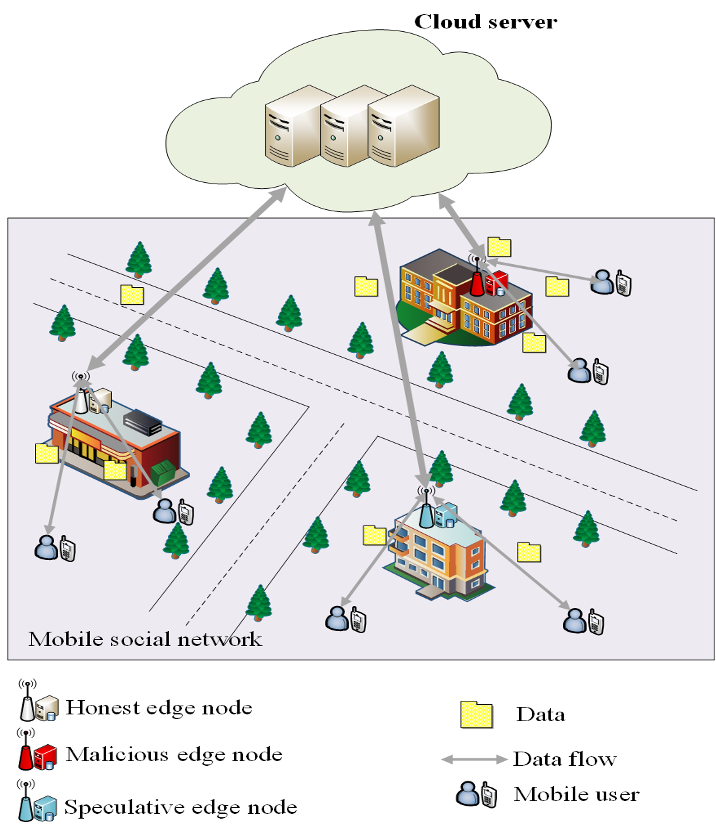 Figure 1: The system model illustrating interactions between Cloud, Edge Nodes, and Mobile Users.
Mathematizing Intuition
The utility for a user choosing node is modeled as: Where is the trust degree and is the size. This ensures that even if a node offers a very low price (), a low trust score () will drive the utility down, preventing users from falling for malicious "honey-pot" nodes.
Experimental Validation
The researchers simulated a network of 20 edge nodes and 50 users. They compared their proposal against:
- Random Scheme: Nodes selected arbitrarily.
- Standard Matching: Matching based on price/size but without trust evaluation.
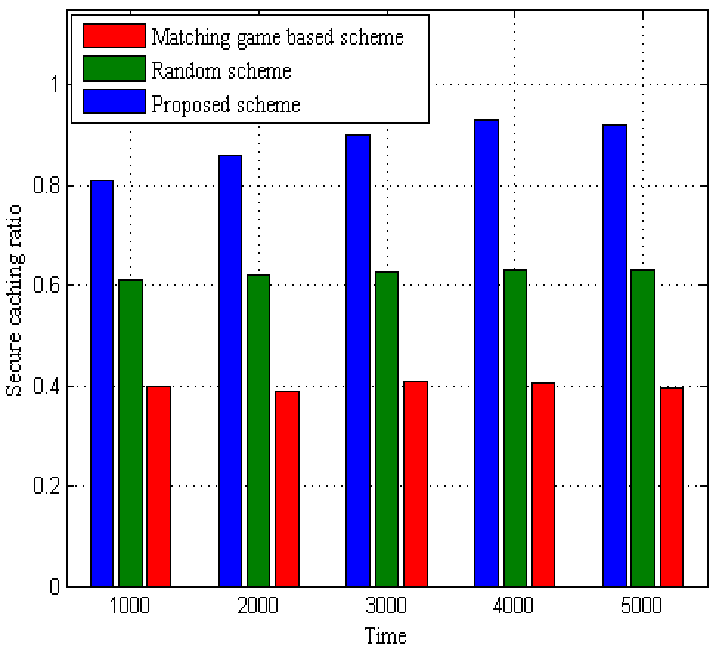 Figure 2: Secure Caching Ratio over time. The proposed scheme (solid line) maintains 90%+ security, while others suffer due to malicious node infiltration.
Key Finding: Malicious nodes often try to "buy" traffic by offering low prices. Without the trust evaluation mechanism, standard matching algorithms are easily deceived. The proposed scheme identifies these patterns and shifts traffic to reputable honest nodes.
Summary and Future Outlook
This work highlights that in the era of Mobile Big Data, Trust is a Resource. By quantifiable trust through social relationships and historical data, we can build edge networks that are not just fast, but resilient. The authors suggest that the next frontier is Privacy Disclosure—ensuring that while we trust a node to store data, we also prevent it from "peeking" at sensitive user information.