
SocialCloud: Turning Social Trust into a Decentralized Supercomputer
Trustworthy Distributed Computing on Social Networks
The paper introduces "SocialCloud," a novel decentralized computing paradigm where resource sharing is bootstrapped by social trust ties. Unlike traditional grids, it leverages 1-hop social acquaintances to ensure security and altruistic participation, achieving significant performance gains in distributed task execution.
TL;DR
SocialCloud is a paradigm shift in distributed computing that replaces the commercial "pay-as-you-go" model with an altruistic, social-tie-based resource sharing economy. By bootstrapping from real-world social graphs, it solves the long-standing "trust gap" in volunteer computing, enabling secure and efficient task outsourcing to 1-hop social neighbors.
Potential & Motivation: The Trust Deficit in Distributed Systems
While Cloud Computing has revolutionized access to resources, it remains a centralized "black box" where users have little control over data privacy. On the other hand, Grid and Volunteer Computing (like SETI@home) depend on the goodwill of strangers, making them vulnerable to "Sybil attacks" (where one attacker creates multiple fake identities) and "stragglers" (slow nodes that stall the entire process).
The authors' key Insight is that the missing ingredient in decentralized computing isn't just more bandwidth or CPU—it is Social Trust. By restricting workers to a user's actual social circle, the system gains a built-in security layer that is naturally resistant to malicious infiltration.
Methodology: Architecture of a Trusted Cloud
SocialCloud operates as an overlay on existing social structures. The design focuses on two critical components:
1. The Scheduling Framework
The system supports both centralized and decentralized scheduling. While centralized servers are efficient for state management (O(n) communication), the authors advocate for Decentralized Scheduling to avoid single points of failure and preserve the privacy-first nature of social networks.
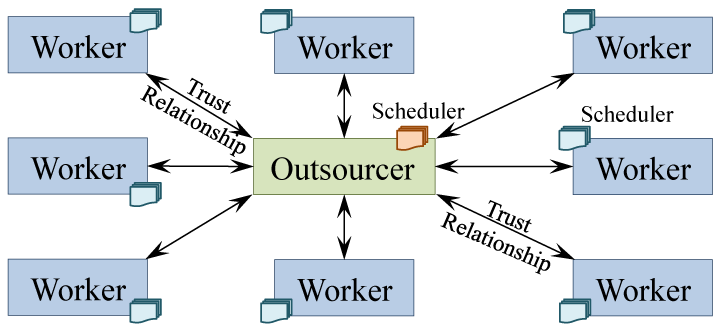
2. Trust-Based Job Distribution
Instead of treating all neighbors equally, SocialCloud applies two sophisticated metrics to weight task distribution:
- Similarity-based (Jaccard Index): The more mutual friends two users share, the higher the trust.
- Interaction-based: Frequent communication over time signals a stronger, more reliable bond.
These weights ensure that if a "friend" is actually an infiltrator, they receive a negligible portion of the workload, which can be easily re-executed by a more trusted peer if it fails.
Experiments: Real-World Graph Performance
The authors tested SocialCloud using diverse datasets, including DBLP (scholarly co-authorship) and Epinion (friendship).
Key Finding: Structure Matters
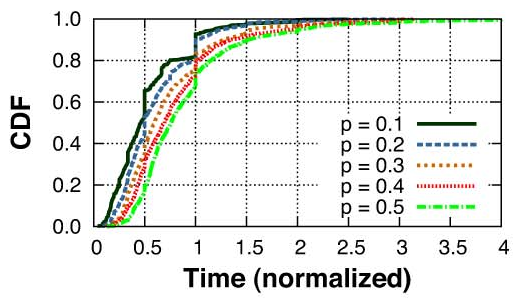
Interestingly, "sparse" graphs like DBLP—often criticized in security circles for being "slow-mixing"—actually performed better for SocialCloud. These structures naturally facilitate self-load-balancing when only a fraction of users have active tasks.
Fighting the Adversary
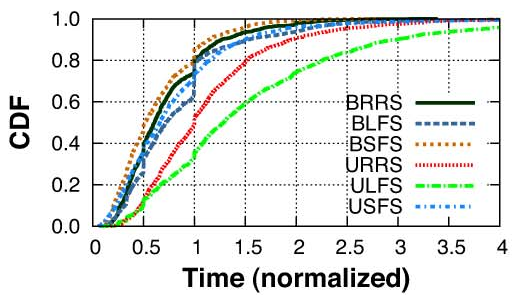
In the presence of malicious nodes, trust-based scheduling proved decisive. As shown in the comparison below, the similarity and interaction models significantly outperformed "plain" scheduling, ensuring that the system remains functional even during an attack.
Critical Analysis & Conclusion
The core contribution of this work is the marriage of Algorithmic Properties (connectivity) with Social Trust.
Takeaways:
- Altruism is Scalable: Using social obligations as an "economic" model can effectively replace financial incentives for specific scientific and personal workloads.
- Robustness via Local Information: Limiting scheduling to 1-hop neighbors creates a "small world" effect that is highly resilient to large-scale network failures.
Limitations: The study currently abstracts away hardware heterogeneity (GPU vs. CPU) and I/O bottlenecks. In a real-world deployment, the bandwidth required to transfer code and data between social peers could potentially offset the "free" CPU cycles.
Future Outlook: As we move toward a more decentralized internet (Web3), the "SocialCloud" ethos offers a blueprint for how we might build global-scale systems that are owned by communities rather than corporations, using our friends as our most trusted server farm.