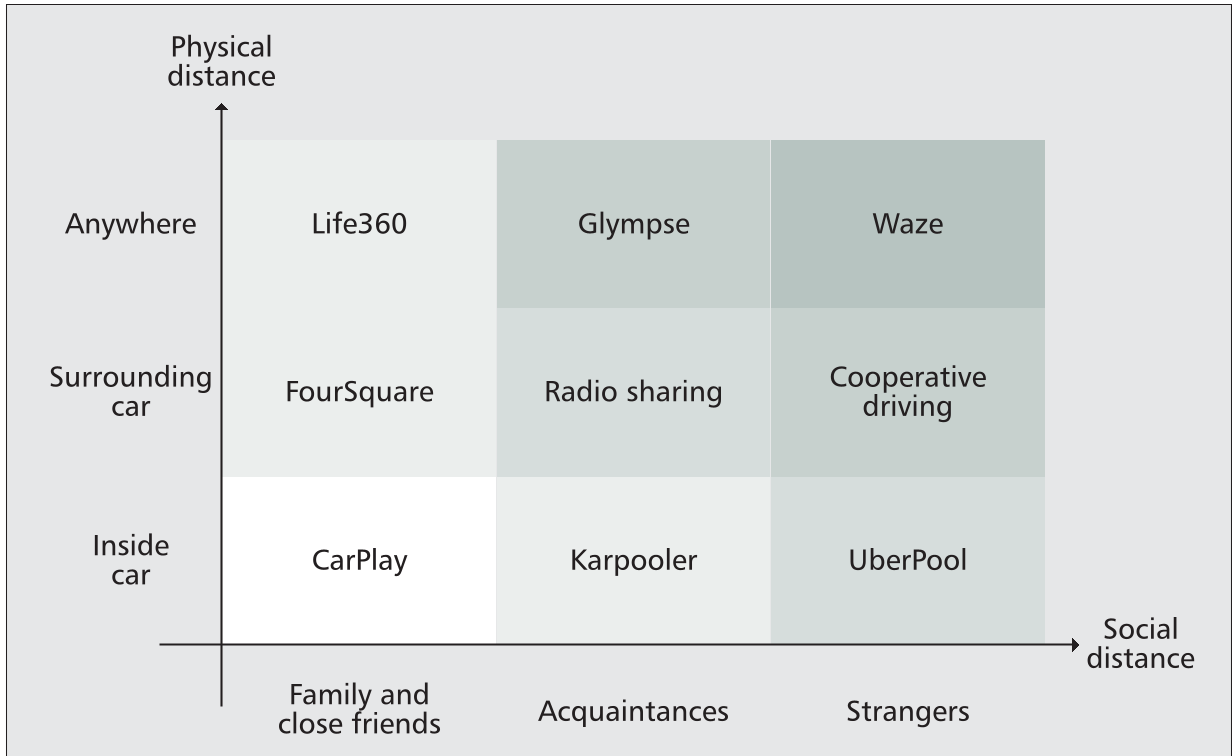
Toward Trustworthy Vehicular Social Networks: Beyond Identity Authentication
8390_Toward trustworthy vehicular social networks.
This article presents a framework for "Trustworthy Vehicular Social Networks" (VSNs), integrating Online Social Network (OSN) trust models into automotive connectivity. It proposes a decentralized Social Connection Tree (SCT) to measure direct trust through interactions and utilizes Subjective Logic for indirect trust inference among stranger vehicles.
TL;DR
As the "Connected Car" market surges, the risks of misinformation—from fake traffic jams to malicious sensor spoofing—become critical. This paper argues that traditional security (PKI) is insufficient. Instead, it proposes transforming vehicular networks into Vehicular Social Networks (VSNs), leveraging social trust models (like Subjective Logic) to help cars decide which "stranger" vehicles to believe.
Context: Why Encryption Isn't Enough
In the world of autonomous and connected vehicles, a "legitimate" car (one with a valid digital certificate) can still be a source of "untrustworthy" data. A driver might report a fake accident to clear a lane for themselves, or a compromised sensor might broadcast incorrect weather alerts.
Current systems rely on Public Key Infrastructure (PKI). PKI confirms who sent the message, but it doesn't confirm if the content is true. The authors argue we need a "Social Layer" where vehicles build reputations based on historical interactions and mutual "friends" (other vehicles).
Methodology: Building a Social Graph on Wheels
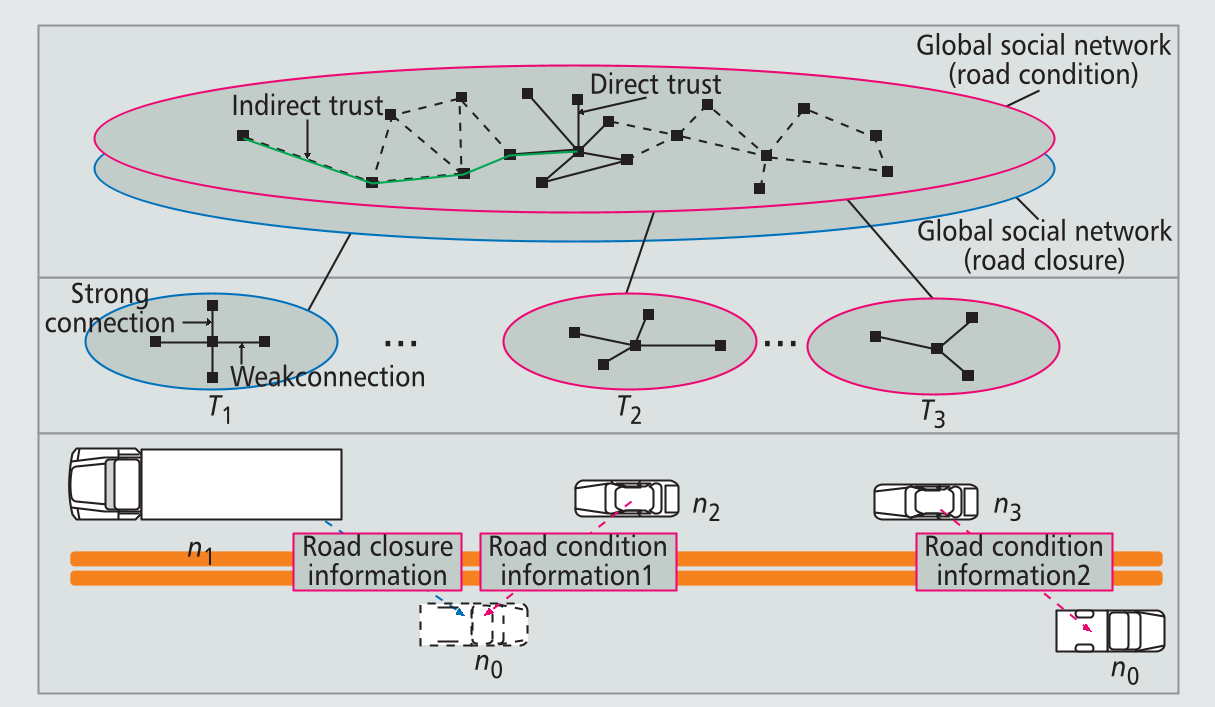
The paper defines the life cycle of a vehicular relationship in three stages: Creation (weak connection), Cultivation (becoming strong through frequent encounters), and Maintenance/Termination.
1. Direct Trust (Local Interaction)
Vehicles maintain a Social Connection Tree (SCT).
- Root: The vehicle itself.
- Edges: Represent direct interactions (e.g., sharing road conditions).
- Logic: More positive interactions increase the "weight" of the connection.
2. Indirect Trust (Social Recommendation)
How do you trust a vehicle you've never met? The author adopts Subjective Logic, which goes beyond binary (Trust/Distrust) by adding Uncertainty.
- If Vehicle A trusts B, and B trusts C, A can infer a level of indirect trust for C.
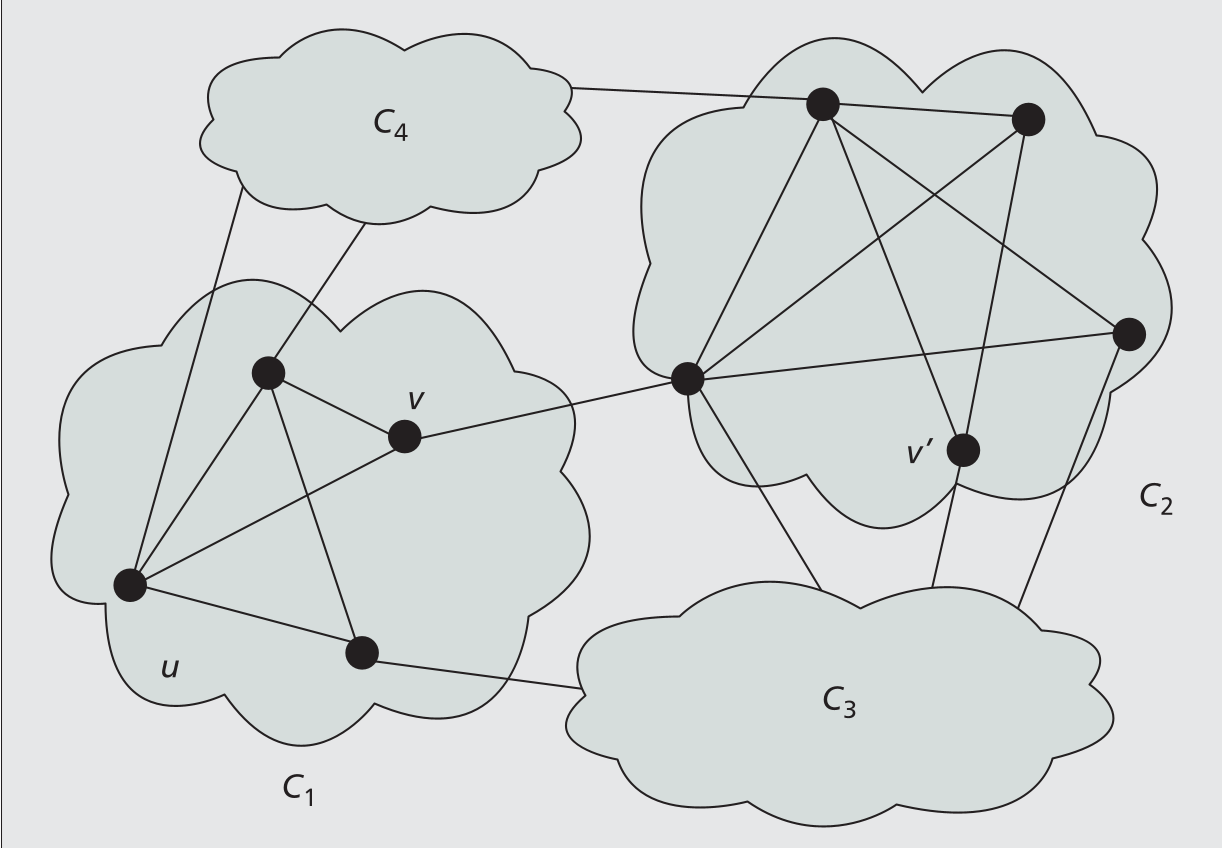
- The NP-Hard Challenge: Finding all paths between two nodes in a massive, moving global graph is computationally impossible in real-time.
Technical Innovation: Managing Complexity
To make this practical, the authors propose a Resource-Aware Discrimination scheme:
- Graph Clustering: Dividing the global network into clusters (using k-means or spectral analysis) so vehicles only search for trust paths within a relevant local vicinity.
- Piggybacking: Instead of every car sensing everything, they share "untrustworthy" notifications with their high-trust friends, creating a "neighborhood watch" effect for data integrity.
Critical Insight & SOTA Comparison
Earlier SOTA methods in vehicular security focused purely on Sybil Attack detection (binary classification of fake nodes). This work advances the field by treating trust as a continuous spectrum. By incorporating "Uncertainty" from Subjective Logic, the model reflects the physical reality of wireless communication—where signal noise and transient connections are the norm, not the exception.
Conclusion: The Road Ahead
The paradigm shift from "Vehicular Network" to "Vehicular Social Network" is not just semantic. It acknowledges that in a decentralized system, social-inspired heuristics are often more robust than centralized hierarchies.
Future Work must address:
- Privacy: How to build a social graph without leaking the driver's movements (location privacy).
- Cross-Domain Trust: Can a car trust a roadside sensor as much as a fellow vehicle?
The future of self-driving isn't just about seeing the road; it's about knowing who to listen to on the road.
Metadata Reference Table for VSN Applications: