
STDA: Optimizing Truth Discovery via Active Learning and Crowdsourcing
Truth Discovery Based on Crowdsourcing
This paper introduces the STDA (Simple Truth Discovery framework with Active learning), a novel framework for truth discovery that integrates basic voting algorithms with crowdsourcing and active learning. By leveraging a "Committee-based" active learning model to select highly uncertain data points for human crowd intervention, the system achieves SOTA-level accuracy in resolving data conflicts while minimizing worker costs.
TL;DR
In an era of information explosion, "truth discovery"—the process of resolving conflicting data from multiple sources—is critical. STDA (Simple Truth Discovery framework with Active learning) bridges the gap between automated voting and expensive human expertise. By using a committee-based active learning model to identify the most "confusing" data points for human workers to label, STDA achieves high accuracy with minimal human intervention.
Problem & Motivation: The Limitations of Popularity
Most automated truth discovery algorithms operate on a simple premise: the most frequent value is likely the truth. However, the web is rife with copying behaviors, where multiple low-quality sources replicate the same error.
The authors identify a core tension:
- Automated methods are cheap but struggle with complex conflicts or systemic errors.
- Expert verification is accurate but prohibitively expensive for large-scale databases.
The research intuition here is to use Crowdsourcing as a middle ground and Active Learning as a filter to ensure that we only pay for human intervention when the machine is genuinely uncertain.
Methodology: The STDA Framework
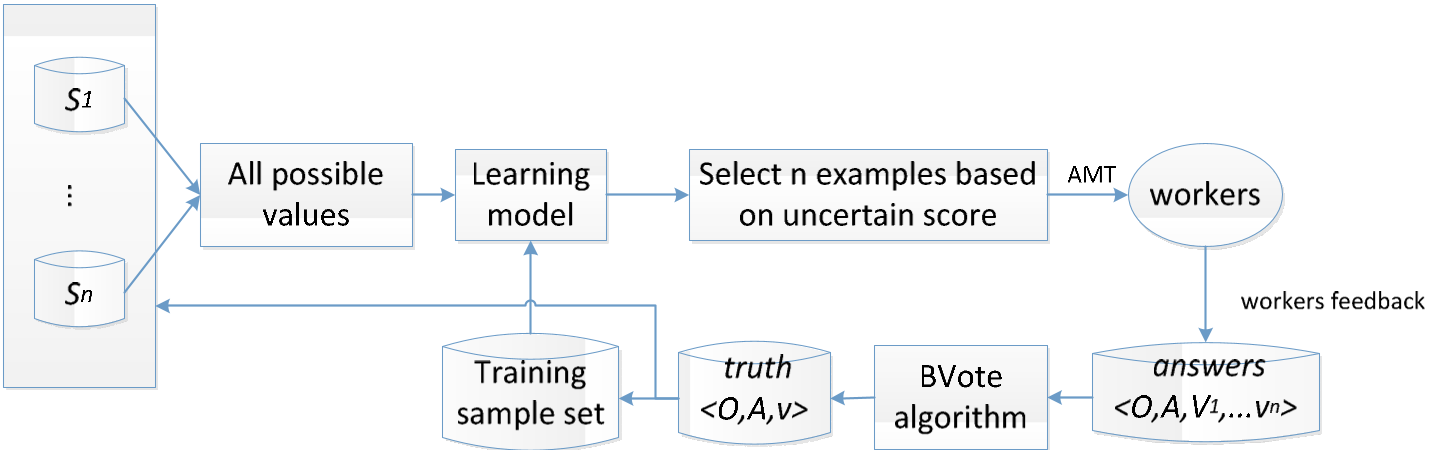
The core of the paper is the STDA (Simple Truth Discovery Framework). It functions through a cyclic process of machine prediction and human feedback.
1. The BVote Baseline
The process starts with BVote. For any given attribute of a tuple , it collects all values from sources and selects the one with the highest frequency. This serves as the initial "candidate true value."
2. Active Learning via Committees
To determine which values need human checking, the paper employs a "Query by Committee" strategy:
- Disjoint Partitioning: The training set is split into sets, and a series of committees () are trained.
- Uncertainty Scoring: The framework uses an Entropy-based score () to measure disagreement among the committee members.
If the committee members disagree significantly, the uncertainty is high, and the record is flagged for the crowd.
3. Human-in-the-Loop
Selected uncertain records are sent to Amazon Mechanical Turk (AMT). Workers provide their selections, which are then used to:
- Confirm the final true value.
- Retrain the machine learning model, creating a positive feedback loop that increases the model's autonomous accuracy over time.
Experiments: Performance Analysis
The authors validated STDA using two primary datasets:
- IndepSet: A synthetic dataset with 20 independent sources to test controlled variables.
- BookAuthors: A real-world dataset containing 1,115 CS books and 41,000 records from bookstores like AbeBooks.
Key Findings
- Accuracy Boost: In the BookAuthors dataset, STDA began to significantly outperform the
BVotebenchmark as more worker feedback was integrated. - Efficiency: The active learning component successfully prioritized the "hardest" cases, meaning the system didn't need to ask humans about every single conflict to reach a high level of global accuracy.
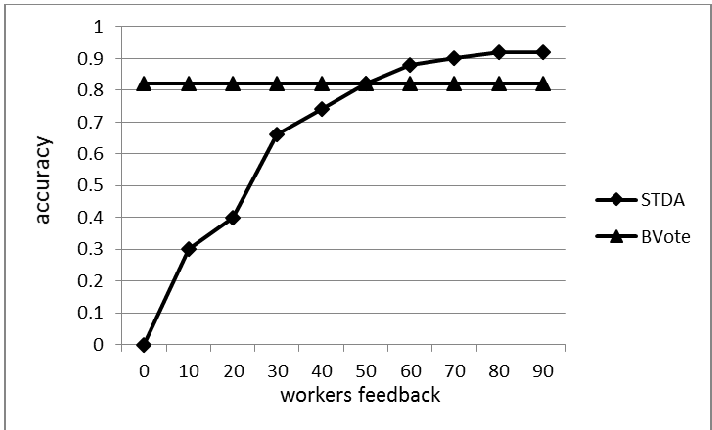 (Image: Comparison between BVote and STDA across different feedback levels)
Critical Analysis & Conclusion
The STDA framework represents a significant step toward "intelligent" data cleaning. Its strength lies in its simplicity and modularity—it can be integrated into existing data integration pipelines with relatively low overhead.
Limitations
- Worker Quality: The current model assumes a contribution of "1" for every worker, ignoring the fact that some workers may be unreliable or malicious.
- Privacy: Sending internal database records to a public crowdsourcing platform like AMT raises privacy concerns, which the authors acknowledge as future work.
Final Takeaway
This paper demonstrates that for Truth Discovery, who we ask is just as important as what we ask. By focusing human attention on the most uncertain 50% of data, STDA provides a blueprint for cost-effective, high-precision data integration that outperforms standard statistical voting.