
TATP: Harmonizing Truthful Incentives and Location Privacy in Mobile Crowdsourcing
Truthful incentive mechanism with location privacy-preserving for mobile crowdsourcing systems R
The paper introduces TATP, a Two-stage Auction algorithm based on Trust degree and Privacy sensibility, combined with a -differential privacy mechanism for mobile crowdsourcing. It aims to maximize system efficiency and user truthfulness while protecting sensitive worker location data against continuous tracking and background knowledge attacks.
TL;DR
Mobile crowdsourcing (MCS) depends on workers reporting data truthfully and platforms protecting worker privacy. This paper presents TATP, an improved two-stage auction mechanism that filters workers based on trust and privacy needs, paired with a hybrid -differential privacy model to shield location trajectories from sophisticated attackers.
Problem & Motivation: The Tug-of-War Between Utility and Privacy
In a typical MCS system (like Waze or Uber), the platform wants the highest quality data for the lowest cost. However, two major hurdles remain:
- Trust & Truthfulness: How do we stop workers from submitting low-quality data or "gaming" the auction?
- Location Vulnerability: Location data is highly sensitive. Even if you hide a user's ID (anonymization), an attacker with "background knowledge" (e.g., knowing where you work) can easily re-identify you from your movement patterns.
Most prior works treat these as separate issues. Static auctions fail in real-time environments, and basic -anonymity fails against "continuous attacks" where the attacker tracks a user over multiple time steps.
Methodology: The TATP Framework
The authors tackle this by splitting the solution into two core modules: the Auction (TATP) and the Privacy Guard ().
1. The TATP Auction Mechanism
Unlike standard auctions that might reject early bidders (the "Secretary Problem"), TATP uses two stages:
- Stage 1 (Sampling): The platform collects a batch of bids to estimate the "market price" and determine a dynamic threshold.
- Stage 2 (Competition): Arriving workers are evaluated not just on their bid price, but on their Trust Degree () and Privacy Sensibility ().
- Trust Decay: Trust isn't static. It follows the Ebbinghaus Forgetting Curve, where older behaviors have less impact on current trust scores.
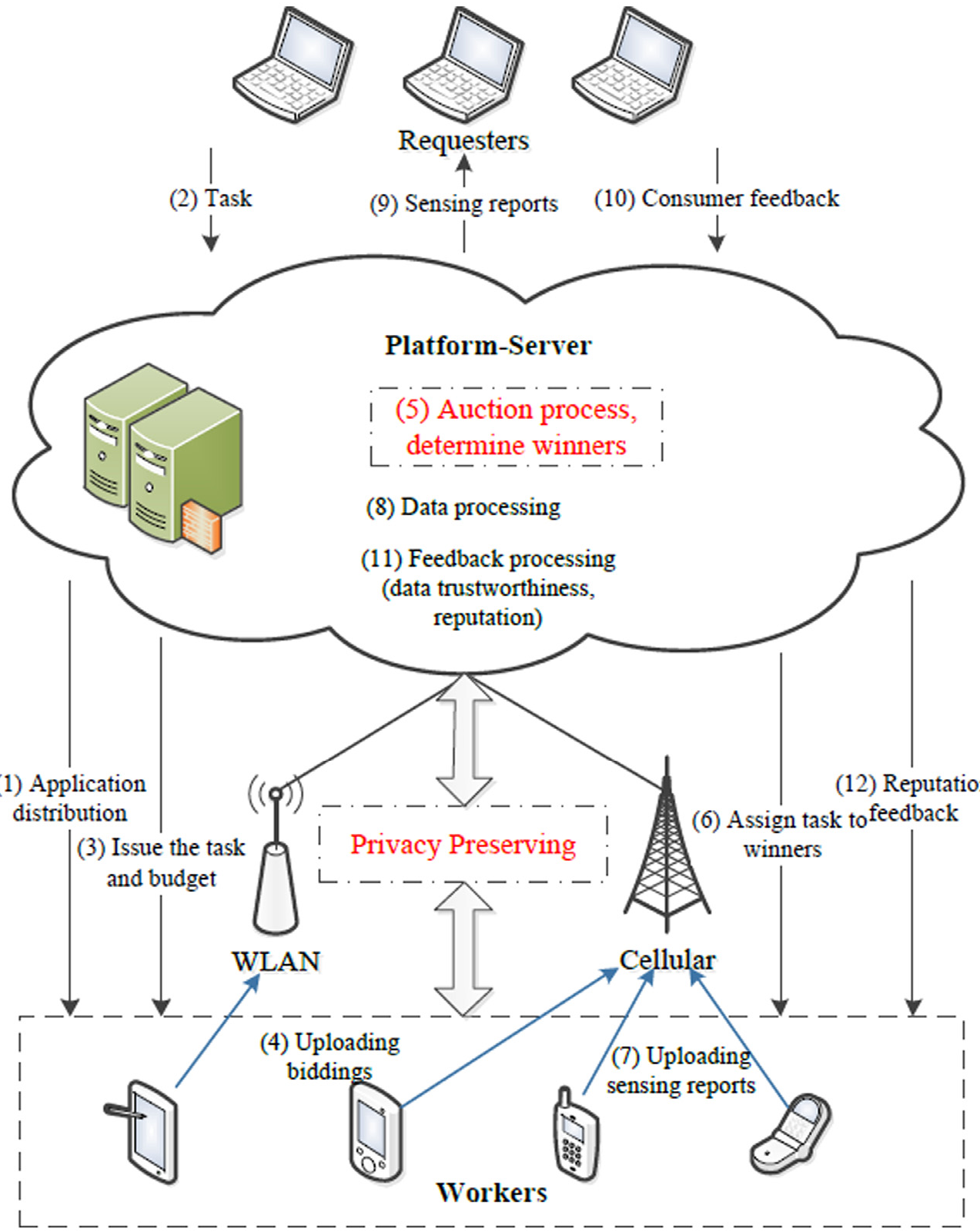 Figure: The architecture of the mobile crowdsourcing system featuring the TATP auction and privacy layers.
2. -Differential Privacy
To stop location leaks, the paper combines two worlds:
- -Anonymity: Ensures a worker's location is indistinguishable from at least others in a "Spatio-temporal Box."
- -Differential Privacy: Adds Gaussian white noise to the reported data. This ensures that the presence or absence of a single individual's data doesn't significantly change the output, thwarting attackers who have partial knowledge of the dataset.
Experimental Results
The authors validated TATP using real-world GPS traces from taxis in Beijing and New York.
Auction Efficiency
Compared to ITA (a general incentive mechanism) and traditional auctions, TATP allowed the platform to recruit enough workers to complete the task much faster. This proves that considering "Trust" prevents the system from wasting budget on unreliable participants.
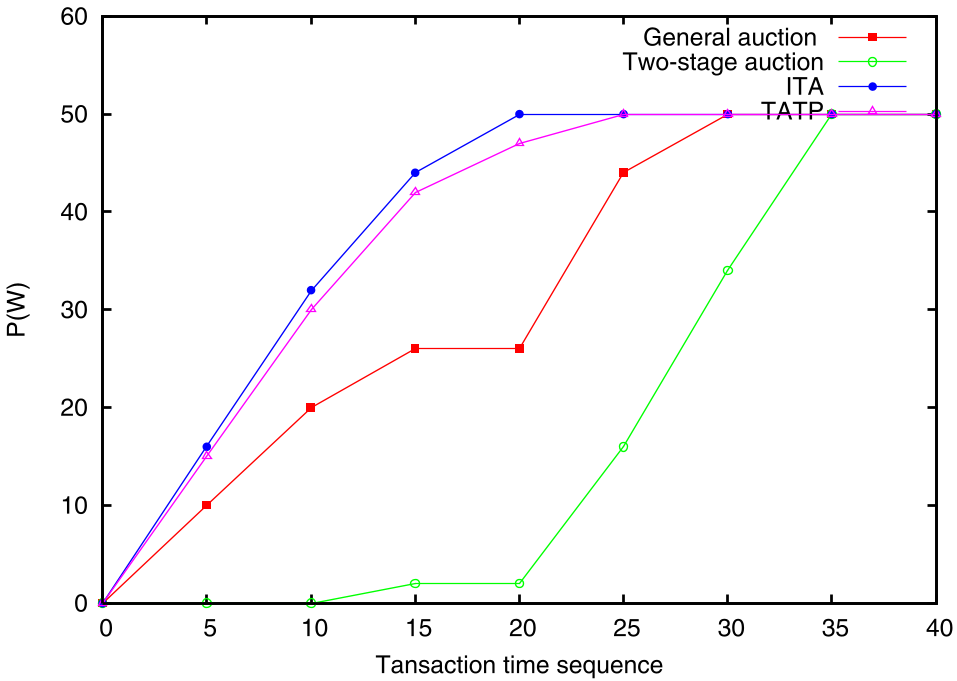 Figure: Comparison of auction efficiencies showing TATP reaching budget/task requirements faster than classic baselines.
Privacy Protection
Using Shannon's Entropy as a metric, the paper demonstrates that the approach provides significantly higher privacy levels than "Clique" based or "BPS" based location cloaking. As the privacy budget is adjusted (decreased), the noise increases, providing a customizable "shield" for the user.
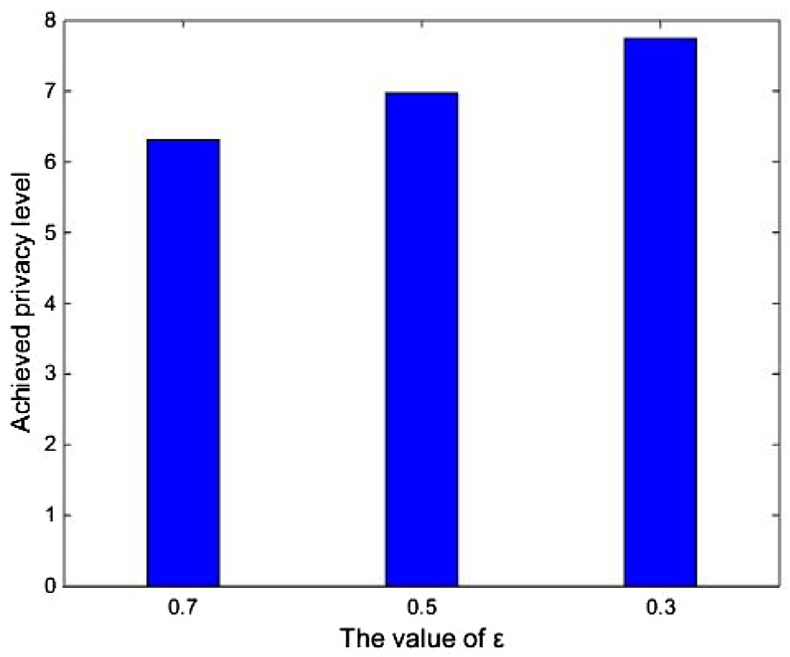 Figure: Privacy levels across different participant counts on Beijing and New York datasets.
Critical Insights & Conclusion
The brilliance of this work lies in the mathematical coupling of trust and privacy. By acknowledging that "privacy sensibility" is a cost factor for the worker, the auction becomes more "truthful"—workers don't feel the need to lie about their locations or costs if they know their privacy is mathematically guaranteed.
Limitations: While the Gaussian noise protects privacy, it inevitably introduces "data pollution." Future research must find the optimal "Goldilocks zone" where the noise is enough to hide the user but not so much that the sensing data becomes useless for the requester.
Final Takeaway: TATP proves that in the age of Big Data, Trust is the new currency, and Differential Privacy is the vault.