
BP-UCB: Mastering the Economics of Crowdsourcing via Regret Minimization
4403_Truthful incentives in crowdsourcing tasks using regret minimization mechanisms.
The paper introduces BP-UCB, a novel posted-price mechanism for online budgeted procurement in crowdsourcing. It leverages the Multi-Armed Bandit (MAB) framework and regret minimization to provide a budget-feasible, incentive-compatible system that achieves near-optimal utility with additive regret guarantees.
Executive Summary
In the world of online labor markets like Amazon Mechanical Turk, "How much should I pay?" is a multi-million dollar question. Pay too much, and you waste your budget; pay too little, and your tasks sit idle. This paper presents BP-UCB, a pricing mechanism that treats crowdsourcing as a learning problem. By transforming procurement auctions into a Multi-Armed Bandit (MAB) setting, the authors provide the first mechanism that is simultaneously budget-feasible, truthful (incentive compatible), and achieves no-regret performance, outperforming prior methods by a staggering 180%.
The Core Challenge: The Cost of Information
The central difficulty in crowdsourcing isn't just paying workers—it's that the requester doesn't know the true cost distribution of the workforce. Workers are strategic; if they think you'll pay more, they'll bid higher.
Current platforms use a "Fixed Price" model, which is rigid and often sub-optimal. The "Bidding Model" is better but harder to implement because it requires workers to understand complex auction rules. The authors target the "Posted Price Model"—a take-it-or-leave-it offer—which is natural for humans but requires the requester to learn the optimal price on the fly while spending a finite budget.
Methodology: From Auctions to Bandits
The authors visualize the problem as a "cost curve" where the intersection of budget constraints and worker availability defines the optimal price . Since is unknown, they discretize the price range into arms.
The BP-UCB Mechanism
- Exploration vs. Exploitation: Using an Upper Confidence Bound (UCB), the model maintains an "optimistic" estimate of the utility of each price arm.
- Budget Guardrails: Unlike standard MAB, BP-UCB must stop as soon as the budget is depleted. The mechanism must account for the fact that expensive arms provide more data (higher acceptance) but kill the budget faster.
- Correlation Exploitation: If a worker rejects a price , we can safely assume they would also reject any price lower than . BP-UCB uses this to update multiple arms simultaneously, accelerating convergence.
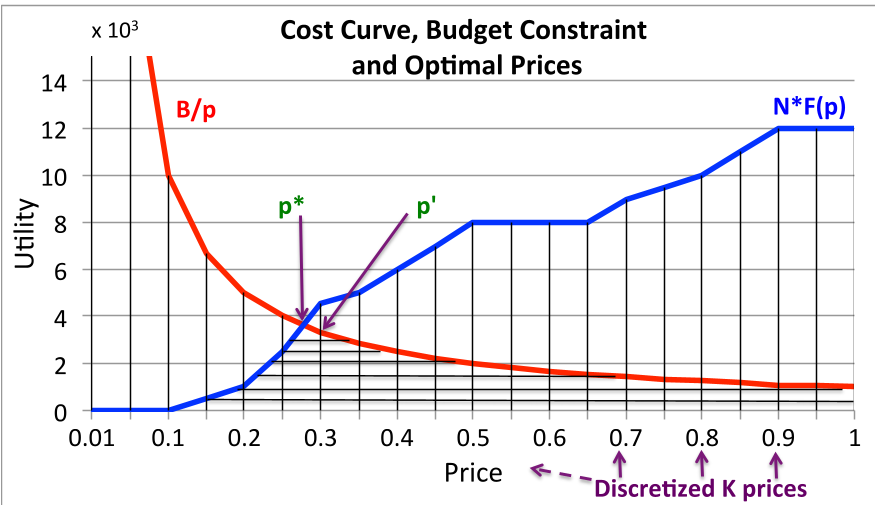 Figure 1: The optimal price occurs at the intersection of the budget constraint and the worker cost distribution.
Proven Performance: 180% More Utility
The researchers tested BP-UCB against "PP'12" (the previous state-of-the-art) using both synthetic data and a survey of 1,200 real workers on Mechanical Turk.
- Utility Leap: In both simulated and real-world trace data, BP-UCB achieved nearly double the task completion rate of existing algorithms.
- Convergence: While other models fluctuated between prices, BP-UCB quickly locked onto the most efficient price arm.
- Robustness: Even when workers didn't arrive in a strictly random (stochastic) order—such as when costs trended upward over time—the mechanism remained stable.
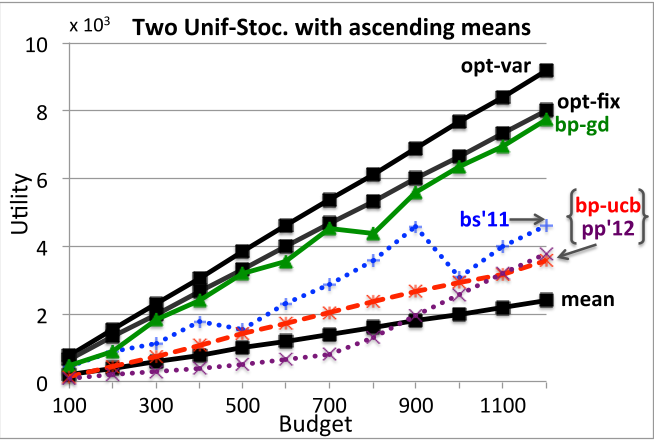 Figure 2: BP-UCB (blue) significantly outperforming the state-of-the-art PP'12 (red) on real Mechanical Turk distributions.
Critical Insight & Conclusion
The true value of this paper lies in its additive regret analysis. Previous theories focused on "approximation ratios" (e.g., being at least half as good as the best). In a large-scale market, a 0.5 ratio is a massive failure. By proving that the average regret goes to zero, the authors ensure that as the budget grows, the mechanism becomes perfectly efficient.
Takeaway: If you are designing an online marketplace, stop guessing prices. Use a no-regret learning framework. BP-UCB proves that transparency (posted prices) and efficiency (optimal utility) can coexist in crowdsourcing.
Limitations to Watch
- Homogeneity: The model assumes all tasks are identical. In reality, a "high-quality" worker might require a higher price than a "low-quality" one.
- Strategic Delay: If workers know the price changes over time, they might wait for the "exploration" phase to end to get a higher price.