
TMC-VCG & TMC-ST: Tackling Market Manipulation in Online Crowdsourcing
Truthful mechanism for crowdsourcing task assignment
The paper proposes two truthful incentive mechanisms, TMC-VCG and TMC-ST, for online crowdsourcing task assignment. By modeling the process as a reverse auction, the authors address the challenge of self-interested participants misreporting costs or budgets to manipulate the market while achieving State-of-the-Art (SOTA) performance in reliability and social welfare.
TL;DR
In the "gig economy" of crowdsourcing, both workers and requesters are naturally self-interested, often misreporting their true valuations to gain an edge. This paper introduces two novel auction-based mechanisms—TMC-VCG and TMC-ST—that force participants to be honest (Truthfulness) while ensuring tasks are completed by the most reliable workers. While TMC-VCG offers high transaction volume, TMC-ST provides a more practical, budget-balanced approach with superior social welfare and efficiency.
The Problem: The "Honesty" Gap in Crowdsourcing
As platforms like Amazon Mechanical Turk grow, the assumption that everyone "plays fair" is collapsing. Current task assignment algorithms face a triple threat:
- Strategic Manipulation: Workers bid higher than their actual costs; requesters offer lower than their true budgets.
- Quality Uncertainty: How do you ensure a low-cost worker isn't providing low-quality output?
- The Online Dilemma: Platforms must make assignment decisions on-the-fly without knowing which workers or tasks will appear in the next hour.
Existing SOTA methods often solve for efficiency but ignore the game-theoretic incentives of the participants.
Methodology: Virtual Bids and Strategic Auctions
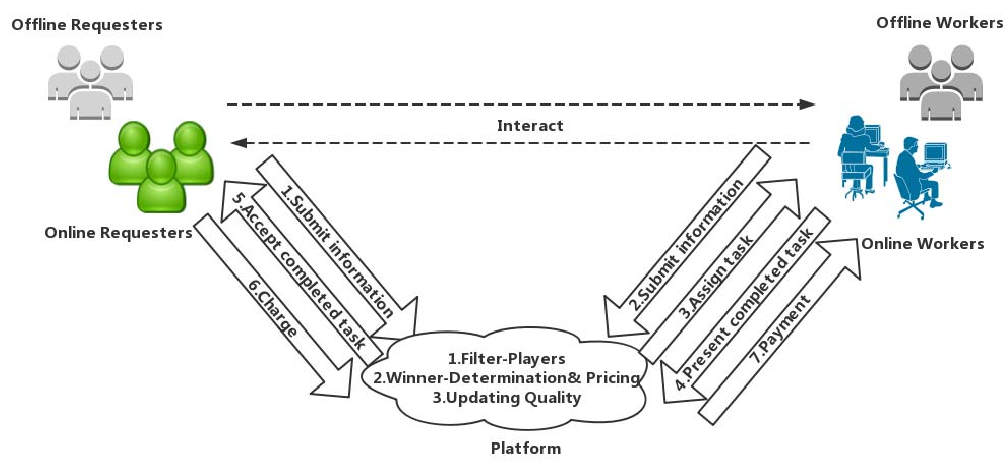
The authors treat the platform as a Reverse Auction auctioneer. The "secret sauce" is the introduction of Virtual Values.
1. The Quality-Value Integration
Unlike standard auctions, this model adjusts bids based on a participant's quality score ():
- Virtual Bid (): . This rewards high-quality requesters.
- Virtual Ask (): . This ensures that "cheap but bad" workers don't automatically win.
2. TMC-VCG (The Theoretical Benchmark)
Based on the Vickrey-Clarke-Groves (VCG) model, this mechanism calculates payments based on the "opportunity cost" a participant imposes on the system. It uses a Maximum Weighted Matching (MWM) algorithm on a bipartite graph.
3. TMC-ST (The Practical Iterative Solution)
TMC-VCG is computationally expensive and often results in a "budget deficit" for the platform. TMC-ST solves this by:
- Ranking Requesters: Based on urgency and quality.
- Reliability-based Worker Selection: Sorting workers by the ratio of .
- Iterative Matching: Processing assignments sequentially, which ensures the platform never pays out more than it collects (Budget Balance).
Experimental Insights
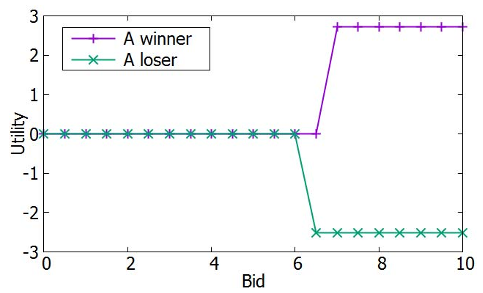
The authors conducted extensive simulations to test the "Truthfulness" of these models.
Key Comparisons:
- Truthfulness: As shown in the figures above, the utility of a participant peaks exactly when they report their true value. Any deviation (over-bidding or under-bidding) leads to lower utility or financial loss.
- Social Welfare: TMC-ST surprisingly outperforms TMC-VCG in social welfare. This is because VCG the assignment is distorted by the virtual values in a way that sometimes favors transaction volume over total system utility.
- Efficiency: TMC-ST follows a nearly linear growth in computation time, making it much more scalable than the VCG-based approach as the number of slots increases.
Critical Analysis & Conclusion
The core contribution of this work is the bridge between Online Learning (Quality scores) and Mechanism Design (Truthfulness).
Strengths:
- Proves that truthfulness and reliability can coexist in crowdsourcing.
- TMC-ST provides a computationally feasible "greedy" approach that doesn't sacrifice economic integrity.
Limitations:
- The current model only handles "Simple Tasks" (one worker per task).
- Quality is assumed to be an external parameter; the integration with real-time quality learning is mentioned but not the primary focus.
Future Outlook: The next frontier is Complex Task Assignment (Team Formation), where a single project requires a "bundle" of workers with different skills. This will require multi-dimensional auctions, which are significantly more complex to keep "truthful."