
Social Network Optimization (SNO): Revolutionizing Vehicle Energy Harvesting Design
Design of Tubular Permanent Magnet Generators for Vehicle Energy Harvesting by Means of Social Network Optimization
This paper introduces Social Network Optimization (SNO), a novel population-based evolutionary algorithm, and applies it to the design of a Tubular Permanent Magnet Linear Generator (TPMLG) for vehicle energy harvesting. By emulating human interactions and "influencer" dynamics within social groups, SNO achieves superior convergence in optimizing complex electromagnetic systems compared to standard genetic algorithms and particle swarm optimization.
TL;DR
Researchers have developed a new metaheuristic called Social Network Optimization (SNO) that mimics human social dynamics to solve complex engineering puzzles. By applying SNO to the design of tubular linear generators, they successfully increased harvested energy from road irregularities by 343%, outperforming traditional genetic and swarm-based algorithms.
Problem & Motivation: The "Stochastic Trap" in Machine Design
Designing an efficient electrical machine isn't just about picking dimensions; it's a high-dimensional balancing act. In the case of Tubular Permanent Magnet Linear Generators (TPMLGs) for vehicles, engineers must maximize power output without ruining the car's ride quality or road safety.
Existing tools like Genetic Algorithms (GA) or Particle Swarm Optimization (PSO) often struggle with:
- Local Optima: Getting stuck in "good enough" designs rather than finding the best possible one.
- Computational Burden: Every "guess" the algorithm makes requires a time-consuming Finite-Element Method (FEM) simulation.
- Conflicting Goals: Boosting power can increase cogging forces, which negatively affects vehicle vibration.
Methodology: Engineering as a Social Network
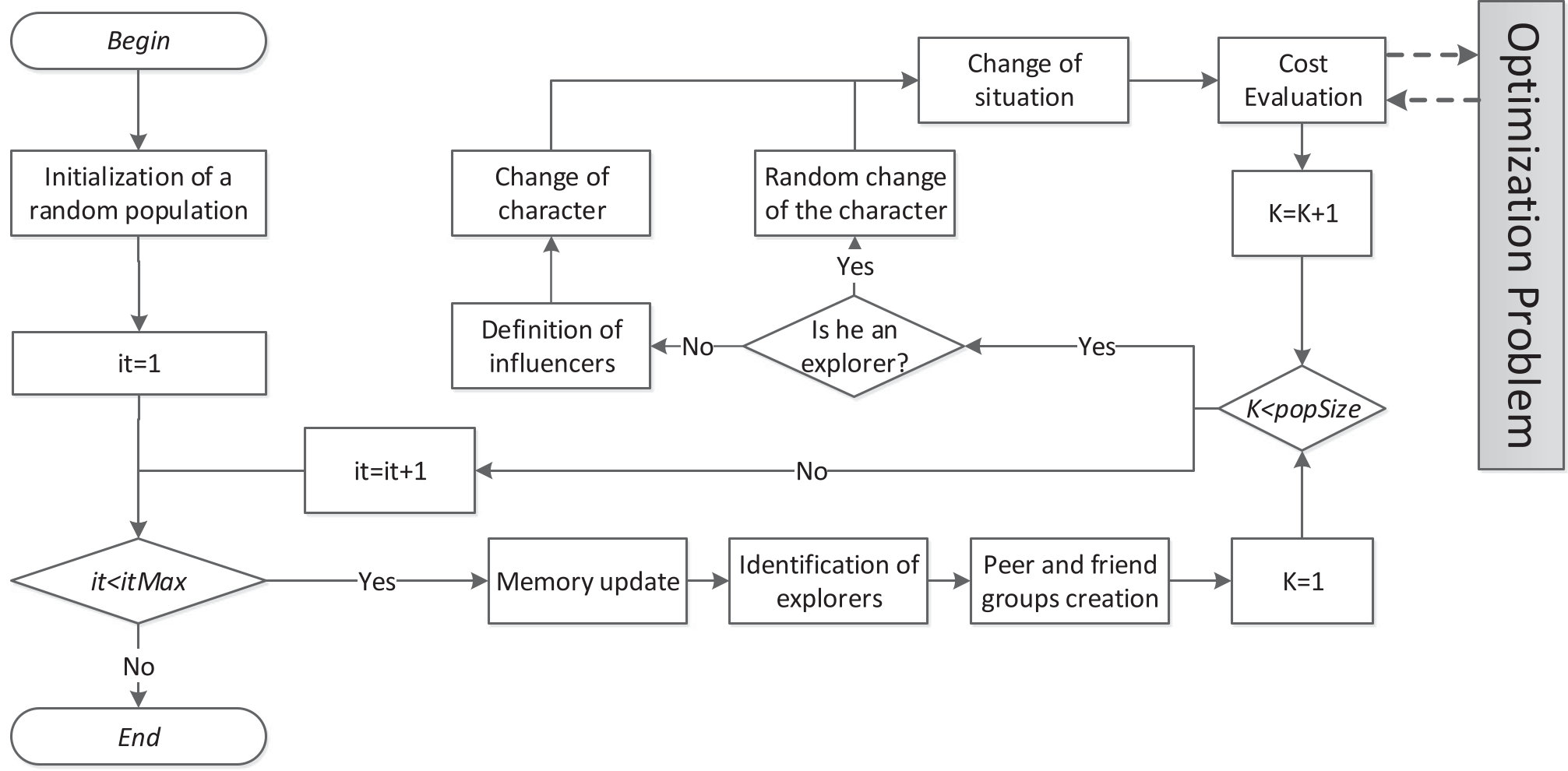
The core insight of the authors is that the way humans learn and influence each other in a social network can be modeled as a powerful search mechanism. SNO treats candidate solutions as "people" with a "status" (their current parameters) and a "character" (their direction of change).
1. The Interaction Framework
The algorithm divides the population into two types of groups:
- Friends: People with similar designs, encouraging local refinement.
- Peers: People with similar "characters," encouraging strategic exploration.
2. The Influencer Mechanism
Within these groups, "influencers" (the best-performing designs) attract others. The movement of an individual is governed by a complex interaction formula:
This balance of inertia, friend influence (), and peer influence () allows the algorithm to pivot quickly when a better design path is discovered.
Experiments & Results: Crushing the Benchmarks
The team first tested SNO against the TEAM Problem 25 (a standard die press optimization). SNO consistently delivered lower error values and better robustness than GA or PSO across 48 trials.
The TPMLG Breakthrough
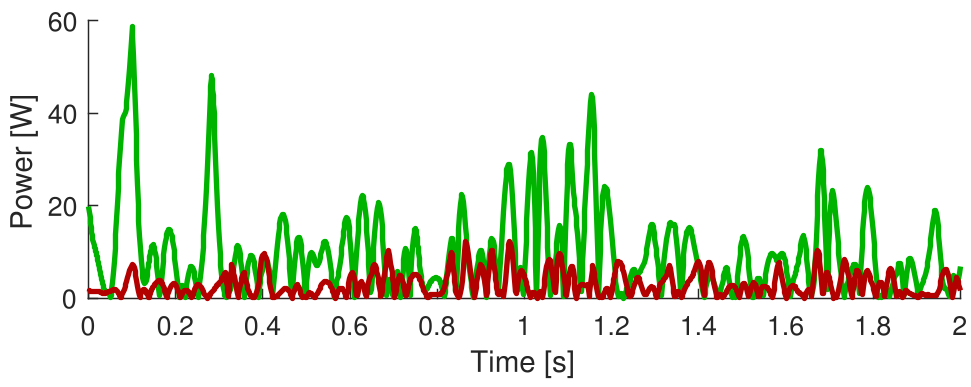
When applied to a vehicle energy harvesting system with 13 design variables (slots, magnet height, air gap, etc.), SNO performed a massive overhaul of the reference design.
- Energy Gain: The optimized generator produced 3.43 times more energy than the baseline.
- Constraint Satisfaction: It achieved this gain while keeping cogging forces below 150 N, ensuring vehicle comfort was not sacrificed.
- Sensitivity Discovery: SNO successfully identified that the number of stator slots is the dominant factor, influencing 80% of the performance outcomes.
Critical Analysis & Conclusion
This work demonstrates that Social Network Optimization is more than just a thematic gimmick; it provides a mathematically sound framework for "innovation" in search spaces. By incorporating "Explorers" who are immune to attraction, the algorithm effectively avoids the stagnation that plagues PSO and GA.
Takeaway: For R&D departments in automotive and electrical engineering, SNO offers a faster, more reliable route to SOTA designs in multi-physics domains.
Future Outlook: While SNO is powerful, its computational complexity is higher than PSO. Integrating SNO with machine-learning-based surrogate models could potentially eliminate the need for thousands of FEM calls, making the design process nearly instantaneous.