
Tuna-2: The Dawn of Encoder-Free Pixel-Space Multimodal Intelligence
Tuna-2: Pixel Embeddings Beat Vision Encoders for Multimodal Understanding and Generation
Tuna-2 is a native unified multimodal model (UMM) that performs visual understanding and generation directly in pixel space, bypassing traditional VAE and representation encoders. By employing simple patch embedding layers and a pixel-space flow matching head, it achieves state-of-the-art performance across multimodal benchmarks, including high-fidelity text-to-image generation and fine-grained perception.
Executive Summary
TL;DR: Tuna-2 is a revolutionary unified multimodal model (UMM) from Meta AI and HKU that completely discards the industry-standard vision encoders (like CLIP) and VAEs. By processing raw pixels directly through simple patch embeddings and a flow-matching head, it achieves a "monolithic" architecture that excels at both seeing (perception) and creating (generation).
Background: Within the current landscape of UMMs, most models are "Frankenstein" architectures—stitching together fixed, pretrained encoders with LLMs. Tuna-2 shifts the paradigm toward a native, end-to-end system that perceives the world at the pixel level, setting new SOTA benchmarks for 7B-scale models.
Problem & Motivation: The "Latent" Bottleneck
Why do we need to move away from encoders? The paper identifies a fundamental "Representation Mismatch." When we use a VAE to compress images into a latent space for generation, we often throw away fine-grained details (low-level textures, small object edges) that are crucial for high-precision visual understanding.
Existing models typically face a trade-off:
- Decoupled Representations: Using different encoders for understanding and generation leads to misalignment.
- Inductive Biases: Pretrained encoders like CLIP often have fixed resolutions and "blurred" perception of small objects.
The authors' intuition was simple: If we can learn directly from pixels, we can capture every detail, provided the model is powerful enough to handle the high-dimensional data.
Methodology: Simplicity is the Ultimate Sophistication
Tuna-2 simplifies the architecture into three main components:
- Patch Embedding Layer: Instead of a heavy ViT encoder, it uses a simple layer to turn image patches into tokens.
- Transformer Decoder: A unified backbone (based on Qwen2.5-7B) that handles both text and visual tokens.
- Pixel-Space Flow Matching: For generation, the model predicts the "velocity" of noise turning into a clean image directly in the pixel space ().
Architectural Evolution
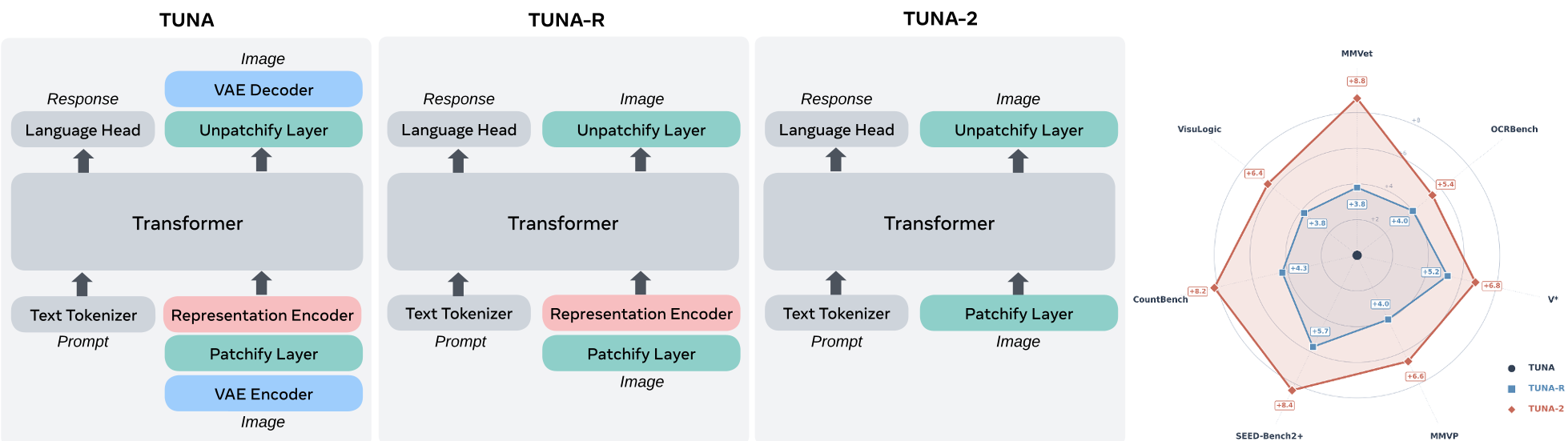 The transition from Tuna (VAE-based) to Tuna-R (VAE-free but with encoder) and finally to Tuna-2 (monolithic and encoder-free).
Learning Robust Features via Masking
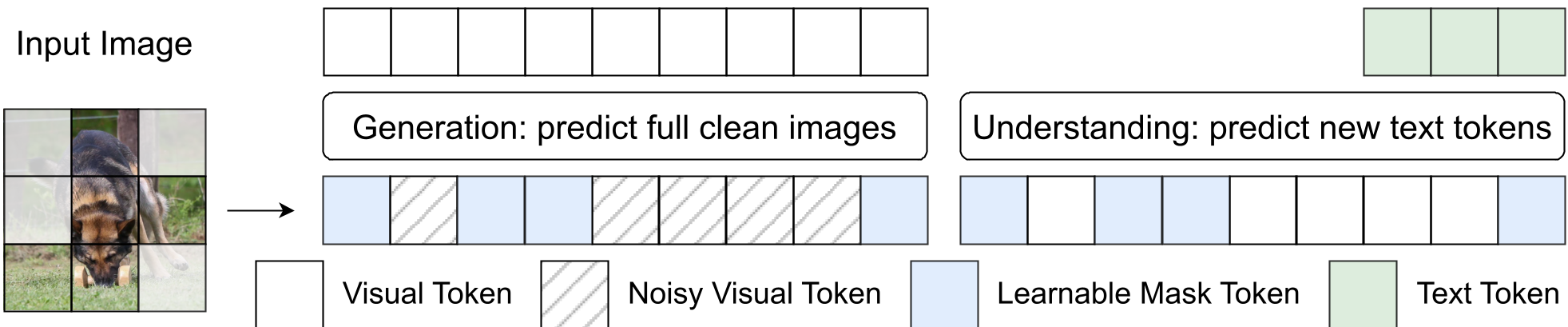
To prevent the model from taking "shortcuts" in the high-dimensional pixel space, the authors introduced a Masking-based Feature Learning scheme. By replacing image patches with a [MASK] token, the model is forced to:
- Understanding: Reason about the whole image from partial views.
- Generation: Reconstruct missing patches, effectively performing "Inpainting" as a pretext task.
Experiments & Results: Pixels Win
1. Superior Fine-Grained Perception
Tuna-2 shines in "Pixel-centric" benchmarks. In tasks requiring counting or recognizing small objects (V*, CountBench), it significantly outperforms latent-space models like Show-o2.
| Metric | Tuna (Latent) | Tuna-2 (Pixel) |
|---|---|---|
| V* | 52.4 | 59.2 |
| CountBench | 73.5 | 81.7 |
2. High-Fidelity Generation
While one might expect pixel-space generation to be blurry, Tuna-2 produces stunning, diverse results. Interestingly, while an encoder-based variant (Tuna-R) converges faster, Tuna-2 eventually catches up and offers higher diversity in generated images.
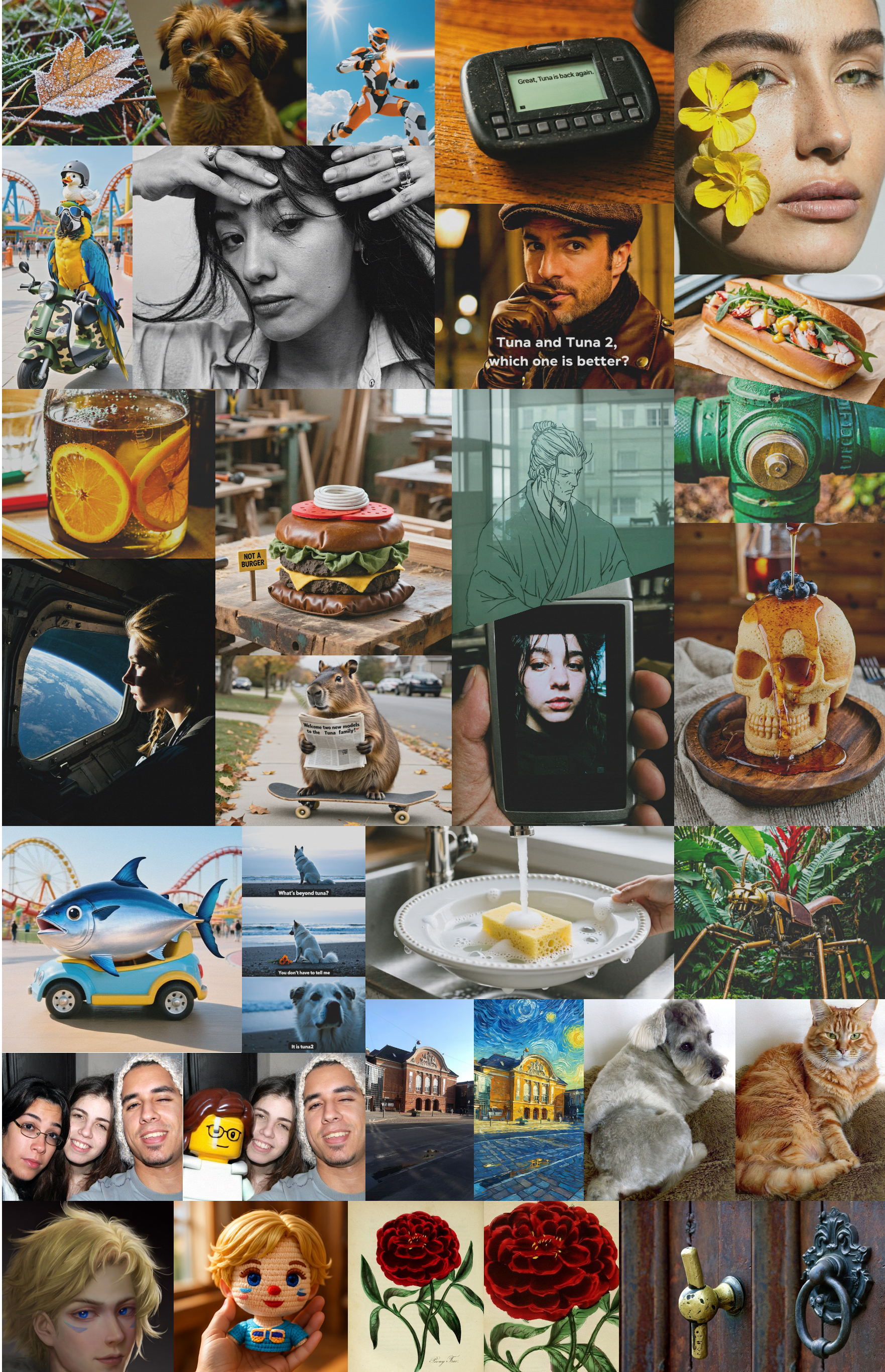 Visual samples of Tuna-2 performing text-to-image and editing tasks.
Deep Insights: The Convergence of Modalities
The most striking finding is the cross-modal alignment. Because Tuna-2 sees pixels directly, its attention maps are much cleaner and more accurate than encoder-based models. It is less likely to be "hallucinated" by misleading text prompts (e.g., seeing a dog when the text says "cat cafe") because its visual features are grounded in raw reality rather than a pretrained semantic bottleneck.
Critical Analysis & Conclusion
Takeaway: Tuna-2 proves that the "modular" era of LMMs might be a transitional phase. A monolithic, encoder-free architecture is not only possible but superior for fine-grained tasks.
Limitations: Pixel-space modeling is computationally expensive during training due to the high dimensionality of raw inputs compared to compressed latents. Additionally, encoder-based models still have a slight edge in "semantic prior" knowledge in low-data regimes.
Future Work: The success of Tuna-2 paves the way for truly unified models that can handle video and high-resolution images natively, moving us closer to human-like visual reasoning where every pixel counts.