
Turbo-GTS: Scaling Mobile Crowdsourcing via Workload-Balancing Bisection Trees
Turbo-GTS: Scaling Mobile Crowdsourcing using Workload-Balancing Bisection Tree (Demo Paper)
Turbo-GTS is a scalable mobile crowdsourcing system that utilizes a novel Workload-balancing Bisection Tree (WBT) to optimize multi-worker task scheduling. By introducing WBT-NNH and WBT-NUD algorithms, it achieves superior task throughput and computational efficiency compared to traditional PR Quadtree and network-partitioning methods like BLALS-T.
TL;DR
Turbo-GTS is a high-performance framework designed to solve the "last-mile" coordination problem in mobile crowdsourcing. By replacing standard spatial trees with a Workload-balancing Bisection Tree (WBT), the system dynamically redistributes workers to areas of high task density. Tested on massive real-world datasets from NYC and Tokyo, it significantly increases the total number of tasks completed while reducing computation time to nearly real-time levels.
Problem & Motivation: The Scalability Wall
In mobile crowdsourcing, the goal is simple but computationally brutal: maximize the total number of tasks completed by a group of workers, each constrained by their location, task deadlines (expiration), and the time it takes to actually perform the work.
Traditional approaches like BLALS-T create a worker-taskflow network, but they break down when the number of tasks explodes. They often assume workers are "trapped" in small neighborhoods or can only handle a few tasks. Previous spatial partitioning methods using PR Quadtrees (like QT-NNH) improved speed but lacked a mechanism to balance the actual difficulty of the tasks across the map—leading to "idle workers" in some zones and "overwhelmed workers" in others.
Methodology: The Logic of WBT
The core innovation is the Workload-balancing Bisection Tree (WBT). Unlike a Quadtree that splits space into four equal quadrants regardless of what's inside, the WBT focuses on the Task-Worker-Density (TWD).
1. The TWD Metric
The system calculates TWD for every node using the following logic:
- Numerator: The sum of work "demand" (reciprocal of execution durations).
- Denominator: The total available "time-distance" capacity of workers in that region, adjusted by the Random Point Distance (RPD)—the mathematical expected distance between two points in a rectangle.

2. Recursive Balancing
When a region is bisected, the system doesn't just split the map; it reassigns workers across the boundary. If region A has too many tasks and region B has too many workers, the WBT logic moves the virtual "responsibility" of workers to ensure both leaf nodes have similar TWD scores.
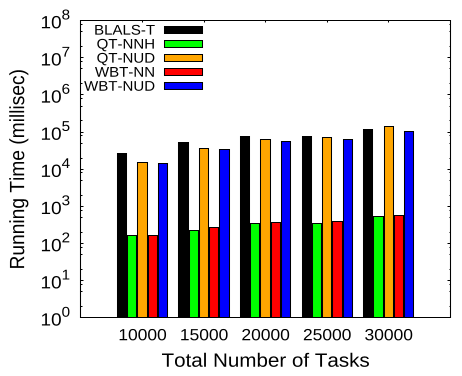 Figure: The WBT process showing worker reassignment (red arrows) to balance task demands.
Experiments & Results: Real-World Superiority
The authors validated the system using Foursquare check-in data from New York City (42k tasks) and Tokyo (67k tasks).
Scaling with Tasks and Workers
- Throughput: Both WBT-NNH and WBT-NUD consistently outperformed prior SOTA. In one case, WBT assigned nearly 500 more successful tasks than the Quadtree approach within the same timeframe.
- Efficiency: Despite the added complexity of balancing, the WBT algorithms maintain a "flat" CPU cost curve, making them suitable for real-time mobile applications.
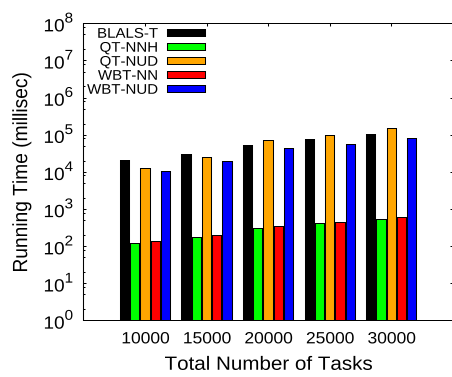 Figure: WBT-based methods (solid lines) achieving higher task completion without an exponential increase in CPU cost.
Critical Analysis & Conclusion
Takeaway
Turbo-GTS proves that Workload-Awareness is the key to scaling spatial systems. By treating workers as a flexible resource that can be "pushed" to high-demand areas through intelligent partitioning, the system avoids the local optima that plague static quadrant-based methods.
Limitations & Future Work
While Turbo-GTS is highly efficient, its current TWD calculation assumes a uniform distribution of tasks within a node once split. Future iterations might incorporate real-time traffic data or worker-specific preferences (e.g., specific types of tasks) to further refine the density metric.
Demonstration Use Cases
The system is not just a theoretical model; it includes a full front-end that allows users to:
- Compare algorithm results visually (e.g., seeing where WBT captures tasks that QT misses).
- Generate an optimal sequence of waypoints for individual workers on a map.
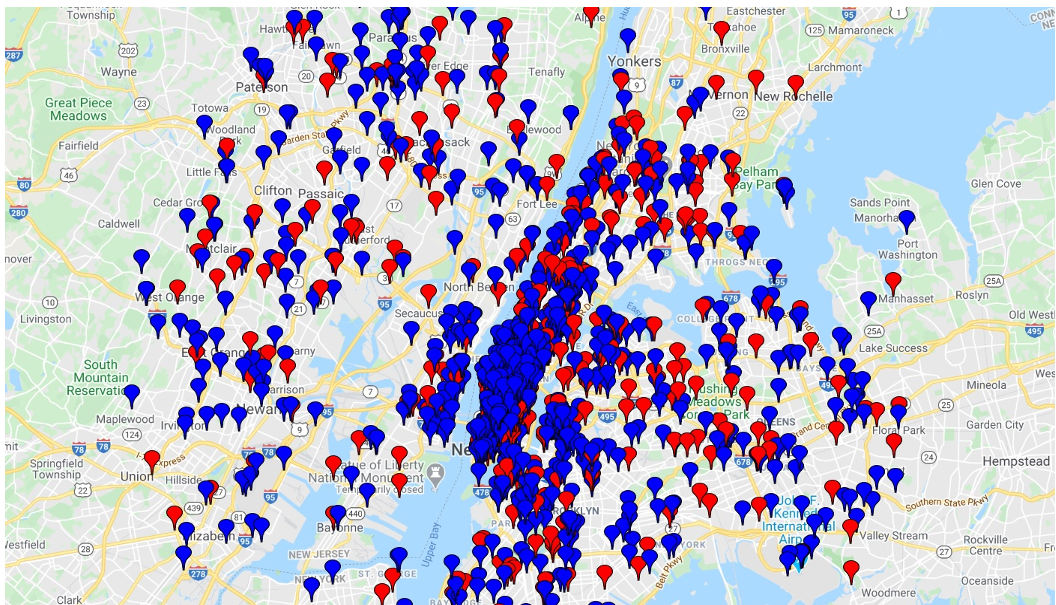 Figure: The Turbo-GTS interface showing task assignment distributions.