
TurnTalk: Mastering the Art of Conversation Through Tangible Scaffolding
Turn taking with turn-talk in group Actions and reflections with children and teachers
This paper introduces TurnTalk, an interactive tangible artifact designed to facilitate turn-taking norms in group conversations among primary school children (ages 8-11). Utilizing a meta-design approach rooted in action research, the study demonstrates how physical, interactive scaffolding can transform abstract social norms into concrete, manageable group behaviors.
TL;DR
Conversations are the heartbeat of the classroom, yet for children, the social "traffic laws" of turn-taking are often too abstract to follow. This paper presents TurnTalk, an IoT-enabled tangible device that uses play-cards and LED feedback to help 8-11-year-olds manage group discussions. The results show that not only does the tool reduce chaotic interruptions, but it also fosters a "social residue"—children began mimicking the device's logic even after it was removed.
Problem & Motivation: The Chaos of Classroom Talk
In primary education, group work is essential, but it is frequently hijacked by dominant personalities or stalled by silence from shy students. Teachers traditionally use "talking sticks," but these are passive and lack the "stickiness" of modern interactive media.
The authors identify a critical gap: Abstract Reasoning vs. Concrete Operations. According to Piagetian theory, children in this age group struggle with abstract norms. They need something physical to hold, see, and interact with to understand the "give and take" of a healthy conversation. The challenge is creating a tool that supports this without becoming a distraction (the "Calm Technology" challenge).
Methodology: Designing the Tangible "Traffic Cop"
The researchers adopted a Meta-Design approach based on Action Research. This means the tool wasn't just built in a lab; it evolved through real cycles of classroom use, observation, and teacher feedback.
The TurnTalk Architecture
The device is a pentagonal wooden base (designed for 2-5 users) containing:
- The Play-Card Mechanism: Children slide a card into the device to "claim" or "reserve" a turn.
- Visual Scaffolding:
- Green LED: Current speaker.
- Flashing Yellow: Next in line (reservation).
- Red LED: Premature interruption alert.
- Progression Feedback: At the end of the session, LED bars show who talked the most, encouraging the group to reflect on balance.
- Tangible Rewards: A motorized dispenser releases 3D-printed coins only if every group member participated.
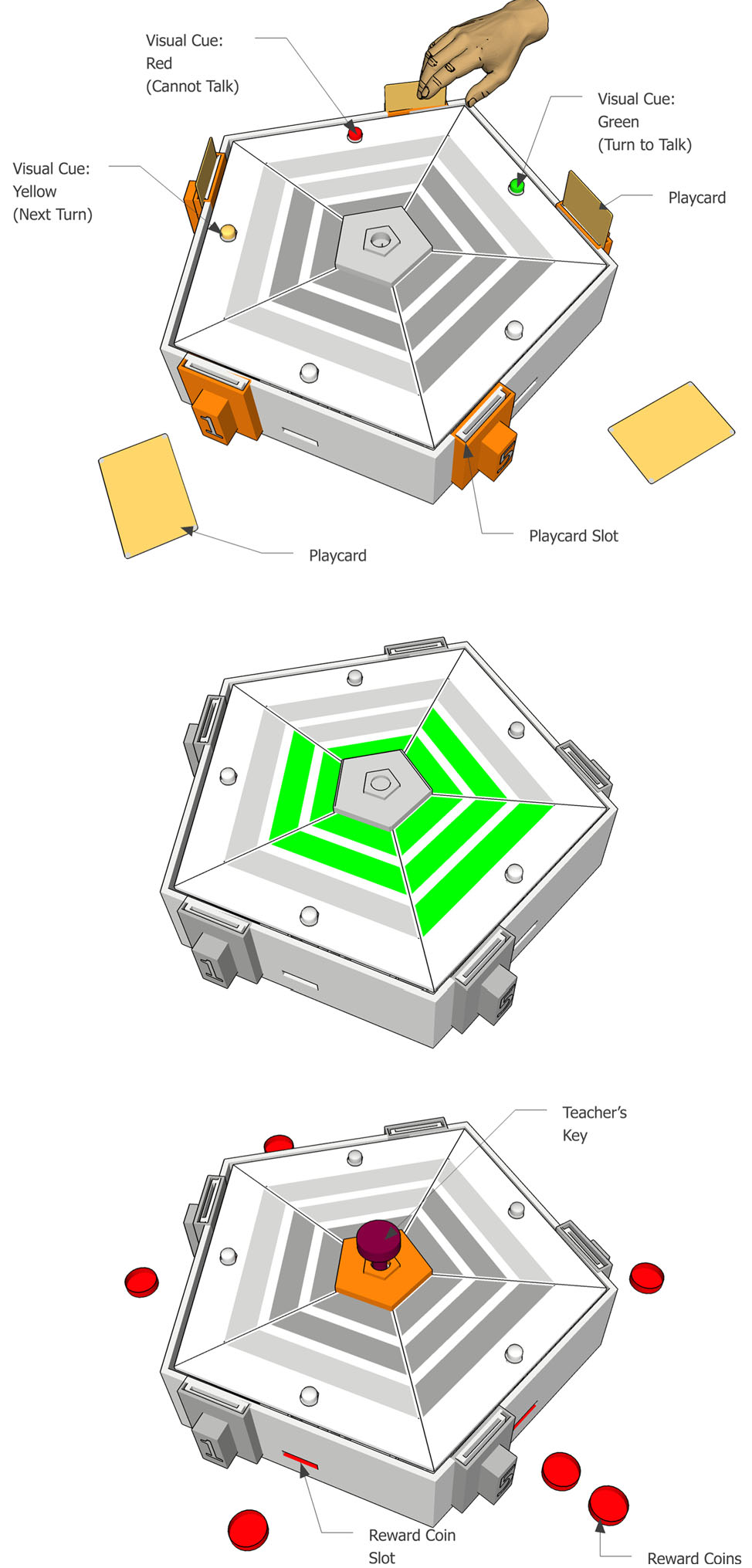 Figure 1: The main design features: play-card mechanism, progression feedback, and reward mechanism.
Experiments & Results: Beyond the Novelty Factor
The study followed a class of 18 children over four stages:
- Baseline (No device).
- Introduction of TurnTalk (Day 1).
- Sustained use (Day 2).
- Withdrawal (Post-intervention).
Key Findings:
- Balance & Engagement: In the "Red Group"—initially dominated by two members while others withdrew—the device forced a shift. Shy students (like "S") were encouraged by peers to use their cards. By Day 2 with TurnTalk, "S" increased her participation from 3 seconds to over a minute.
- Efficiency: Groups spent >92% of their time in active conversation with the device, compared to high rates of "quarrelling" or "silence" in the baseline.
- The Mimicry Effect: Most impressively, during the final "No TurnTalk" session, students were observed using their hands to mimic the "reservation" and "enable" lights of the device, proving that the social norm had been internalized.
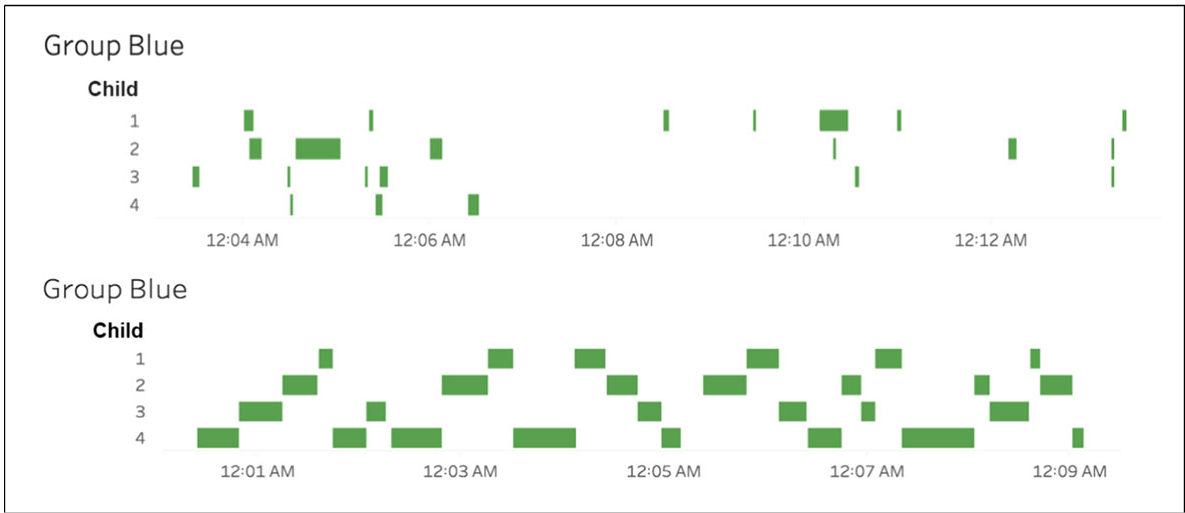 Figure 2: Data logged by TurnTalk allowed for a granular comparison of conversation timelines, showing a marked increase in orderly turn distribution.
Critical Analysis & Conclusion
The Takeaway: TurnTalk succeeds because it doesn't just "talk at" children; it provides a shared physical reality for a social concept. It turns a conversation into a cooperative game where the goal is collective participation (rewarded by coins) rather than individual dominance.
Limitations: As it is a small-scale study in one Italian school, the cultural specifics of "interruption" might vary elsewhere. Additionally, the device is currently limited to groups of five; scaling this to full-class debates remains a challenge.
Future Work: The transition to "ClassTalk" (supporting 20+ students) and extending the tool's use to home environments for socio-emotional learning represents the next frontier for this research.
In an age of digital distraction, TurnTalk reminds us that the best technology sometimes sits quietly in the middle of a table, helping us simply look at each other and listen.