
Interactive Sensing: When Humans Become Rational Sensors in Social Networks
A Tutorial on Interactive Sensing in Social Networks
This paper presents a formal tutorial on interactive sensing in social networks, primarily using Social Learning and Game-Theoretic Learning to model how human agents act as sensors. Key contributions include the design of a protocol to eliminate Data Incest in reputation systems and the identification of non-convex, multi-threshold optimal policies for quickest change detection in multi-agent environments.
TL;DR
In modern social networks, we are no longer just users; we are "social sensors." This paper by Krishnamurthy and Poor explores how the interactions between rational agents—who look at others' actions before making their own—create unique challenges like Information Cascades and Data Incest. They provide mathematical frameworks to fix biased reputation systems and show that detecting changes in such systems requires a radical departure from classical statistical methods.
Background: The Shift from Physical to Social Sensors
Traditional sensing (e.g., GPS, temperature) is passive. However, "Social Sensing" involves agents (humans) who filter their private observations through their own utility functions and the visible actions of their peers. Your Yelp review isn't just a measure of food quality; it's a decision influenced by the 500 reviews you read before entering the restaurant. This Inductive Bias creates a feedback loop that classical Signal Processing isn't designed to handle.
1. The Social Learning Filter: Why Rationality Hits a Wall
The core of the paper is the Social Learning Filter. Unlike a Kalman Filter where the sensor noise is independent of the state estimate, in social learning, the likelihood of an action is a discontinuous function of the prior belief.
The Herding Phenomenon
When the "Public Belief" becomes sufficiently strong, a rational agent will ignore their own noisy private signal and simply follow the crowd. This is an Information Cascade.
- The Problem: Once herding starts, new private information stops entering the system. The "Wisdom of Crowds" effectively freezes, and the group can stay wrong indefinitely.
2. Methodology: Solving Data Incest in Loopy Networks
One of the most practical contributions is the analysis of Data Incest. In a social network with loops (Agent A influences Agent B, who later influences Agent A), information is "double-counted," leading to extreme bias and overconfidence.
The Fair Rating Algorithm
The authors propose a network protocol to "de-bias" these ratings. By using the Transitive Closure Matrix () of the social graph, the network administrator can calculate specific weights () to subtract the redundant information influence.
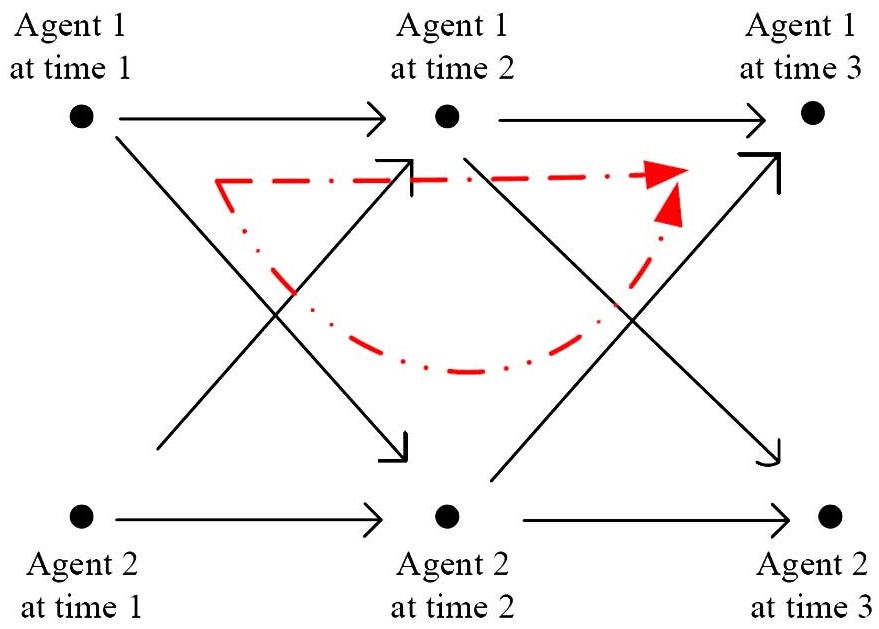 Fig 1: A loopy information exchange graph where Agent 1's influence at time 1 can be counted multiple times by Agent 5.
The Insight: To have a "Fair" system, the information flow must satisfy a specific reachability condition: the single-hop neighbors must contain all the historical components required to invert the influence of previous nodes.
3. Quickest Change Detection: The Multi-Threshold Surprise
In classical statistics (Wald’s Sequential Analysis), if you want to detect if a "state" has changed, you wait until the probability hits a certain threshold and then sound the alarm.
However, in Social Sensing, the authors found something counter-intuitive: the Multi-Threshold Policy.
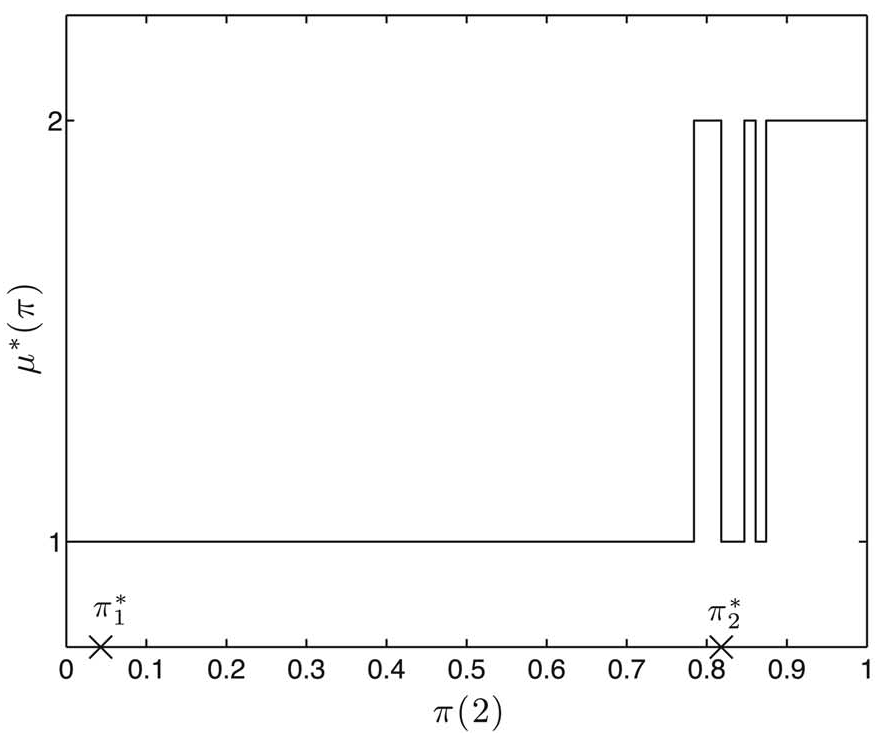 Fig 2: The optimal decision () is non-monotonic. As the probability of "no change" increases, the agent might switch from 'Continue' to 'Stop' and back to 'Continue'.
Why does this happen? Because of herding. In certain probability regions, agents stop providing useful info. The global observer might decide to "Stop" (declare a change) early because they realize that waiting longer won't provide any new information due to the social herd, even if the current confidence isn't at the absolute maximum.
4. Game Theory: Local Heuristics, Global Equilibrium
Finally, the paper addresses coordination using Regret-Based Learning.
- Regret-Matching: Agents don't need to be hyper-rational. They just need to track "internal regret"—how much better off they would have been if they had picked Action B instead of Action A in the past.
- The Result: If everyone follows this simple local rule, the network converges to a Correlated Equilibrium. This is a massive win for decentralized systems: sophisticated global coordination arises from simple individual "rule-of-thumb" behavior.
Critical Insight & Conclusion
This paper bridges the gap between Economics (Social Learning) and Electrical Engineering (Signal Processing). The key takeaway for AI and Network architects is that information is not data. In social settings, information is a strategic choice.
Limitations: The model assumes agents are "rational" in an economic sense. In reality, human biases (like confirming their own beliefs regardless of utility) might make the "Social Learning Filter" even more chaotic than the discontinuous Bayesian models suggested here.
Future Outlook: As we integrate LLM-based agents into social networks, these "Electronic Social Sensors" will exhibit the same herding and incest patterns. Applying these "Fair Rating" algorithms will be crucial to prevent AI model collapse caused by recursive self-influence.